Bad News: Proposed Online News Act Trades on Myths and Misconceptions

Last week, the Liberal Government introduced the Online News Act. The Act’s main aim is to redress the dominant market power that Google and Facebook have amassed by building an online advertising system around third-party content, including news, and people’s online activities.
Canada is not alone in taking steps to rein in “big tech”. In fact, this bill is modeled on the News Media Bargaining Code adopted in Australia last year. In addition, public inquiries and regulators in Australia, the European Commission, France, Germany, the United Kingdom, the United States and elsewhere have all concluded that Google and Facebook have monopoly power: the long-term ability to set the prices and terms of trade in the online advertising marketplace (for a running tally of such efforts, see Winseck & Puppis).
This is especially true of Google, which dominates the buying and selling of Internet advertising while also controlling its own online advertising exchange through which much of the buying and selling of advertising online takes place. Those inquiries have also found that the online advertising system is inscrutable to businesses and Internet users alike, coursing with dirty and unreliable data, at odds with European and UK data and privacy protection laws, and free of democratic regulatory oversight (UK ICO, 2019; Belgium DPA, 2022).
As a result of their stranglehold on the key elements of the online advertising system, by 2020, the Google and Facebook had carved out an 80% share of the $9.7 billion online advertising market in Canada.
This is the reality to which the Online News Act, ostensibly, responds. Other governments are taking similar steps to do counteract this state of affairs.
In an ideal world, the Online News Act could help give news media a bigger cut of the dollars and help improve the terms of trade upon which the future of the news media and journalism depend. It could also help give us all a clearer view of the complex black box technical systems upon which the online advertising marketplace is built. Doing so could improve not just journalism but also help to repair the “broken Internet”, an Internet that a small number of international Internet giants have colonized and remade in their image.
In sum, there are good reasons why digital platform regulation could be a good thing. Here’s some of the highlights of what the Online News Act could do well, followed by a list of the ugly parts of the bill that lead me to conclude that it falls far short of its potential.
One, the Online News Act does not impose a link tax on Google and Facebook for linking to news. While France and Spain, for example, have pursued this option, the link tax is a bad idea because it relies on untenable and undesirable changes to copyright law, strikes at a basic technical building block of the Internet (hyperlinks), and rests on the faulty premise that it is possible to attach a clear price to the news. This latter idea has never been possible, and is why we are struggling to find a viable framework to support journalism in the first place.
Second, the Online News Act bill contains a powerful set of tools to strike at the heart of dominant market and gatekeeping power drawn from over a century of antitrust and telecoms regulation history: measures that prohibit Google and Facebook from giving one news provider undue preference over another (or to unjustly discriminate between different services) and a code of conduct that is tantamount to a “fair carriage” regime for all news media services made available over the platforms.
Not only are these measures amongst the best bits of this bill, the Government would do well to put similar measures in the Online Streaming Act, which currently does nothing to deal with these issues of dominant market and gatekeeping power (as I have written elsewhere).
Third, unlike the Australian model which gives a government minister the power to designate which digital platforms will be covered, the Online News Act bill gives the Canadian Radio-television and Telecommunications Commission (CRTC) the power to make the call. The has the obvious advantage of creating a shield against direct political interference by the Minister in charge (i.e. Heritage Minister Pablo Rodriguez, at the moment).
Fourth, the Online News Act opens two options for platforms to strike deals with news media providers operating in Canada, either individually or collectively: the first option encourages voluntary deals; the second imposes final offer arbitration overseen by the CRTC.
In Australia, Google and Facebook have avoided being designated under the News Code altogether by striking voluntary, multi-year deals with the three biggest commercial media conglomerates, one of the country’s two public service media outlets (the Australian Broadcasting Corporation but not SBS), and some smaller regional and local news sources.
The problem, however, is that nobody knows anything about these deals because the Code does not apply to voluntary deals. Did Rupert Murdoch’s media empire (News Corp/Sky) and the country’s two other biggest media groups—Seven West Media and Fairfax Media-Nine—do better than one another or the ABC or any of the smaller media groups? How much of the money agreed upon will be used to hire journalists, expand newsrooms and support international news bureaus versus padding corporate profits? Who knows!
The drafters of Online News Act have wisely made sure that even voluntary deals struck between platforms and news publishers/broadcasters will be subject to review to ensure they are fair and support original journalism versus lining investors’ pockets.
Fifth, that process of review is also a key part of one of the bill’s other potential strengths: its information disclosure and audit requirements. The premise is simple: effective regulation hinges on knowing about the entities to be regulated.
That we have got this far already without Google, Facebook, Amazon, Netflix, Apple, etc. not being subject to such minimal requirements speaks volumes about how much power they have obtained without any real public responsibilities. The Online News Act would help fix that. Furthermore, the idea that regulated companies have an obligation to disclose information to regulators has been a bare minimum part of the regulatory tradition in Canada since the creation of the Board of Railway Commissioners way back in 1903.
So, if there’s all this good stuff in the Online News Act, why should we still put a stake through its heart? Let me count the ways.
For one, rather than trying to counteract the source of Google and Facebook’s market dominance and gatekeeping power, the Online News Act tries to leverage their market dominance for public policy ends: saving journalism. In so doing, if adopted, the act ties the future of journalism to a steady flow of money from Google and Facebook, thereby increasing the dependence of journalism on both firms. It also fails to include one of the best parts of early drafts of Australian Code: a requirement that the US tech giants give news outlets advance-notice of big changes that could up-end the latters’ operations.
Second, the Online News Act mechanics are all about transferring dollars from Google and Facebook to news media operating in Canada through corporatist bargaining arrangements with no seat at the table for rivals, advertisers, experts, academics or anybody else to articulate the “public’s interests” in these matters. In contrast, the public has had a seat in CRTC telecoms and broadcasting proceedings since 1976! Freezing the public out in this way is a profound act of depoliticizing platform regulation and is anti-democratic.
Third, the Online News Act does not tackle the taproots of Google and Facebook’s dominance: i.e. control of the online advertising system, cross-market consolidation of activities across digital markets, and business models driven by the unlimited harvesting of personal information. The last of these points reveals a major reason why Canada has such weak privacy and data protection laws: the big international digital platforms and domestic communications and media firms such as BCE, Rogers, Postmedia, Quebecor, Shaw, Telus, etc. are all joined at the hip in wanting to expand their intensive harvesting of people’s data.
In the context of the Online News Act, and just like in Australia, domestic news media companies don’t want strong privacy and data protection rules for just that reason. Instead, they want a bigger slice of the big data pie. The Trudeau Government is helping to give them what they want with this bill–at the expense of protecting Canadians’ privacy and personal information.
Fourth, while the crisis of journalism that the Online News Act tries to solve is real, the bill is built on a severe misdiagnosis of the problems we face and incessant pleading by Canadian media groups, think tanks, lobbyists as well as the platforms themselves. In fact, the crisis of journalism is the result of a confluence of events that have unfolded for decades, and years before either Google and Facebook had consolidated their dominance in the last ten years. We have reported on these factors for years as part of our research at the Canadian Media Concentration Research Project:
- declining per capita and per household circulation since the early 1970s;
- an orgy of debt-addled consolidation from the mid-1990s until 2010 that put some media firms into bankruptcy (e.g. Canwest, whose broadcasting and newspaper assets were acquired by Shaw and Postmedia, respectively) while leaving many others on shaky financial grounds ever since;
- wild swings in journalist employment levels over the same period and a precipitous drop since 2013;
- revenues for newspapers and broadcast news media companies that peaked in the mid-2000s but which have collapsed since, especially after the bottom fell out for advertising spending across the economy after the financial crisis of 2008.
While casting Google at Facebook as the main villains in the piece might make for a good story, it does not reflect an accurate or holistic view of the problems and is misleading. Having fundamentally misdiagnosed the issues, the idea that the Online News Act will solve the problems is wishful thinking.
Fifth, the Online News Act also anticipates a role for the CRTC as a kind of super-regulator. To do that, however, is to ignore the reality that the Commission has proven itself to be ill-equipped to handle its existing mandate, especially under its current leadership. Furthermore, while the bill is said to be about redressing market power imbalances, the CRTC has been extremely timid about tackling such issues in telecoms & broadcasting. Its approval of the Rogers’ blockbuster bid to acquire Shaw’s broadcasting assets—the sixth largest acquisition in Canadian history—last month is just the latest example of this. For it to now turn around and turn the screws on Google and Facebook would be seen as anomalous, even unjust. This is especially so, given that a combined Rogers-Shaw, if approved by the Competition Bureau and ISED, would become Canada’s largest communications and media conglomerate with revenues that would be single-handedly more than three times Google and Facebook’s revenue from Canada, combined.
Finally, while the CRTC’s newfound powers to review deals made under the Online News Act, compel information disclosure and conduct annual audits would be improvements on the “Australian model”, those measures are vague and the details punted to the Commission itself to work out. That problem also plagues the government’s Online Streaming Act (for my analysis of that bill, see here). In both cases, this puts too much trust in the CRTC that it does not deserve and also moves the issues out of the public spotlight and Parliament into the bowels of an agency that has a spotty track record on these matters.
In sum, while the Online News Act has been wrapped in noble cloth, from conception to now, it stands as a massive missed opportunity. Instead of a model to embrace it offers valuable lessons of how not to regulate digital platforms and Internet-based services. Time to go back to the drawing board.
In Defence of the Emergencies Act: Why We Must Put a Stake Through the Heart of the Insurrection Bubble-Wrapped as a Protest (while keeping the EA on a short leash)
The Emergencies Act: Time to Bring in its Never-Before-Used Powers?
Last week, on Feb. 14, the federal government introduced a motion to invoke the Emergencies Act to quell the, then three-week long occupation of Ottawa as well as other blockades set up in Emerson, Manitoba, Coutts, Alberta and the Ambassador Bridge in Windsor, Ontario. As required by the law, Parliament has sat non-stop since (except last Friday) to debate this never-before-used legislation, a law created in 1988 by the then Conservative government of Brian Mulroney. Parliament will vote tonight (February 21, 2022) to determine whether the use of the Emergencies Act is justified and legitimate.
Before the government invoked this extra-ordinary law, discussion was already raging as to whether or not calling on the biggest hammer in the government’s toolkit to deal with threats to national security, the rule of law and public order was justified. A colleague in the Norman Patterson School of Public Affairs (NPSIA) at Carleton University, and a former national security advisor to the Department of Justice, Leah West, questioned whether the high bar for deploying the act had been met. As Professor West stated, the government “must believe the protests rise to the level of a national emergency”. In her view, that high bar had not been met.
While national security law is outside my wheelhouse of expertise, my work over the last three decades on telecommunications, the Internet, communication regulation, privacy, media and democracy, within Canada and internationally, regularly bumps up against such issues. My work as a communications and media scholar, also at Carleton University, as also forever focused on questions about communications, society & democracy. As such, I want to weigh in with a few thoughts of my own in the hope that I have something worthwhile to contribute to the debate.
Here’s the bottom line: While I disagree with Professor West’s provisional conclusions, I do agree that we must be very vigilant that this precedent setting use of the Emergencies Act remains limited in time, targeted in terms of geography, subject to Parliamentary review & snuggled tightly within the confines of the Canadian Charter of Rights & Freedoms.
The big new tools that allow the government to follow the money backing the occupation and to bring crowd-funding services such as GoFundMe and GiveSendGo under the purview of FINTRACK—a part of the financial regulation tools that have been in place for some time—must be given especially close and ongoing scrutiny, as others with expertise in such matters, such as another Carleton colleague from NPSIA, Stephanie Carvin, and others such as Jess Marin Davin, have said (also see Davis, Convoy Finance, Emergencies Act edition).
These commentators have also stressed that, as part of this scrutiny, it will also be essential to closely watch to make sure the use of these tools remain consistent with federal privacy legislation such as the Personal Information Protection and Electronic Documents Act (PIPEDA) and the Canadian Charter of Rights and Freedoms. In this respect, the government should be consulting closely with the Office of the Privacy Commissioner (OPC) to ensure that the privacy & data protection implications of PIPEDA are met.
On this point, it is important to bear in mind that the government already faces a big credibility problem given the Public Health Agency of Canada (PHAC) controversial commercial deal with Telus, the third largest telecoms and mobile wireless operator in Canada, to use Canadians bulk mobile data as part of the public health measures now in place and that many people have grown increasingly impatient with. The government’s decision to play fast-and-loose with such rules has already received a strong rebuke from the head of the OPC, Daniel Therrien. As Therrien has stated, rather than the government (PHAC) consulting with his office, as required by PIPEDA, his office was only informed.
This attempt to do an end-run around the guardrails in place to govern the use of mobile data in the context of public health measures serves as a self-inflicted wound. It also triggered a hastily convened Parliamentary review by the Access to Information, Privacy and Ethics (ETHI) Committee. Serious scholars and observers of Internet surveillance and privacy and data protection issues in Canada, such as Chris Parsons from Citizens Lab at the University of Toronto, Teresa Scassa, Canada research Chair in Information Law and Policy at the University of Ottawa Law School and former Ontario Privacy Commissioner Ann Cavoukian have been highly critical of this short-circuiting of properly informing the public and playing fast-and-loose with the already weak privacy and data protection framework that we do have in Canada. At the very least, this experience shows exactly what the government must NOT do if it hopes to maintain people’s trust in, and the legitimacy of, the extraordinary tools the Emergencies Act will allow it to use.
What is happening is not a protest
With the above in mind, here are my views: First, what had been taking place in Ottawa, Coutts, Emerson and Windsor for three weeks was not a lawful protest but, at is core, and in terms of its conception and management of its execution, an insurrection-wrapped-in-the-trappings of legitimate protest. These are not words to be use lightly. They are, however, justified given that the leadership of these demonstrations and their initial manifesto have openly called for the overthrow of the government of Canada and democracy (since rescinded). As journalists such as Justin Ling have chronicled in this context and over the years, this has been the aim of these events in the insurrectionists’ own words since the outset of the Ottawa Occupation on January 28, 2022.
Ling and others have been tracking extremist groups like the Proud Boys long before they became the far-right Canada First after the government put the Proud Boys on the list of banned terrorist groups in Canada in 2021. The movement whose presence has been on full display in Ottawa since Day 1 is led by far-right extremist who have been active for years and especially since the 2019 Yellow Jackets protests in Canada (ISD, 2021). At a minimum, these groups are anti-state and, after that, the consist of a long list of horribles: racists, neo-Nazis, anti-Muslim, homophobes and others who, far from working within the boundaries of democracy, seek to subvert democracy.
Well-known figures at the core of the unrest are include : James Bauder, Tamara Lich, Chris Barber, Benjamin Dichter, Patrick King. They are opponents of democracy not its champions (Hames, 2019). Canada Unity, another prominent group running the chaos, is led by ex-national intelligence analyst Tom Quiggin, an ex-member of the RCMP and National Emergency Response Team, Daniel Bulford and ex-Canadian military members such as Tom Marazzo . Their skill-sets would seem to pose a grave threat.
Researchers with Antihate.ca have done excellent work for several years chronicling these individuals and the groups they lead, including daily updates since the occupations began.
The movement organizers have money as well as material & ideological support flowing in from across Canada as well as from the US and, far less so, internationally (see here). To be clear: over half of the money has come from within Canada but the vast bulk after than is from the US, followed in a distant second by the UK, a handful of other EU countries, Australia and New Zealand (Cardoso, Globe & Mail).
The big tech billionaire class is also behind the occupation of Ottawa and the demonstrations elsewhere in Canada. This is the case, for example, from Peter Thiel, a co-founder of PayPal and Palantir, as well as part of former President Trump’s inner circle of advisors. Thiel was also a member of Facebook’s board of directors until stepping down earlier this month (Feiner & Levy, 2022). As Thiel emphatically told readers of publication put out by the U.S.-based libertarian think tank, Cato, “I no longer believe that freedom and democracy are compatible.” In Thiel’s view, it is time to get rid of democracy in order to promote the widest realization of individual freedoms.
Elon Musk, founder of Tesla and who also owns and operates the Starlink, the low earth orbiting constellation of satellites that now provides Internet access service to rural and remote areas around the world, including in Canada, hols views that mirror those of Thiel. Musk has been especially vocal in the present context, cheering on the insurrection as if it is merely a benign “Freedom Convoy” and protest. He has also helped to bankroll the unrest (Fortune, 2022).

The Trump connections to this insurrection-occupation-protest are also unmistakeable. Donald Trump Jr. has weighed in many times to give his full-throated support of the demonstrations while condemning the Liberal Government as undemocratic. He has called Canada a “banana republic”, despite overwhelming evidence that it is a strong democracy and typically ranks higher than the United States on various “democracy indices”. Trump Jr. has also shouted from the rooftop the false information that Justin Trudeau is the son of Fidel Castro (see here and here).
Hangers on and former minions of the Trump Administration like Seb Gorka have also piled on (see here, here, here). The hacked GiveSendGo spreadsheet is chok-a-blok full of references to Trump, Trump 2024, January 6, 2022, the false stolen election campaign that brought Biden into office, and on and on.
GiveSendGo List of Donors: Trump Fans Support “Freedom Convoy”

The core group behind this insurrection has bubble wrapped their mission in a disparate array of groups and people with a grab bag of grievances, including about public health measures, for which there can be legitimate basis for lawful protest. There should be a very wide berth for the latter, and there has been, both before the imposition of the Emergencies Act and now. That said, there should be no accommodation for those who openly call for the overthrow of the Government of Canada and the imposition of a provisional junta made up of representatives of the seditionists’ choosing.
It cannot be underscored enough that this is not a protest conceived of and carried out by truckers who have picked up supporters along the way. It has been unfortunate that a great deal media coverage has framed things as being sparked by many people’s legitimate concerns about the ongoing use of public health measures in the context of the Covid-19 pandemic. This has helped to install and reinforce a frame and discursive agenda for how we think about what has been taking place that is highly misleading.
While the insurrectionists are being supported by the far right, Trump supporters and Christian fundamentalists in the United States, the support from rightwing Conservatives in the Conservative Party of Canada (CPC) has been stunning.
Pierre Poilievre, the Conservative Party of Canada’s MP for Carleton, an area just outside of Ottawa, has taken the insurrection-wrapped-in-the-trappings-of-a-protest as opportunity to announce his candidacy for leadership of his party. In a video release one week into the #OttawaSiege that did not hide its opportunistic endorsement of what was already far beyond a legal protest.
Another CPC MP, Candace Bergen has also used the occasion to grandstand for both the demonstrators and her party’s base. She did so during question period in Parliament, for instance, when she hinged a call to demonstrators to “take down the barricades” and “stop disruptive action” while calling on the federal government for an “end to [all public health] mandates. In other words, Conservative Party MP Bergen called on the federal government—a government just re-elected last year explicitly on issues tied to the pandemic-related public health measures—to concede to the demonstrators’ demand in return for an end to the chaos that had been consuming Ottawa and tormenting its citizens for two weeks by the time she made her call.
The second last Conservative Party leader before the ouster of its most recent leader, Andrew Sheer, also gave the the occupation a thumbs up as the siege of Ottawa entered its second week. Sheer’s symbolic support was the Canadian equivalent to U.S. Senator and Trump loyalist Josh Hawley’s famous fist pump to those engaged in the January 6, 2021 uprising against the U.S. Congress and galvanized by the outgoing president’s fraudulent claims that the 2020 US election had been stolen. Yet, here were top members of the Conservative Party in Canada cheerleading on similar forces on the doorsteps of the Parliament of Canada for three weeks by the time that Sheer was endorsing them.

Another former Conservative Party leader, Stockwell Day, was also out rallying the mob tend days into the unrest & extremist minority uprising. Previous members of the CPC who have been recently banished from the party for their rightwing extremist views, such as Maxime Bernier (who has since founded the right wing People’s Party of Canada) and Lanark County MPP Randy Hillier, have also been out in force lending succour to the demonstrators.
Rachel Curran, ex policy director for former Conservative Prime Minister Steven Harper, and now a top Facebook executive in Canada, has also given her blessing to the fun times down at Parliament Hill.

At the provincial levels, the patterns are similar. Doug Ford’s Conservative government in Ontario, for example, was slow to authorize additional policing resources for Ottawa Police and deceptive about the quantum of support when he finally did give it. Instead of promptly and fully meeting calls for 1,800 more police officers from Ottawa Police Chief Sloly and Ottawa City Mayor, the Ford Government engaged in “misleading by design” wordsmithing, as my colleague Josh Greenberg put it, to give the impression that it was doing just that. In fact, the Ford Government offered less than a tenth of that amount but, added up over twelve days, 150 officers per day did amount to 1,800 “officer days” just not the 1,800 officers were needed for a s long as it would take to quell the insurrection.
At the provincial levels, the patterns are similar. Doug Ford’s Conservative government in Ontario, for example, was slow to authorize additional policing resources for Ottawa Police and deceptive about the quantum of support when he finally did give it. Instead of promptly and fully meeting calls for 1,800 more police officers from Ottawa Police Chief Sloly and Ottawa City Mayor, the Ford Government engaged in “misleading by design” wordsmithing, as my colleague Josh Greenberg put it, to give the impression that it was doing just that. In fact, the Ford Government offered less than a tenth of that amount but, added up over twelve days, 150 officers per day did amount to 1,800 “officer days” just not the 1,800 officers were needed for a s long as it would take to quell the insurrection.
That said, Premier Ford is now on board with the Emergencies Act but only just, it seems. In a sidebar to this already tragic story, Chief Sloly, Ottawa’s first black police chief, unexpectedly resigned last week midway through the events.
Two weeks into these events, I also quickly scanned area Ontario MPPs to see where they have stood with respect to the demonstrations and broke them into three groups: 1. those who have condemned the on Ottawa Occupation and blockades of the Ambassador Bridge; 2. those who have gently scolded the demonstrators; 3. and those who have said nothing or openly condoned them. As of February 10, no members of Premier Ford’s government jad explicitly condemned the occupations (see the results here).
In sharp contrast, all of the rest of the Ottawa region’s MPPs from the Liberal and NDP parties had condemned the siege: Joel Harden, Stephen Blais, Lucill Collard and John Fraser.
Other provincial premiers, such as Alberta Premier Jason Kenney, have also been overly solicitous to demonstrators, slow to move and engaged in political gamesmanship with the Trudeau government based on years of ongoing hatred of both Liberals and Justin Trudeau. Kenney has also flirted with hard right conservatives and Trump supporters, such as Senator Ted Cruz, as the photo of the two together helps to illustrate.

At this juncture, it is important to remember that it is now official Republican Party dogma that the January 6, 2021 assault on Congress in favour of overturning the 2020 election that brought President Biden into office constitutes “legitimate speech”. The point here is that acts of insurrection are within the range of acceptable action for these politicians.
That so many members of the Conservative Party of Canada have, at the very least, being playing footsies with such notions, and in some cases embracing those who would seem bent on overthrowing a democratic government, gives rise to the great concern that a large swathe of the official opposition cannot be relied on to uphold the principles of democracy at a time of crisis. This, in turn, feeds into the very basis upon which invoking the Emergencies Act is premised: the threat to public order, national security, the safety of Canadians and the institutions of democracy itself are real and it is no longer possible to count fully on all political parties to stand firm in favour of democracy.
Indeed, as some grass-roots citizens have documented, somewhere around half of CPC’s sitting MPs have offered open support for demonstrators. When half of the official opposition reveals itself to be sympathetic to the events that have shaken the country for the last three weeks and running, it is reasonable to be worried, as the Trudeau Government is, that the institutions of democracy—in this case, the CPC—might not hold. As a result, stern measures are needed and the Conservative Party of Canada have helped to bring about this extraordinary and undesirable state of affairs.
In light of the above, it looks like extremists in the CPC have, at least temporarily, taken over control of the party. It is now time for the Party’s leadership and members to get back control of of the CPC and for conservatives who still believe in democracy to continue to step up. Fortunately, a few journalists who have long been supportive of the Conservatives, such as Andrew Coyne at the Globe and Mail, have been stepping up draw clear blue water between conservatives and insurrectionists.
Crisis of the State? The Ottawa City Government and Police Forces Teeter on the Verge of Collapse
At the city level in Ottawa, Mayor Jim Watson was, for the first two weeks, slow to grasp the severity of the situation. He was also obsequious when dealing with occupation of Ottawa by calling for the federal government to negotiate with the leaders of the demonstrations. Later, just after citizens had taken to the streets to defend their neighbourhoods on their on—as in the #BattleofBillingsBridge—the mayor publicly scolded them for doing so. At the same time, Mayor Watson was striking a deal with the leaders of the demonstration that resulted in some of the demonstrators moving their vehicles out of some neighbourhoods into areas more adjacent to Parliament Hill. The deal was facilitated by Premier Ford’s fixers who had connections to some of the leadership behind the conception and execution of the occupation.
People across Ottawa also watched in frustration and feat that the Ottawa Police proved to be either unable or, frighteningly, unwilling to enforce the law (see CBC journalist Harewood commenting on the situation here; also see here and here). The rule-of-law in many respects was not being upheld around Parliament Hill and adjacent areas such as Centretown where I live for three weeks running. This led to very real questions about whether or not Ottawa Police had the resources they need or, worse, whether they might have been compromised?
That last question, in turn, took on a particular salience given that there had been publicized defiance in the ranks of the Ottawa police on account of the then new Chief Sloly’s attempts at modest reforms designed to root out racism in the force and a small but significant continency of officers opposed to the public health mandates, especially the vaccination requirement for essential workers.
Even after police announced on February 7, that they were cracking down on demonstrators bringing fuel to the trucks idling for weeks on end in the occupied zone, night-after-night I took photos of trucks loading their flatbeds full with gas cans destined for downtown (see here). Other demonstrators carried gas cans in the open, with no repercussions and as they pleased. The downtown turned into a rave scene by the third weekend, replete with a professional sound stage and DJ cranking out the tunes.
It was dangerous to walk in certain parts of the city, to go shopping, to wear a mask, to say the kinds of things that I am writing about here. The threats of violence have been very real, including an attempt by arsonists linked to the demonstration setting fire to large apartment building whose residents had voiced their discontent with the demonstrators incessant threatening behaviour, honking, urinating in public, etc. The attempted arson is now being investigated by the Ottawa Police. For an excellent, first hand account by one of the residents of that apartment building, less than two kilometres from my house, see here.
The neighbourhood grocery store at Bank & Somerset, which serves much of Centretown including many immigrants, low wage earners & refugees who have escaped hell elsewhere only to find it in downtown Ottawa had to close. It’s not been safe to go out and buy food. Another grocery store just a few blocks away from that store, the apartment building mentioned in the paragraph above and Parliament Hill also had to shut its doors.
And when the shops were open, you had to do your shopping in the face of maskless marauders who have refused to follow any public health guidance at all. One result of that was that Ottawa’s biggest shopping mall, The Rideau Centre, has had to close for several weeks. Ice cream shops, vintage stores, restaurants, you name it, all have been held hostage and experienced violence at the hands of those who have occupied our city. At the height of the chaos a week or so ago, Ottawa Police told store owners and people they don’t have the resources to protect them. We were literally on our own!
If you still think there has been little danger, and the my story is over wrought, or that such dangers have been far and in-between, there here’s a crowd-source list that chronicles the impact of the siege on daily life; the harassment, threats, assaults, damage to property (public & private), etc. You can find it here. It is one more example of people—citizens, the public—stepping in to do what “the state” has utterly failed to do, i.e. take steps to help protect the public and maintain public order.
Several city councillors have dithered or been slow to grasp the scale of the assault on our city. In particular, several councillors have led the charge for their constituents since day one: Catherine McKenney (Centretown, and my councillor), Shawn Menard, Jeff Leiper, Mathieu Fleury and Caroline Meehan. They have been incredible in their leadership, brave and resolute.
Mercifully, even if they did not take a role as active and assertive as those just mentioned, most of the others on City council were solidly opposed to what was happening. Only a few seemed to be slow to act or sit on the fence. While Mayor Watson was very slow out of the gate, and took steps that many opposed, he finally seemed to seize hold of the magnitude and gravity of the threat late in the day. Here’s a link to what councillors did what according to my scan of the public statements as of February 9.
Finally, on February 11, “Ontario’s Big City Mayors” finally stepped up to condemn the convoy demonstration (see here). Of course, Canada’s biggest business groups also demanded action once the Ambassador Bridge Blockade gnarled cross border trade. The White House called urging Canada to act & offering help at all levels of the US government. Long before that, the biggest union representing 55,000 drivers and 15,000 long haul truckers in Canada, Teamsters Canada, condemned the “Freedom Convoy” in no uncertain terms.
The Assault on Journalism and the Media
While the Conservative Party of Canada, MPs, provincial conservatives & many politicians at the federal, provincial and city level have failed, there has also been a parallel assault on journalists and journalism. The actions and talk of the former is likely aiding and abetting the latter. This assault on one of the pillars of democratic society—and this from me, a long-standing, harsh critic of the media in this country—this provides clear evidence that the insurrection-cum-occupation/demonstration is not here to improve democracy but to subvert it.
It is one thing to criticize the media with the aim of prodding its members to live up to their fabled role in speaking truth to power and performing their democratic functions. It is something else altogether, however, to vilify journalism so as to open a vacuum into which disinformation, delusional conspiracies and propaganda can pour. Examples of this assault on journalism, the media and democracy are as easy to pile up as leaves in autumn (see here, here & here, for example), but a few here will have to do.
The Canadian Association of Journalists and individual journalists have been sounding the alarm on this front throughout the occupation, but with increasing distress and urgency in the last few days before the police regained control of the city over this past weekend. Lucas Meyer had compiled the list below by February 11.

Canadian journalists now have to be very careful walking the streets of Ottawa and some media outlets, like Canada’s largest private media group, CTV, have had to remove corporate branding from their vehicles in order to safely do their jobs.
Fox News has continued to pour fuel on the flames for the last week or so and brought it’s unhinged approach to media agitation to Canada. It has also encouraged similar events in the U.S.

Last Friday, just as the police were ramping up their efforts to restore public order to the streets of the nation’s capital, Fox News reporter Sara Carter made the incendiary claim that a woman protestor had been killed at the hands of the police.

Only 18 hours later did Carter issue a garbled correction despite authoritative sources and the Ottawa Police itself having quickly declared her incendiary claim to be false. Indeed, instead of correcting the record, she quickly buried her tweet in a pile of other tweets so as to push the false claim and her retraction further into oblivion. By the time, however, the damage had been done: Carters tweet, backed the undeserved authority of Fox News, was cursing, unchallenged, through the right wing of the Internet and on the streets of Ottawa and elsewhere where sympathetic protests in some cities across Canada emerged (see here and here).
Despite one of its journalists spreading a demonstrably false and incendiary claim, Fox News, as far as I know, has still not issued a correction or any kind of statement on the matter. Meanwhile, the damage to us, to police on the street and to democracy continues from Fox News unabated.
This is part for the course for Fox News. What Fox does is not journalism. To understand the enclosed, right-wing network propaganda system that Fox News serves as a hub and megaphone for, in the US, with overflow and influence in Canada and internationally, the Harvard University’s Yochai Benkler, Robert Faris & Hal Robert’s (2018) book Network Propaganda is essential reading. Here’s how they depict the network propaganda system they meticulously describe and explain (note: Fox News off to the right and its links to others to the right of it but not, generally speaking, anywhere else).

It does not play by the normal rules of journalism and media in a democracy. It does not correct errors. It was openly allied with the Trump Administration, serving as its mouthpiece and as a lapdog rather than as a watchdog and independent member of the fourth estate. It serves as a node and megaphone in an enclosed right wing networked media propaganda system offering lots of channels to media outlets—online and legacy—even further to the right but few links to the centre right, the mainstream middle, progressive left and the “far left”.
It’s partners in the rightwing, network propaganda system consists of outlets like Breitbart, the Daily Caller, Gateway Pundit and beyond, many of which have brought their fevered delusions and attempts to discredit mainstream media and subvert democracy to my doorstep on Twitter.
Benkler et. al. stress that we can and do have a rational public sphere capable of doing the work democracy demands BUT they also reveal just how fragile the conditions for a viable public and democracy are today. According to them, roughly a quarter- to one-third of US adults and the network propaganda system centred on hubs like Fox that constantly draw on and pump out extremist ideas from the far-right fringes into the body politic.
This sizeable slice of the US population and their media have, essentially, checked out when it comes to basic precepts of democracy, i.e.:
• respect for evidence,
• pursuit of understanding,
• correcting errors when identified,
• provding independent, critical knowledge/reporting,
• baseline trust in institutions of democracy, experts, science & fellow citizens still persists, etc.
That big slice of the US population no longer operates in a manner consistent with a culture of democracy. What we have been seeing in Canada and the streets in Canada in these past few weeks—but building up over the past decade or more, while always existing underground—is smaller and still less entrenched and vociferous. As a guestimate based on a rough-and-ready reading of recent public opinion surveys, the proportion of the Canadian population checked out from democracy is probably around half the rate in the U.S.. In other words, there are probably between 10-15% of Canadians who no longer believe in democracy and act accordingly. They are the source of the inarticulate grunts of FREEDOM that we have heard from the occupied streets of Canada’s capital for the past three weeks.
This coverage from Evan Solomon for CTV’s Power and Politics and from Jordan Klepper of The Daily Show captures the drift of things. The people that they spoke to, in a literal sense, seemed to have no words. A discourse of democracy is beyond them. Why this is so is complex, but it is rooted in a half century of the neoliberal conquest of society & neglect of some minimum sense of economic justice, steps to ameliorate wage stagnation & widening income and wealth inequality, quality education for all, an appreciation of ‘the public’ and a generous view of public goods.
Disenfranchised at one end & prioritizing self-aggrandizing accumulations of wealth freedom at the other (ala Thiel’s freedom versus democracy), here we are: a stunted public incapable of self-governance because while they’ve talked for so long–a half century–nobody has listened & helped to translate their dreams into a viable political project and reality.
At the same time, it would be a colossal mistake to believe that everybody who has taken part in, or supported, this insurrection-cum-occupation (pretend protest) is stupid. They are not. I will return to that issue some other time.
I digress. The impact of the network propaganda system cuts across class. As discussed above, a slice of economic and political elites are driving the corrosive behaviour that has brought to where we now stand and democracy teetering on the brink and our streets filled having been filled with menacing threats. For the rest of us who have little desire for the nihilistic fantasies of this anti-democracy group we now face major conflicts and clashes, within our own families and amongst friends and colleagues, as we watch people we thought we knew float off the deep-end (but with memories of how they might have become this way.
For a long time, the goings on in Parliament and key segments of the media in Canada have also jhad a very corrosive impact, as the views of extremists get amplified, broadcast & normalized. This is the game of the far right vying for the soul of the Conservative Party of Canada right now, as well as the editorial pages of the National Post, the Postmedia chain of papers in major cities across the country and Sun Newspaper chain (also owned by Postmedia).
Citizens, Activists, Community Groups, Hackers Begin to Take Matters & Public Order into their Own Hands
As the state collapsed around them, and the assault on the media and routines of daily life continued unabated, and even amped up in the second and third weeks of the occupation, people, citizens and activists began to take matters into their own hand.
I saw that two weeks ago when joining hundreds and maybe more than a 1000 of Ottawans in the counterprotest march down Bank Street from Landsdowne. The next day many of the same people and many others joined a group of women to block a convoy heading from the Occupation’s organizational centre at Conventry Road to Downtown Ottawa. Over the course of the next nine hours, in the great #BattleofBillingsBridge, we blocked their path and forced them, with the aid of the police, to return back to where they came from, one-by-one, and only after they stripped their vehicles of flags and other pro-occupation symbols (see here, here and here).
They were supported by several city councillors and an area MPP, all of whom’s names you’ve been introduced to earlier: Catherine McKkenney, Shawn Menard, Jeff Leiper, Mathieu Fleury and Joel Harden. But it’s been people who have been taking to the streets to get them back under our control and out of the hands of marauding thugs in pick-up trucks. Zexi Li and a team of lawyers led by Paul Champ also emerged as something like town heroes when they by getting an injunction to silence the incessant honking from big rigs throughout the downtown core before the city and province seemed to have lifted a finger.
Resistance and citizens taking matters into their own hands have also been aided by some pretty far out and brave acts by the RamRanchResistance. They hacked the chat rooms and social media services of the demonstrators and filled them with videos and a gay porno music soundtrack that must have drove the demonstrators crazy. Hackers obtained the donors list from GiveSendGo and distributed it to other researchers but within a short of time the list was being widely shared (see here).
Every movement needs its spectacles and theatre. The occupation forces knew that and had their’s. This was our’s even if came a bit late in the day.
So, why did the federal government have to step in and reach for the Emergencies Act? Because, going into the third week of the occupation its own inaction and the complete failure and, indeed, collapse of political and policing authority at the city and provincial levels was a palpable threat to the safety and security of both the citizens of Canada and the state itself.
With citizens, activists and everyday neighbours beginning to step in to fill the void where the state had failed, things were now becoming even more dangerous. Somebody had to act because now conditions were becoming explosive, just as the insurrectionists at the core of this slow motion coup-wrapped-in-a-legit-looking demonstration/protest have wanted all along. It’s part of their nihilistic fantasies.
Stick your head in the sand if you want to, but the above provides an accurate portrait of the reality of living in Ottawa, the capital city of one of the strongest democracies in the world, for three weeks running . . . before the announcement of the Emergencies Act last week and this week’s assertive moves by Ottawa police, backed by the Ontario Provincial Police (OPP), the RCMP and officers brought in from across the country restored some semblance of law and order. In case you haven’t been paying attention for the last decade-and-a-half, democracies have fallen on very hard times and been rolled back in many countries (see The Economist’s annual surveys on the state of democracy, for example). That distemper is now in our streets and it is time to take resolute steps to protect the democracy that we have with an eye to rebuilding a new, stronger and more inclusive democracy in the days, months and years ahead.
Back to the Law, or the Return of the State, the Emergencies Act and Democracy
Now, back to the legal question that I started with. The point underpinning everything to this point is that the threats are very real, not just to the state itself but to us, the citizens of Canada & society. This is why I respectfully disagree with my colleague, Professor West and all others who oppose the invocation of the Emergencies Act at this time.
Participating in these events, for me and others personally, has been dangerous. The treat of serious injury is real and it is chilling. I have not been able to walk my streets freely with the freedom to speak my mind freely and openly, to associate with others, to wear a mask and to move about without fear for close to a month.
I have had death threats and I have had menacing tweets flooding my timeline for weeks. Here’s a sample of some of the most vile and odious (see here as well).


This is not freedom, nor is it normal in a democracy. It is tyranny of an authoritarian kind, as Hannah Arendt would probably say (see Williams, 2017 & Arendt, 1951/2004).
I am not alone. My colleagues report receiving much the same.
I have reported all of these instances of threats to Twitter and then blocked all of the accounts that had been tweeting them at me. My success rate for getting Twitter to find that these tweets violate their terms of service, however, is roughly a third and I have no idea how they have arrived at their decision to take something down or leave it up.
I suppose we might take some cold comfort that Twitter is at least doing something and that most of these accounts appear to be fake, sock puppet accounts run from troll farms in far-away places (see Ben Collins on this point in this context). That there is LIKELY no real person behind most of the threats is helpful, I guess, but barely.
These threats are why the government is actively pursuing Online Harms legislation as we speak (to track the Online Harms Consultation, see here). I vehemently disagree with the tack being taken with respect to online harms, and still do even after all this.
That opposition is based in a lot of things, including that the concept of online harms is too woolly and unbounded, that the imagined role of online content services like Twitter, Youtube and Facebook in being able to execute what’s being asked of them is unlikely and for two other huge reasons: first, because I believe in free speech, as set out in the Charter and, second, because I think the real problem stems from the fact that so much of the rot that we are concerned about starts at the top, especially within the Conservative Party of Canada, while at “the bottom” we have fifty years of pushing the marketization of society and the stripping away of society so that those tearing up our streets have had no place to go. Until we take of all those things, online harms is little more than lipstick on a pig.
As an aside, if you are interested in my views on the Liberal government’s proposals on regulating Internet content services, this post on the Online Streaming Act will give you a flavour of how strongly I stand in favour of free expression rights and remain critical of this government’s proposals with respect to these matters.
Back to the point: people are now having to take matters in their own hands at the risk of very serious bodily harm at the hands of those who had seized control of our lawless streets. The threat is real. Respectfully, while Professor West might still be able to claim that the current state of affairs does not meet the formal legal and technical requirements of the Emergencies Act, I am not sure if she and others opposed to its use have the full scope of the situation in view.
In fact, I wonder if opponents of the use of the Emergencies Act have adopted an overly formalistic view of the technical facts of the law that effectively obscures the reality that law is always a mix of such facts and procedures on the one side and social and political reality and the need to anchor law in legitimating norms, on the other. On this point, I’m channeling Jurgen Habermas’ (1996) Between Facts and Norms, a magisterial treatment of the nature and role of law in liberal capitalist democracies.
However, I also agree that we must be very vigilant that this precedent-setting use of the Emergencies Act created by the Conservative government of Brian Mulroney in 1988 remains limited in time, targeted in terms of geography, subject to Parliamentary review and snuggled tightly within the confines of the Canadian Charter of Rights & Freedoms. State powers once established and locked in place are very hard to rollback.
That will be our challenge in the days, weeks & maybe months ahead. Now, the goal is to recognize that the uprising was fairly easily quelled once all levels of government got their acts together and there is little doubt that the Emergencies Act hanging in the winds played a vital role in getting the streets clear and some sense of order back. The clear and present danger to my life, my freedoms, our way of life and to Canadian democracy was relatively swiftly pushed back with an absolute minimum of blood shed (as far as I know).
In light of all this, I say pass the Emergencies Act tonight. Then keep it on a very short leash. Bring on the legal challenges now being mounted by the Canadian Civil Liberties Association. I am all for that. Critics? Let a thousand critiques bloom. For now, I’m off to the puppy park, glad to see a minimal police state doing what needs to be done so I do not have to live in the tyranny of a bunch of insurrectionists bubble-wrapping their attempts to overthrow democracy and the state in the guise of legit protest.
Still not dead: Why we need to kill Bill C-11, the Online Streaming Act, and start over
How fitting that the day after groundhog day, here we are once again assessing whether Bill C-11, the Online Streaming Act (or Broadcasting Act reform bill) introduced yesterday, is any better than the one that failed to become law last year? The short answer is, there have been some important improvements to address critics’ concerns, but there is still a long way to go.
The biggest problem stems from the fact that the bill’s drafters and backers are still trying to see the Internet-centric communications and media environment through yesteryear’s broadcasting prism. Moreover, the bill is all about content, and says nothing at all, really, about concentration in digital markets or the surveillance capitalism model that has, in essence, wrecked the Internet.
The Good
On the surface, the aim of Bill C-11, the Online Streaming Act, is to bring influential streaming television, film and music services such as Netflix, Crave, Disney+ and Spotify under the Broadcasting Act and the authority of Canada’s communication and media regulator, the Canadian Radio-television and Telecommunications Commission (CRTC). That was the stated goal of C-10 and it is still the stated goal of this year’s version. In some ways, it would be easy to say that not much has changed between the new bill and previous versions of it, i.e. Bill C-10. And if that was the case, then I could just send you off to read what I wrote about the last version (see here and here). That would be too easy, not least because there are three important improvements to what was previously on offer but also a basketful of problems held-over from the last bill and with some new ones thrown in just to make things interesting.
First, the headline change is that the bill restores the explicit exemption for people who use social media services from it—and the CRTC’s—reach (sec. 2.1) and for the content (redefined as programs) that they upload to such a service (sec. 4.1). On the surface, this responds to the firestorm of criticism ignited around questions of free speech when a similar clause was removed midway through debates over C-10 (also see Michael Geist on this point).
The technical briefing notes distributed by Canadian Heritage emphasize the point, “Regulation will not apply to individual creators, streamers or influencers or social media services themselves in respect of the amateur programs posted by their users” (DCH, 2022, p. 8, emphasis in original).
Second, the bill does not make social media services responsible for the content people make available through online services (but see the exceptions below) (sec. 2.2). Bill C-10 had no such measure and some groups like Friends of Canadian Broadcasting, amongst others, have been pushing the idea that platforms’ should be responsible for people’s expressions on their services just like broadcasters are responsible for the editorial choices they make and the content they commission. In other words, while social media companies might be media companies—rather than just ‘mere conduits’ or platforms—they are not broadcasters, with all the means with respect to exercising control and responsibility over what people do and say on their services.
This is a good thing. It is an important improvement because it minimizes concerns that making Facebook, Twitter, Tiktok, Youtube, etc. responsible for what people do or say on their service could have a chilling effect because such services, keen to avoid liability for users’ speech, would have legal and business incentives to quickly take down risky speech rather than just speech that is not protected by the Charter. Doing so would not just minimize their risk, it would also minimize costs and be good for business.
Online streaming services such as Netflix, Crave, Amazon, Disney+ and Spotify, however, as online broadcasting undertakings (see below), will be responsible for programs commissioned by and/or distributed on their services. Conceivably, this would give the CRTC a role vis-à-vis Spotify and the current, red-hot controversy over its hosting of rightwing provocateur Joe Rogan (sec. 4a). This follows from, as we will see in a moment, the fact that Spotify would fit the definition of an online broadcasting undertaking. The upshot is that speech would be regulated in such instances but within an explicitly articulated legal and regulatory framework and against the backdrop of the Charter protections for freedom of expression and the press.
I believe that this will be helpful. It democratizes decisions that are now the exclusive prerogative of massive, international businesses who, in many cases, have no ties or particular obligations to the citizens and people that live in the countries they serve and feel the brunt of decisions they make.
This points to the third major improvement in the new bill over its predecessors, namely that Bill C-11 now gives pride of place to freedom of expression and values of the free press by putting it at the top of the list of the Broadcasting Act reform bill’s objectives (sec. 3(a)). Given the case just outlined—and the realities of the world around us at this fraught time in the history of democracy in general as well as Canadian democracy in particular–I believe that this is a very good thing.
The Bad and Ugly
These are significant improvements. However, there’s much more than first meets the eye. The upshot of these limitations, as we will see momentarily, is that this bill still falls far short of what is needed from the get-go in terms of creating a new set of public interest-based Internet services regulation fit for a democracy. This is largely because the regulatory framework the bill proposes still tries to force-fit issues arising from the Internet, streaming services and social media platforms into the broadcasting mold. It’s a cramped and poor fit.
The first indicator of this arises in the definitions set out at the top of the bill. First up in this regard is the addition of “online undertakings . . . for the transmission or retransmission of programs over the Internet for reception by the public” as a new and distinct class of broadcasting undertakings (sec 2.1). As a result, instead of flexibly tailoring a legislative response to the rise of new and influential streaming audio, television and film services such as Netflix, Crave, Disney+ and Spotify in a manner that reflects developments over the past three decades, the Bill tries to bend these new entities and ways of organizing the media business backwards into the definition of broadcasting.
It is also worth noting that, like its predecessor, the bill sweeps a whole new category of media into its ambit: music services. Sure, radio broadcasting is where broadcasting regulation started back in the 1920s and 1930s, but stand-alone music services, record companies and music stores were never covered. This bill would change that.
Second, while the Bill, to its credit, as we saw earlier, explicitly excludes people who use social media from its reach, the Act redefines all forms of expression/content/speech that people upload and make available over an online streaming service or social media platform as a “program”. So, while individual social media users will not be directly regulated (but see below), their expressions, pictures, messages, life history, etc. will now be defined as a broadcasting program and in some cases regulated as such (see DCH, 2022, p. 11). In other words, while individual users (speakers) are out, it appears that the content of their expressions are within the reach of the Broadcasting Reform Act while whether or not they will be specifically regulated by the CRTC will turn on a number of criteria set out in the bill.
The problems in this respect are two-fold: first, this exercise in redefining a wide range of human expression in the confined box of “broadcasting programs” threatens to smuggle in through the backdoor what the bill explicitly says is being excluded: expressions/content that people upload to a social media service. The slippage in the technical briefing notes handed out yesterday, and Minister Rodriguez’s comments in the media between a clear and emphatic emphasis on how social media users will be excluded from the bill—and the CRTC’s—reach without a consistent and similar emphasis on how their expressions/speech/content, and the re-labelling of such as “programs, will be treated further muddies the waters on this issue.
Philosophically, recasting the entire range of human expression and activity now conducted online through the digital platforms as “programs” seems technocratic. Doing so, wittingly or unwittingly, strips the questions of speech and expression of the normative values that flow out of the long-standing discourse over freedom of expression and democracy. Moreover, and in simple terms, it is unclear what purposes redefining speech and expression in this stunted, technocratic way will ultimately serve. It is worth noting that such efforts to confine the full range of expression into the cramped confines connoted by the concept of a “broadcasting progam” is new and seems wrong on the face of it.
In other words, while individual users (speakers) are not covered by the proposed law, it appears that the content of their expressions—redefined as programs—are within the reach of the Broadcasting Reform Act but whether or not they will be specifically regulated by the CRTC will turn on three specific criteria set out in the bill. In fact, the new version of Broadcasting Act reform bill strives to limit the potentially far sweeping reach of this new definition by being explicit that only programs—that is, all kinds of expression uploaded to a platform—that meet the following three criteria will fall under the reach of the CRTC:
- generate revenue;
- are broadcast or made available on more than one service that is either licensed by or registered with the CRTC;
- have some kind of an international service identifier tied to it, such as ISO number (sec 4.2(2).
The intent of these criteria is to give the CRTC the tools that it needs to distinguish between the programs that will fall under its authority versus those that will not. The goal is to distinguish between professional, commercially-driven media content and content creators versus everybody else who will be left untouched. The distinction itself is consistent with the European Union’s Audiovisual Media Services Directive, which much of this bill’s design and justification rests on, but both, these specific criteria and the line that they are supposedly meant to drawn between professional, commercial programs versus people’s everyday online activities, are muddled. Too many conceptual contortions are required just to follow the plot and to serve as a steady guide.
To help assuage such concerns, CRTC chairman Ian Scott has repeatedly said that the Commission has no interest in regulating social media, but he has also prevaricated by pointing to just how broad the existing definition of broadcast program already is. In other words, Scott is saying that Commission could already do what this bill contemplates but won’t because it does not want to. That is not good enough. His assurances, moreover, rings hollow given statements made by the Executive Director, Broadcasting, at the CRTC, Scott Hutton, to the ETHI committee in 2018 that suggest otherwise.
Once a “program” delivered over Internet meets those three criteria, the specific obligations that an online platform service (online broadcasting undertaking) would have to meet are, as with the last bill, left to the CRTC to decide. Things that it would be able to decide on include:
- the amount of Canadian content in an online streaming services catalogue.
- the amount of money they would have to invest in Canadian programming.
- promote the accessibility of programming in English and French and in terms of accessibility for people with disabilities (see sec 3(4).
C-11 also extend the CRTC’s order making power to these online content services (sec. 7(7). It would also give it the power to imposed “administrative monetary penalties” (AMPs) (Part II.2).
The major problem in all of this is that Bill C-10, like its predecessor, punts far too much power and rule-making authority to the CRTC. Moreover, it does so precisely at a moment in time when neither the current chair or the Commission writ large seem to have the resources, inclination or leadership to cover the existing mandate to effectively regulate telecoms and broadcasting in the public interest. Adding additional matters on to the CRTC’s remit in this context is inappropriate.
In fact, just as the liberal government was setting up to reintroduce the new bill and extend the CRTC’s regulatory authority over online video and music services, as Fenwich Mckelvey, Brenda McPhail and Reza Rajabuin observe, in a recent decision that could have opened the door for greater public oversight of algorithms and artificial intelligence capabilities being deployed by Canada’s telecoms operators, the CRTC slammed the door shut on that prospect while also making it next-to-impossible for independent scholars to effectively know the crux of the issues at stake and, thus, to effectively participate in the proceeding, period.
Moreover, the CRTC’s ability to take on new tasks is compromised by the fact that its own data on online content services over the past several years has been badly flawed and based on cherry-picked evidence that, in hindsight, has been revealed to be grossly over-stated, seemingly as part of its own ongoing campaign to expand its turf in exactly the way Bill C—11 contemplates. The Commission has acknowledged as much by restating previous year’s data for several years running now (see CMCR Project, 2021, for example). In short, the Commission now lacks the credibility and trust upon which the successful execution of the tasks that Bill C-11 assigns to it depends.
The Neglected/Ignored
Crucially, we must also ask what is missing from this bill? Five things stand out.
First, this bill lacks clear thresholds for determining what’s in and outside its scope. This is unfortunate because establishing clear thresholds based on revenue, the size of the user base and market capitalization, for example, are headline features of the European Union’s Digital Markets Act and Digital Services Act as well as a suite of platform regulation bills now before the U.S. Congress (see here). In the EU, the proposed legislation is very clear that it only covers a well targeted set of “very large online platforms” (VLOPs), while in the U.S., current bills before Congress speak of “covered platforms”.
This is low hanging fruit and should have been included in Bill C-11. Not only would it have clarified some of the muddled line drawing exercises and definitions outlined above, it would put the CRTC on a shorter leash and hold it more accountable to Parliament—a formal requirement in terms of democratic legitimacy.
Second, the bill maintains no clear and robust information disclosure obligations that would apply to the services brought under the Act and CRTC authority. Doing so would help us—the public, academics, parliamentarians, journalists, and regulators—to better understand the streaming services & online platforms activities that now operate in Canada and their decision-making processes. Without such obligations, these services remain a blackbox.
Third, and relatedly, Bill C-11 continues to feature a stunted view of “discovery” that is primarily about pushing more Canadian content (Cancon) in front of more Canadians’ eyeballs. Instead, it should have looked toward a more progressive view of “discoverability” along the lines that, for example, Fenwick McKelvey, communication studies professor at Concordia University, has articulated. In this more progressive view, instead of forcing CanCon to rise to the top, as the broadcasting-driven Bill C-11 does, discoverability would focus on opening the complex technical communication and media systems that increasingly influence access to and the presentation of expression online to greater public scrutiny and regulatory oversight. Instead, C-11 retains the stunted Cancon view of discoverability and, worse, the bill back-peddles on the issues of greater algorithmic transparency and information disclosure by introducing new limits on the CRTC’s access to the algorithms and source code at the heart of the online streaming and platform services (sec. 10(8)).
Fourth, the flipside of the lack of accountability and robust information disclosure obligations, C-11 does nothing to establish privacy and data protection rules. As such, the legislation not only neglects a critical moment in which it could begin to lay down strong data and privacy protection rules across the many different aspects of the online digital environment, it effectively puts its thumbs on the scale in favour of the surveillance capitalism model upon which these services are based.
Fifth, not only does C-11 add further momentum to the surveillance capitalism imperatives that are the taproot of so many of the problems that now characterize the digital online environment, it does nothing to address issues of market dominance and anti-competitive conduct. In other words, by fixing its eyes on content issues, the bill accepts the status quo and leaves problems of digital market dominance where it does exist unscathed.
Take, for example, the recent contretemps in the U.S. that saw a classic goliath versus goliath battle between Google’s Youtube subscription service and Disney (Bloomberg, 2021). The battle had all the hallmarks of a classic cable industry fight over the terms of retransmission, including a black out on programming when Disney withdrew its content from the service. The case raised critically important issues about the conditions of carriage that are at the heart of what all “broadcasting distribution undertaking” (aka, BDUs, or in simple language, cable television, in everyday parlance) are obligated to do and how disputes between them and programs rights holders are to be handled. The Broadcasting Act reform bill, however, is completely silent and seemingly oblivious to such issues.
As app stores, such as Google Play and Apple’s App Store, as well as digital platforms, such as Amazon Prime Video, Crave, Netflix and Apple TV and iTunes, operating in a way similar to cable television, IPTV (internet protocol television) and direct-to-home satellite providers (all BDUs in official CRTC-speak), these issues will become more important. That they are ignored here is, while not surprising, is a big mistake and a fatal weakness of C-11, like its predecessor. In sum, just as the previous bill did, C-11 leaves the problematic system of market power & surveillance capitalism intact.
These issues were, in fact, taken up in the Broadcasting and Telecommunications Legislative Review Panel’s Canada’s Communication Future (2020) (see chapter 2, in particular). The fact that they are absent from C-11, to my eyes, stands as an index of just how one-sidedly fixated on broadcasting and content issues this bill is, and the extent to which the Canadian cultural policy community continues to have a strangehold on the government’s policy and regulatory agenda. That the drafters of C-11 have ignored these issues is an index of a bill that still, for the most part, has its head stuck in the sand.
To sum up, the Liberal government had an opportunity to go back to the drawing board & really get this opening plan in its emerging Internet services regulation right. It had/has a huge opportunity to align this agenda with what a new generation of public interest, Internet regulation fit for a democracy should look like. It made some baby steps in this direction, as we saw above, but it did not engage in thorough-going overhaul that is needed. As a result, C-11 stands as another missed opportunity.
Time to Kill Bill C-10, An Act to Amend the Broadcasting Act
Bill C10, the Broadcasting Act reform bill, has set off a firestorm of controversy. Originally presented as being all about revising the Broadcasting Act to bring online audio and visual streaming media services like Netflix, Crave, Spotify, and so on into its reach, the bill has taken on far wider and worrying prospects.
This is because Bill C10 treats any expression online that is aggregated by the likes of Google’s YouTube, Facebook, Reddit, TikTok, and so forth as if it’s a broadcasting program and should be regulated as such. The bill’s defenders are correct that it does not directly subject individual Canadians to CRTC regulatory oversight. However, through a process akin to alchemy that turns people’s everyday expressions into programs when uploaded to a platform, people’s expressions (content) will become subject to CRTC authority. It also makes “content aggregation” the baseline for defining a broadcaster, similar to how ideas about spectrum scarcity (among other things) were used to justify broadcasting regulation in the 20th Century. The very act of “content aggregation” is then seen to magically transform a platform into a broadcaster. Lastly, all of this would bring digital platforms under the CRTC’s supervision, as if it is already not struggling to meet its mandate given its current resources and leadership.
To be crystal clear, I agree that we need a new generation of digital platform and Internet regulation. In fact, liberal democracies worldwide are actively engaged in efforts to this end. The Liberal Government, in other words, is not alone, although its botched approach is something to behold. Indeed, these efforts by liberal, capitalist democracies are so extensive that my head has been spinning just trying to keep track of them all. To help fix that, Manuel Puppis and I decided last year to maintain a document just to keep track of them all. You can find the list now approaching 100 items here.
I fully support the idea that digital platforms and Internet-based content, applications and services can and should be subject to democratic oversight and rules made by Canadians through legitimate processes versus letting the rules be set unilaterally and unaccountably by global Internet corporations based in the United States or anywhere else. We need a new generation of platform and Internet regulation that tackles the extraordinarily high levels of concentration—in online advertising, app stores, search, social media, online video services, etc.—that now characterize vast swathes of the Internet. In most of those cases, the dominant players are tightening their grip rather than seeing new competition emerge.
Second, we also need strong rules designed to open up and subject the digital platforms’ blackbox technical system to regular regulated audits. We need such rules so that we can “discover” what’s inside the platforms’ blackbox, to shed light on how these complex technical systems work so that we can spot the potential for ‘systemic risks’, and to make sure nothing fishy is going on that could allow the Amazon, Netflix, Facebook, Google, Bell, Rogers, Quebecor, Shaw, Telus, etc. an unfair advantage over those who use the same platforms to offer competitive services, to understand how billing systems work and ensure that 3rd parties offering their wares on these platforms are getting a fair shake (e.g. YouTube and TikTok creators)(Mckelvey, 2020).
Opening the black box is also needed to address a crucial question that has forever defined the relationship between those who own and control communication networks/distribution, on the one side, and set-top boxes, tv services and program rights holders, on the other: who controls the data about individual users/audiences and on what terms to the other parties get a peak of at that data–data that is essential for them to know their audience and craft their wares?
There are excellent discussions about these issues under the guise of “discoverability” (Mckelvey, 2019). Unfortunately, however, the concept of “discoverability” has been hijacked and disfigured in the discussions about C10 to seemingly mean only that the platforms would have to actively take steps to make sure that Canadian content floats to the top of what users see in, for example, search results, their Facebook feed, TikTok list, etc. In other words, they’d have to act like old-school television and radio broadcasters and be required to make sure that a certain proportion of Cancon gets put before our eyes.
To my mind, in cases where platforms do have market power, creators, regulators and everyday people should be able to open the kimono, so to speak, and get a peak inside to see how the Willy Wonka content factories built, owned and run by massive global Internet companies like Google, Facebook, Twitter, TikTok, etc. work. This will help us make sure that all is on the up-and-up, fight online advertising fraud, for example, and that creators get a fair deal and what’s supposed to be coming to them in terms of cold hard cash. Regrettably, Minister Guilbeault and Liberal MPs sent to explain the bill like Julie Dabrusin indicate that rather than what I (or Concordia University’s Fen Mckelvey) would like “discoverability” to be, right now it’s all about getting Cancon in front of more Canadian eyeballs over the Internets.
Third, this also means establishing clear rules of content moderation so that people have a very clear understanding of what kinds of content and expressions will stay up on a platform and those that will be removed or otherwise subject to restrictions, e.g. demonetization. The presumption here would be for “fair carriage”, as it’s being called in Germany, for example, where there is a “presumption of inclusion” for all legal content, applications and services in the search, social media and apps stores of the large platform companies based on the premise that citizens have a positive right to express themselves, and it is the government’s role to ensure that private actors that offer public communication services must respect such rights. This approach allows platforms to moderate their services but limits their scope to do as they please insofar that citizen’s lawful expressions and interactions must stay up, unless a proper and just explanation of why it has been removed, and will stay down, is offered and defensible in court (Ketteman & Tiedeke, 2020, pp. 9-11)
Finally, it means adopting strong data and privacy protection regulation. This approach to regulation would aim to put a stop to the free-for-all in data harvesting that now reigns. As Srinivan (2019) shows, having established their online dominance of social media and search, firms like Facebook and Google have systematically degraded the quality of their service’s commitments to respecting people’s expectations of privacy (also see here).
So, the problem is not that regulating “the Internet” or big platforms, per se, is an assault on free speech and de facto illegitimate, as conservative columnists, the Conservative Party, Conservative MPs, and many others who are fulminating against Bill C10 and the Liberal Government assert. The big platforms already regulate speech, and do so extensively, albeit unaccountably. Markets have also failed insofar that they are already extremely concentrated, and becoming moreso by the day. This reality, in turn, allows the biggest global platforms to impose take-it-or-leave-it conditions on users in terms of data and privacy protection and on creators in terms of who gets paid how much and who gets to see inside the kimono when it comes to the data generated around a YouTube video, for example. Such things must change.
The problem for me, however, is that while I fully support the idea of regulating the platforms for the reasons just set out, Bill C10 is a failure and should be withdrawn. It is a failure, in turn, because the Liberals and the public servants over at Canadian Heritage in Gatineau seem to have given over the keys to a small and cloistered group of industry trade associations, media industries guilds, think tanks like the Public Policy Forum and lobby groups like Friends of Canadian Broadcasting who have been pushing to have the CRTC regulate Internet services as broadcasting for a quarter-of-a-century.
Here’s a snapshot of that record stretching back to the CRTC’S first decision in 1999 to reject that position:

In the interim two-plus decades, the same interests now trying to use broadcasting as the “model” for platform regulation have also leaned on the idea of broadcasting to give their blessing to media consolidation amongst major TV, radio, newspaper & telecom groups in this country, all in the name of . . . strengthening Canadian broadcasting (see CMCR Project’s, 2020, Media & Internet Concentration in Canada, 1984-2019, p. 15).

The same groups have also blessed levels of vertical integration that have been given the green light by weak regulators at the CRTC and Competition Bureau that are exceptionally high in Canada by historical & international standards between, e.g. Rogers & City TV, Bell/CTV/CHUM/Astral & Shaw/Corus/Canwest/Alliance Atlantis, circa 2006-2013. We now have the very odd situation in Canada where nearly all of the main commercial television and radio services are owned by telecoms companies. And these groups clapped and cheer-leaded as these developments took place all in the name of . . . strengthening Canadian broadcasting.

Never mind that even the head of the CRTC for most of those deals now pleads mea culpa whenever discussing this issue. This permissive approach has been a colossal failure, he says. Meanwhile, think tanks and lobbyist groups such as PPF and Friends, respectively, and some journalists defending C10 have either joined the cheer-leading or yawned.
The same groups have also blessed the idea that when people access the Internet over mobile phones it was a-ok for Bell, for example, to charge them full rate for access to the “full Internet” versus a cheaper rate for Bell “aggregated content” (i.e. Bell’s Mobile TV offering), all in the name of . . . strengthening Canadian broadcasting–a case fought & won at the CRTC & Federal Court of Appeal by Carleton University Communication Studies doctoral candidate Ben Klass. Klass’s tenacity and victories helped to fortify the crown jewel in Canadian communication policy, i.e. common carriage (aka net neutrality).
The idea of broadcasting has also been used and abused by the same groups to bless the notion that not just Bell but all ISPs & mobile operators in Canada should be able to charge people more to access the full Internet versus their “aggregated” zero-rated services (CRTC, 2017). Those same groups now want to take this same notion of “aggregated content” and help build it into the cornerstone of a new generation of Internet regulation modelled on broadcasting regulation. For nearly 25 years we have stopped them from doing so and we should forcefully do so this time around. They won’t give up and neither should or can we.
In that case, the “Internet-as-broadcasting” group, including, regrettably, the CBC (since I’m a huge fan), argued that all ISPs should be able to lift subscribers’ data caps in favour of Cancon while applying those data limits to content, apps & services from anywhere else . . . again, all to strengthen Canadian broadcasting. Klass, Fenwick Mckelvey, Marc Nanni and I argued against this idea (see here). Fortunately, the CRTC—under J. P. Blais, not the current leader who has basically downed tools on the telecoms and market concentration fronts while overseeing a plan to vastly expand the Commission’s reach to the four corners of the Internet—agreed and killed that bid.
In doing so, the CRTC clarified, adapted and fortified Canada’s common carrier/net neutrality rules. As a result, we now have the international gold standard in this respect.
The same industry groups and their hangers on in the think tank and lobbying worlds turned around a year later to argue that ISPs like Bell, Rogers, Telus, Shaw, Quebecor, and so on should be required to implement an ISP-level website blocking scheme. Again, this unprecedented attempt to undo our gold-standard common carriage rules was ponied up in the name of . . . strengthening Canadian broadcasting. The CRTC lamented it lacked power to do so but seemed to be chomping at the bit to carry out its industry masters’ wishes (CRTC, 2018). It now has its chance since the Department of Canadian Heritage has put that item back on the table and the CRTC seems anxious to get what its hitherto been denied: more power to issue website blocking orders for copyright enforcement purposes (Canadian Heritage, 2021).
Now that the telcos are mostly vertically-integrated they have all changed their tune from 2011 when they flat out rejected this idea on the grounds that it was a blunt tool that a common carrier should not be required to use on behalf of copyright claimants and that it clashed with Canadians’ privacy and expressive rights. Now having come to own more than 100 television services and an equal number of radio services between them, the companies have done an about face. Again, it’s all about . . . strengthening broadcasting.
On other matters like, for example, the proposed Rogers-Shaw deal—the 6th largest M&A in Canadian history—successful efforts to expand universal affordable Internet service, bring about more affordable Internet data plans, etc., you know who hasn’t been there?
Anyone from the regulate-the-Internet-like-broadcasting group of interests like the Public Policy Forum, Friends of Canadian Broadcasting, etc., that’s who. They don’t give a damn about any of these things, only the narrow view of the Internet as a wee thing grafted onto broadcasting that they’ve been pushing non-stop for 25 years.
The damage these groups have already caused by cheerleading on all the above, or sitting on their hands, in the face of the vitally important matters of communication and the public interest these issues raise is enough. Their hands should not be anywhere near the controls of what a new generation of Internet and digital platform regulation should look like. Incredibly, however, it now appears that they are driving C10. That’s why it must go. And that’s why the Liberal Government and Minister Guilbeault must kill C10. It is also why the good people working at Canadian Heritage need to go back to the drawing board and start this process all over.
I hope that anyone offering one iota of support for C10 considers what that means in terms of tossing all of the small but important gains just reviewed under the bus & how C10 will block paths to better & more legitimate democratic oversight of platforms & the Internet.
In sum, this is a once-in-a-lifetime moment. Things are just too important to not get it right. And to get it right, we need a legitimate process that ultimately gives us a new generation of internet regulation for the public interest and democracy. This agenda needs to be both more ambitious in its goals and more circumspect of who has the power to define them.
Australia’s New Internet Regulation Bill: A Model for Canada?
A new bill being before the Australian parliament would require Google and Facebook to pay news media organizations for the news content they use as part of their online search and social media services. Australia’s proposed “News Media and Digital Platforms Mandatory Bargaining Code” would also establish a new code of conduct to address the digital power imbalances between Australian news media and American platform corporations such as Google and Facebook.
On first blush, Australia’s proposed bill can be read as response to Google and Facebook’s outsized foothold in the country’s Internet market. According to the ACCC’s recent Digital Platforms Inquiry Report that underpins the bill, Google accounted for 95% of search queries in Australia in 2019, while it and Facebook combined took in 61% of the country’s USD $9.1 billion online ad market. Nearly two-fifths of the time Australians spent on the Internet in that year was on Google and Facebook.
Australia’s bill has far-reaching implications for search and social media platform regulation around the world. It makes for a popular “David vs Goliath” tale of a small nation-state using its sovereignty to curb the power of big American platform giants, and it is now being held up in Canada and elsewhere as a viable model of what a new generation of Internet regulation for the public interest and democracy might look like.
But is it?
Some believe that the bill would let Australia impose a “link tax” on Google and Facebook, but that’s not the case. Instead, the real ‘crown jewel’ in the bill is a new code of conduct that would enable the ACCC to compel Google and Facebook to carry designated Australian news services for a yet-to-be specified fee, make these American companies give Australian news outlets fourteen days advance-notice of big changes that could up-end their operations, and get them to share more monetizable audience data with national news providers. Also, the bill would let the ACCC gain greater insight into how Google and Facebook’s business models and algorithms actually work, and let the Minister of the Treasury in charge of the ACCC to expand its remit to cover other platform players, with hints that Apple’s App Store may be next in line.
There is much to commend about Australia’s bill, as it seeks to ensure that the country’s news media system is governed not just by laissez-faire global market interests, but by public interest policy and regulation. The bill also highlights how Google and Facebook will fight such moves tooth-and-nail, despite their pretense of welcoming public interest Internet regulation. Two weeks ago, they threatened to withdraw some services from Australia if the government went ahead with the bill. Google also recently ran “experiments” that effectively made certain Australian news stories vanish from its search results. The government, however, has shown no signs of backing down.
Nonetheless, Australia’s bill is deeply flawed.
For one, rather than trying to undo the power wielded by Google and Facebook in Australia, the bill seeks to create a corporatist-style arrangement between them and Australian media companies, with no room for public participation in such processes. Also, instead of trying to disrupt Google and Facebook’s data surveillance business model with stronger data protection and personal privacy rules for citizens, the bill aims to give big Australian news media companies a bigger slice of the country’s ‘big data’ pie. Consequently, it reinforces the surveillance capitalism model at the heart of the global online advertising market with the aim of spreading its ill-gotten benefits to a few more Australian industry players.
Furthermore, the analysis behind the bill also ignores the fact that the problems faced by some ad-funded Australian media companies go far beyond blaming the “vampire squids” from Silicon Valley. For instance, Australian ad-supported news media revenues peaked in 2006, long before Google and Facebook’s online ad market duopoly. In fact, the ACCC’s own evidence showed that ad spending across all media collapsed after the 2008 financial crisis and remains below 2008 levels even now. As a result, for over a decade, traditional ad-based media in Australia have been competing with the global Internet giants over stagnant/shrinking pool of advertising revenue.
Likewise, while highlighting how much time Australians spend using Google and Facebook’s services, the ACCC’s Digital Platform Inquiry Report ignores how they spend the rest of their time online and the fact that they still spend twice as much time watching television and listening to the radio than they do using the Internet. The overall effect of such blind-spots and cherry-picked evidence is to inflate the perception of just how much the digital duopoly dominates people’s lives while neglecting alternative (and better) explanations of why some advertising-funded media are in crisis in favour of placing the blame entirely on the vampire squids of Silicon Valley.
Crucially, the ACCC’s report ignores the effects that the recurring bouts of media consolidation that have led to Australia having one of the most concentrated media markets in the world and commercial media enterprises saddled with crippling debt loads. Moreover, the Digital Platforms Inquiry itself was born out of a dubious deal in 2016 between the right wing Liberal National government and Rupert Murdoch, the Australian media mogul behind News Corp Australia, Sky News and the largest chain of newspapers in the country (and Fox News in the US, amongst other media outlets). Murdoch blessed the government’s bill to loosen media ownership rules in return for a pledge from the government to examine the impact of the global Internet giants and public service Australian Broadcasting Corporation (ABC) and SBS, respectively, on Australia’s commercial media companies.
In fact, Murdoch’s media empire and Australia’s two other biggest media groups—Seven West Media and Fairfax Media-Nine Entertainment—have driven Australia’s platform regulation agenda from the get-go, although recent changes have brought the ABC and SBS into the fold. While the news code bill skirts such issues, Australia’s two most recent Prime Ministers, Kevin Rudd (Labour) and Malcolm Turnbull (Liberal), are pushing hard for a new inquiry into media concentration and Murdoch’s News Corp in particular on the grounds that both factors are having a more devastating impact on Australia’s news media system, society and democracy than anything that Google and Facebook are currently up to.
As much as Australia’s new platform governance effort flags the possibility of designing sovereign Internet policy and regulation that serves the public interest and democracy, it falls short of reaching that high bar. That said, neither Australia nor Canada should bend over backwards for Google or Facebook. But instead of being a model that Canada should follow, the Australian case teaches us that the pursuit of Internet regulation for the public interest and democracy must be more ambitious in its goals and more circumspect of who has the power to define them.
* I would also like to thank my friend and colleague, Dr. Tanner Mirrlees, a critical political economist of digital media technologies at Ontario Tech University (Toronto), for lending a firm but smooth editorial hand on this post.
Curious and Curiouser: As Economists’ Anti-Common Carriage (#NetNeutrality)/FCC Case Crumbles, Industry Advocacy Group Lawyers Threaten Armageddon
Just over a week ago, the International Journal of Communication published an article that I co-authored with Jeff Pooley, “A Curious Tale of Economics and Common Carriage (Net Neutrality) at the FCC”—a reply to another IJOC article published in late March by Gerald Faulhaber, Hal Singer and Augustus Urschel that had claimed that economics was “curiously absent” at the Obama-era FCC.
In that paper, the authors hold up the FCC’s 2015 landmark ruling to reclassify broadband internet access services as common carriers (the historical bedrock principle that informs what most people now refer to as ‘net neutrality’) as exhibit A in support of their claim. They also point to a raft of other decisions over the past half-decade that addressed high levels of concentration in key segments of the mobile wireless, broadband internet access and TV industries as further evidence of the supposed triumph of populist politics over economic reason at the Obama-era FCC. Finally, they claim that the FCC’s refusal to file cost benefit analyses to justify any of these actions clinches their case about the “curious absence of economics at the FCC”.
The claims became a big deal after the Trump Administration’s new FCC chair Ajit Pai repeatedly cited them to justify his bid to roll back the common carrier rules and to create a new Office of Economics and Data (see here, here and here). Pundits, think tanks and telcos, not just in the US but in Canada and the European Union too, have pointed to the “curious absence” charge in their support of Pai’s rush to remake the regulatory landscape in the image that they have wanted all along: no common carrier rules and regulations premised on the assumption that communication markets are fiercely competitive.
As we show in our reply, however, the authors’ claims about the “curious absence of economics” are baseless. Our review of the FCC’s public docket for the Open Internet Order, several blockbuster mergers and acquisitions, roundtables, seminars, workshops, and so on shows that the public record of the Commission’s work is stuffed full with the contributions of economists—including those of Faulhaber and Singer. A better interpretation, we argue, is that, having lost many hot-ticket regulatory items in recent years, the authors have thrown up a dubious pretext for what amounts to a regulatory do-over in which they hope to score big under the Trump regime.
Not only does the paper’s main claim fall apart upon inspection, its undisclosed origins as a commissioned piece of policy advocacy runs afoul of scholarly publishing norms and ethics. Indeed, the paper is a model of information laundering, whereby paid policy advocacy prepared for an industry-friendly group—in this case, CALinnovates—is put on the public record in two separate FCC proceedings (see here and here), then recycled as an original article in a prestigious, peer-reviewed scholarly journal with no acknowledgement of these origins, and finally recycled back into the policy process on several occasions by Pai to justify his sprint to reverse many of the signature accomplishments of his predecessor—all with the telcos, consultants, industry-friendly think tanks such as the American Enterprise Institute, etc., cheering him on from the sidelines, both within the US and beyond.
Legal Threats
We had plainly struck a nerve. After a draft of our reply was shared with the article’s authors in late May, they started to backfill their missing disclosures (compare the lack of any disclosure in the original March publication, the terse one-liner that followed in mid-April after we called them out on Twitter, and a fuller but still wholly inadequate disclosure in June). And instead of dealing with any of our substantive criticisms about the complete lack of any evidence to support their main claim about the alleged “curious absence of economics” at the FCC, the authors along with the executive director and PR rep for the industry-friendly advocacy outfit, CALinnovates, wrote weak replies that protested loudly and threw a lot of mud, but did absolutely nothing to shore up their allegations. You can see those replies here, here and here.
As our article was being prepared for publication, CALinnovates also lawyered up and sent a barrage of letters to the editors of the International Journal of Communication—and its host, the University of Southern California. The legal threats—explicit and implied—ramped up in each letter (see here, here, here, and here).
In the first missive, the group’s attorney charged that the “academic portion” of our paper—those pages that constitute the bulk of our article and that challenge the original article’s sidelined-economists storyline and which provide copious details refuting that claim—is merely a “vehicle to serve incorrect and potentially libelous messaging to the public” about the group. He asked the journal to disclose our funding for the article (we have none), and to remove the CALinnovates discussion altogether.
The second letter, sent a week later, detailed “concerns” about our reply and warned that its “potentially libelous rebuttal,” the lawyer wrote, “seeks to tarnish the reputation of CALinnovates,” an organization whose “only role in this imbroglio was the funding of the [original] paper.” Quoting liberally from the journal’s code of ethics, the letter lays out 13 charges. “Winseck and Pooley,” he wrote, “have weaponized their rebuttal for the purposes of their own mischievous political goals.” The letter accuses us of serving “corporate interests,” which we—so said the attorney—failed to disclose.
Another week, another letter, this one from a second firm (“litigation counsel to CALinnovates”) and delivered not just to the editor but to the general counsel of USC, where the journal is hosted. It is, this attorney wrote, “extraordinarily surprising and deeply disappointing” that USC “would even consider publishing what appears to be a bias-motivated hit piece”. The letter concludes by warning USC that it would “expose itself to significant liability” by publishing our reply.
To its credit, the journal stood its ground, asking us to furnish documentation on just those errors of fact flagged by the lawyers. We replied with a point-by-point accounting. “Neither of us,” we wrote, “has ever received a single cent of funding for this reply or for work whatsoever from any parties.” Bluster aside, the innuendo and legal threats had the opposite effect, strengthening our resolve to publish the reply. Sponsored surrogacy like the “Curious Absence” paper needs ummasking now, before the Pai-led FCC recasts the evermore internet-centric communications universe in an industry-serving mold. If Pai succeeds, it will be hard to go back—hard, that is, to get the regulatory toothpaste back in the tube. At that point, exposing the industry scholar-lobbyist network’s campaign would be (merely) academic.
Information Laundering, Economists and Ajit Pai’s Race to Roll-Back the Obama-era FCC’s Net Neutrality Rules
Today, the International Journal of Communication published my reply (co-authored with Jeff Pooley) to a recent paper in the same journal by economists Gerald Faulhaber, Hal Singer and Augustus Urschel. That paper has become especially influential after the Federal Communication Commission’s Chairman Ajit Pai repeatedly called on its “independent” evidence to justify his plan to roll-back common carriage (net neutrality) rules for internet access providers and to create an Office of Economics and Data. As our reply shows, the paper contains undisclosed ties to the telecommunications industry and is riddled with factual errors. Most importantly, its central claim that economics and economists have been “curiously absent” at the FCC in recent years is simply incorrect.
Faulhaber, Singer and Urschel’s “The Curious Absence of Economic Analysis at the Federal Communications Commission” is a prominent example of how industry-friendly think tanks have commissioned academic economists, legal scholars and others to flood the ‘marketplace of ideas’ with dubious ideas and ‘white papers’, often without disclosing these origins. These efforts, in turn, give a veneer of academic legitimacy to Pai’s sprint to reverse not just the net neutrality rules adopted two years ago, but a raft of measures that deal with concentration in the broadband, mobile wireless, cable TV and broadcasting markets, broadband privacy and pricing, and on and on. If the rollback is successful, Pai’s FCC will deliver a regulatory agenda beyond the biggest telecom-ISP and media companies’ wildest dreams.
In their paper, Faulhaber, Singer and Urschel purport to tell the story of the rise and fall of economic analysis at the FCC. They hold up the Commission’s landmark 2015 decision to reclassify broadband internet access services as “common carriers”—the bedrock historical principle underpinning what most people call “net neutrality”—as Exhibit A in support of their “curious absence” allegation. The authors also point to the FCC’s alleged failure to conduct cost-benefit analyses as further evidence of the agency’s supposed indifference to economics. Finally, the authors singled out John Oliver’s 2014 late-night rant on net neutrality for triggering “four million angry letters”. The episode exemplified, in their telling, the triumph of unruly populism over economic expertise—a gaping wound that needs to be redressed, and fast, they urge.
Straight away, however, the article’s main claim that economists have next to no influence at the FCC struck us as preposterous. This must be, we thought, the first article ever published to claim that economists don’t have enough influence on federal policy making. The story of social science and U.S. policy since World War II just is the story of economics (see, for example, Bernstein, 2004 and Franklin, 2016). More to the point, economists have been extensively—and disproportionately—involved in FCC rule-making for decades, this one included. What could the authors possibly mean?
Adding to our doubts, we quickly discovered that a longer version of the same paper had been submitted to the FCC’s official docket last summer, not once but twice, by CALinnovates—an “advocacy” group with deep ties to the telecommunications industry (see the submissions to Broadband Privacy and Business Data Services proceedings). In other words, the paper published in the IJoC originated as a white paper commissioned by a telecommunications industry advocacy group but without disclosing any of this background do the journal’s editors or readers.
Digging deeper, it soon became evident that the paper’s authors have been especially active in many hot-button issues before the FCC in recent years, including its landmark Open Internet Order in 2015—the main object of their criticism. They have also cast doubts on how the FCC has dealt with blockbuster mergers and acquisitions and sky-high levels of concentration in the mobile wireless market, backed an unsuccessful legal appeal of those 2015 net neutrality rules, and lent their work to a volley of actions now underway by the Trump administration’s new FCC Chair, Ajit Pai (see here and here).
In April—just five days after the peer-reviewed article appeared—Pai gave a major speech at the Hudson Institute lamenting that the views of economists “have become an afterthought.” Citing the paper (but with no mention of its provenance), Pai announced a new FCC Office of Economics and Data (OED). The authors’ “curious absence” claim supplied the warrant for creating the OED. Pai soon issued his fateful plan to roll back net neutrality regulations—set to take effect in a matter of weeks—and again invoked the authors’ work as a warrant for taking the course that he has (see here and here).
In short, an industry front group commissioned and funded research that was put on the public record in two FCC proceedings and then published in a leading academic journal. Soon it was cited by the country’s top policy-maker to justify his industry-friendly regulatory rollback. We contend that this is a clear case of information laundering.
Murky origins aside, does Faulhaber, Singer and Urschel’s core claim that the FCC has “abandon[ed] the dismal science” (p. 1215) hold water? Our reply argues an emphatic “no”. Our review of FCC workshops, roundtables, working papers, seminars, reports, dockets and rulings—including during its landmark 2015 Open Internet Order and several blockbuster mergers and acquisitions—provides detailed evidence to refute the paper’s core “curious absence” charge. Indeed, the public record is stuffed full with economists’ contributions—including those of the authors, though they mention none of it. As we show, the agency has actually been working in earnest to bolster, not sideline, economic analysis in recent years—a conclusion in line with other researchers’ findings (e.g., Copeland, 2013).
Moreover, while the authors charge that the FCC’s cavalier disregard for sound economic judgement is revealed by the fact that it does not do proper cost benefit analyses, the truth is that there are nineteen federal, independent regulatory agencies and none of them does such analyses along the lines they call for—except the Consumer Financial Protection Bureau (and for reasons specific to its own creation in 2011 in the aftermath of the financial crisis of 2008). While there have been calls since at least the Reagan Administration for things to be otherwise, those calls have been rejected because to concede to them would undercut regulators’ independence. In short, despite the authors’ misleading suggestion to the contrary, the FCC is not unique in this regard and as a matter of fact all federal independent regulatory agencies except the CFPB report to Congress (see Breger & Edles, 2015; Sunstein, 2013).
When Faulhaber, Singer and Urschel bemoan the “curious absence” of economists at the FCC in the IJOC paper, what they’re really objecting to is their own string of policy losses across several high-profile issues in recent years. What they want, in effect, is an across-the-board do-over on these issues. Their paper—with its serial non-disclosure—is already helping that effort. Indeed, the authors have been fighting on this project’s front-lines for years and their IJOC paper and its undisclosed precursors have been weaponized for this campaign.
The stakes couldn’t be higher. Pai is sprinting to reverse the most prominent accomplishments of the Obama-era FCC—and leaning on Faulhaber, Singer and Urschel’s paper to legitimate his efforts. The IJOC paper, and its undisclosed predecessors, also serve as the touchstone for op-eds across think tanks and their blogs as well as the business and popular press. The authors’ appeal to the authority of economics, in short, cloaks a full-throated political project designed to remake communications markets along the lines that incumbent telecommunications, broadband internet, and media industries have desired all along.
If the lessons of the last century are a guide, the outcomes of these battles could shape the emergent internet- and mobile wireless-centric communications universe for many decades to come. Moreover, the fact that much the same charges are being lobbed at regulators in Canada, the EU, India and other countries underscores the point that while the specifics of the US situation—and the FCC—are unique, the lessons to be learned are far more global in scope.
Legal Threats
We plainly struck a nerve. After a draft of our reply was shared with the article’s authors in late May, the journal’s editor received a barrage of letters from attorneys representing CALinnovates, the telco-linked group. The legal threats—explicit and implied—ramped up in each letter.
We will address more of the substance of these letters in a subsequent post in short order but for the time being we’ll close by saying that, to its credit, the International Journal of Communication stood its ground, asking us to furnish documentation on just those errors of fact claimed by the lawyers. We replied with a point-by-point accounting. And on their claim that we ourselves had written the “hit piece” under hire to either Free Press, Open Media, Mozilla or Google, we had a blunt response of our own: “Neither of us has ever received a single cent of funding for this reply or for work whatsoever from any parties.”
Bluster aside, the innuendo and legal threats had the opposite effect, strengthening our resolve to publish the reply. As a general matter, sponsored surrogacy like the “Curious Absence” paper needs ummasking because it tries to harness the academic credibility of scholarly, peer-reviewed publishing for private gain—typically without disclosing either the interests or processes in the information laundering behind such efforts. And if such critiques are necessary in general they are acutely so now before the Pai-led FCC recasts the evermore internet-centric communications universe in an industry-serving mold. If Pai succeeds, it will be hard to go back—hard, that is, to get the regulatory toothpaste back in the tube. At that point, exposing the industry scholar-lobbyist network’s campaign would be (merely) academic.
The CBC’s Place and Role in the Networked Media Universe
Today I participated in a panel debate at the Manning Centre’s annual conference. It’s a big conflab that attracts a whose who list of the Conservative Party and party faithful.
The question we debated was, “Is it time to pull the plug on the CBC?” I debated the question with James Baxter from iPolitics and Brian Lilley, a co-founder of Rebel Media and all about town commentator for various conservative-type talk shows, publications, etc.
So, should we pull the plug on the CBC? I said no! What follows is a slightly tidied up copy of my talking notes.
Main Arguments for how to think about the CBC, and why we need it:
- Over the last three decades, the CBC has become a much dimmer star in a much larger internet- and mobile wireless-centric media universe;
- it is still important — just a lot smaller than it once was;
- the CBC should be put on better footings with respect to funding, its mandate and independence from the government of the day;
- However, I also wonder if focusing on the CBC is like looking at things through the wrong end of the telescope?
- Broadband internet and mobile wireless are now central to our whole way of life, economy and society, including the media, the CBC and journalism.
- We can no longer talk about the CBC, journalism or ‘the media’ without talking about internet & mobile phones.
- Mobile phone rates, data caps, broadband access, fibre-to-the-doorstep, and common carriage are as important as the CBC to most CDNs – in personal terms (intimacy @ a distance), social terms (access to knowledge, entertainment, opportunities, others), and $ terms (CDNs spend $5 on bandwidth for every $1 on media content).
I leaned on two main sources for my talk: Noam (2016). Who Owns the World’s Media. New York: Oxford University Press and, of course, the data sets and reports from the Canadian Media Concentration Research Project that I direct.
Argument #1: CBC is a small fish and a vastly bigger pond
It has shrunk greatly over time against the backdrop of a vastly larger media landscape, as Figure 1 below illustrates.
Figure 1: CBC vs Network Media Economy, 1984-2015, (Total $ millions)
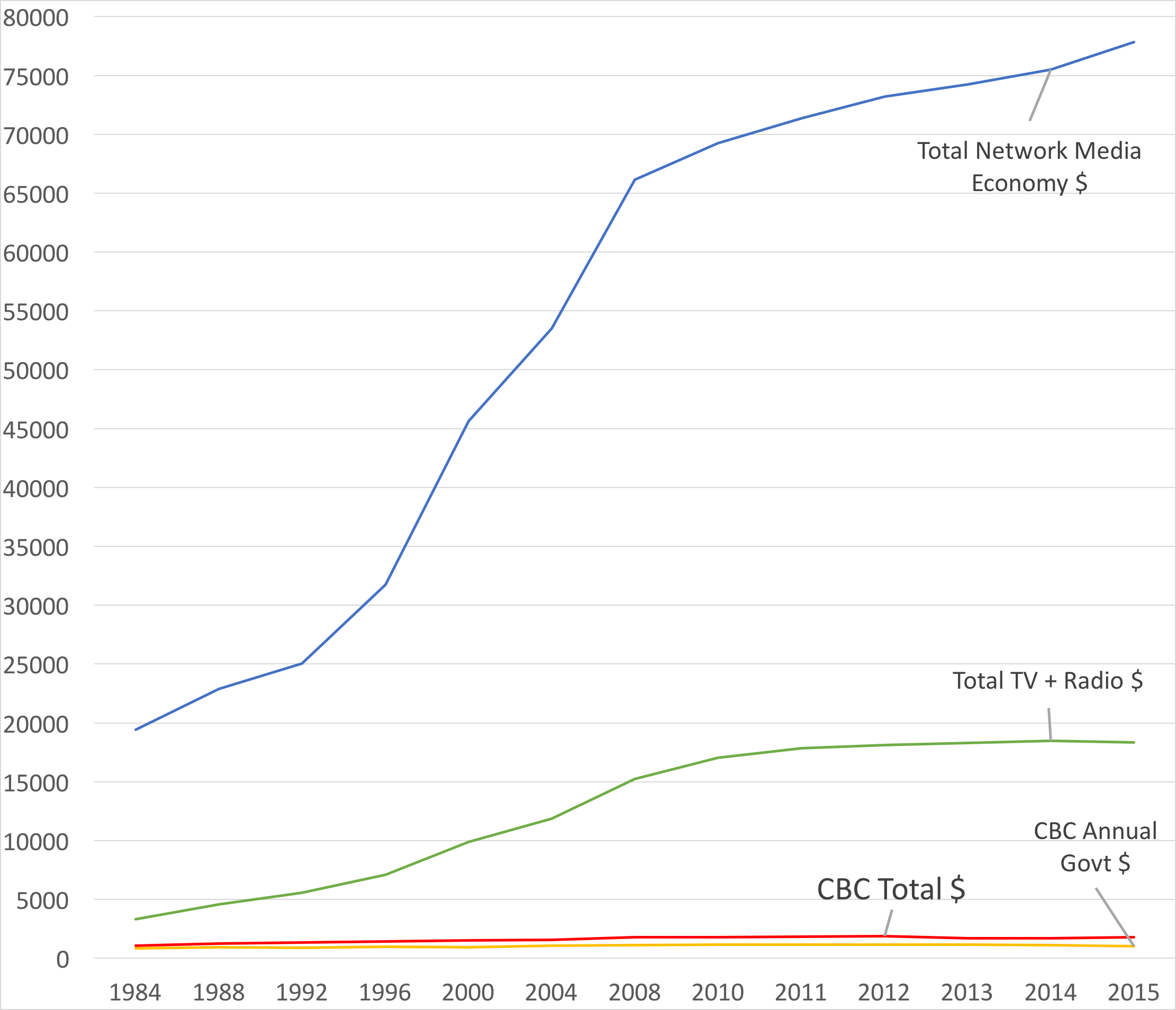 Source: Canadian Media Concentration Research Project (2016).
The role of the CBC has been dwarfed by a handful of developments:
- Wholly new media have been added to the media universe: e.g. mobile phones, broadband internet access, pay TV, OTT, online gaming, social media, search engines, the hosting, buying and selling of stuff – ebay, Amazon, kijijji.
- The media universe is becoming ever more internet- and mobile wireless-centric, hence why I talk about the “network media economy” — carriage is king, not content;
- The size of the network media economy quadrupled from $19 billion in 1984 to $75 billion today;
- Canada’s media economy is not small but one of the twelve biggest in the world;
- The Canadian media economy has not only become much bigger and more complex but also become more concentrated since the turn-of-the-21st Century (although with important exceptions, such as, and crucially, internet news sources, radio and magazines). Among other things, Figure 2 below shows how the CBC’s place within the Canadian media economy shrunk between 1992 and 2015.
Figure 2: CBC place in the Network Media Universe, 1992 vs 2015
1992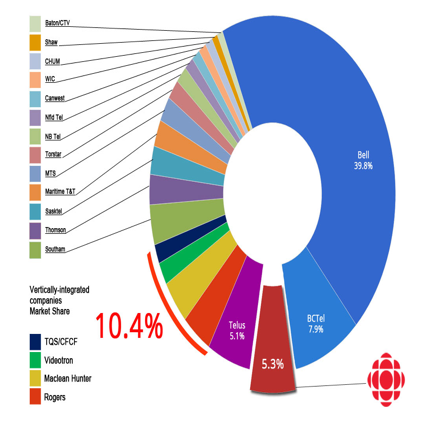 2015
2015
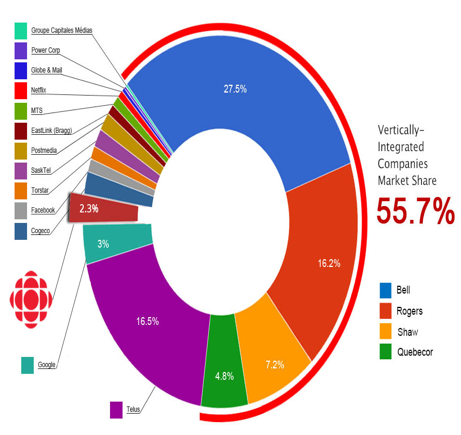
The CBC is now a pygmy amongst giants. It’s share of the total media economy dropped from 5% in 1980s and early 1990s to less than half that amount today.
Based on revenues in Canada, Google is now bigger than the CBC, while Facebook is about half its size.
What also stands out is the extent to which a handful of companies stand at the apex of the internet and media landscape: Bell, Rogers, Telus, Shaw, Quebecor. Bell dominates with nearly 30% of all revenue, while the big five account for just under three-quarters of all revenue; that figure was 64% in 2000 and 60% in 1996.
High levels of media concentration are not unusual, however. Summarizing the results of a thirty-country study, Eli Noam observes that media concentration is often “astonishingly high” around the world. Canada is no exception.
Canada does stand out, however, in terms of the extent to which telephone companies and ISPs own all the main TV services and most radio services in Canada, except for the CBC. The “Big 5’s” share of the total TV market — Bell, Rogers, Telus, Shaw and Quebecor — has grown from 54% in 2008 to just under 80% in 2015 (78%). This combination of carriage and content is called vertical integration; Canada has some of the highest levels of vertical integration in the world, and this is not a good thing. It matters because:
- Having come to own content, telcos increasingly want to act as gatekeepers (publishers) to the internet rather than as gateways (common carriers). CBC has been excluded from Videotron’s Unlimited Music offering, for example, where wireless subscribers get access to a selected catalogue of streaming music services without the use of them counting against your monthly data caps. All telcos would like to do this. Bell’s Mobile TV offering tried to do much the same before being slapped down by the CRTC and the Federal Court of Appeals;
- Telcos’ content holdings in TV, radio, online and print are trinkets on their much larger corporate edifices. They don’t care much about media, content or journalism other than that they hope this “content” stuff will help them sell mobile phone and internet subscriptions – the real engines and profit centres of their operations;
- Signing up for mobile wireless and broadband internet services in Canada is very expensive relative to the forty countries that make up the EU and OECD, as is the price of data. Data caps are also used widely and set at low levels after which punishing ‘overage charges’ kick in – as if we are using ‘too much internet’.
- As a result, markets for fibre-based internet access are underdeveloped while mobile wireless and broadband internet uptake is lower than it could be;
- Regulatory capture – governments have been unwilling to steal their spine to deal with such realities. The revolving door between industry and government does not help. The Harper Government went part way down the path needed to bring about more competition but the Liberal’s approval of Bell’s takeover of MTS last week effectively throws the last government’s pro-telecoms competition policy under the bus. CPC leadership candidate Maxime Bernier probably knows this file best amongst all of the party’s leadership candidates, but his plans are uninspired and too closely linked to those of the telcos.
Instead of railing against the CBC, these kinds of issues should be higher up on our list of priorities. The industrial media age of the 19th and 20th centuries is giving way to the internet-based society of the 21st Century. The choices we make now will shape what happens for decades, and perhaps longer. We need to get this right.
Besides getting a better measure of the CBC’s diminished place within the digital media marketplace, we also need to realize that the CBC is kept on a very short leash by a several political constraints, four to be specific:
- Funding levels for the CBC are low by international standards – less than half the average and about a sixth of the high-end of the scale. The figure below illustrates funding levels per person in Canada versus other OECD countries, using 2014 data from all of the other countries but 2016 data for Canada to capture the increased funding put into the CBC by the Trudeau Government.
Figure 3: Public Service Media Funding/Person: Canada vs Select OECD Countries, 2014
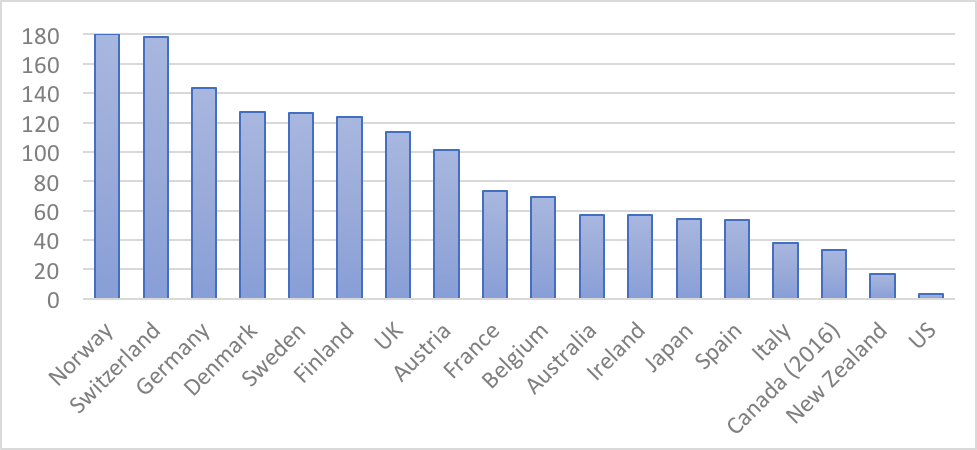
Source: Nordicity (2016). Analysis of Government Support for Public Broadcasting. London, UK & Ottawa: Nordicity.
- Short-term annual funding cycles opens the CBC up to political influence through budgeting – should have five- or ten-year cycles instead;
- Lack of independence from the government-of-the-day in terms how the CEO and Board is appointed – Conservative or Liberal;
- As a recent article by DeCillia and McCurdy shows, the 467 instances of media coverage of the CBC that they examined between 2009 and 2014 highlights the extent to which the CBC faces an overwhelmingly hostile press that typically casts it as threat to commercial interests rather than taking up its place within a democratic society.
However, despite being hemmed in by business interests on one side and political constraints on the other, the CBC still manages to do some things remarkably well:
- Investment in original journalism and Canadian content. While the CBC accounts for just a fifth of all TV and radio revenue, it is accounts for a third of investment in original TV/radio journalism, news and information programs and a quarter of all spending on TV and radio content production in Canada. It also maintains 9 foreign news bureaus while the private sector has cut to a bare minimum.
- The CBC TV audience has declined but still garners 10% audience share and is still a significant TV news source (8% in English regions, 18% in QC).
- CBC radio services are much loved (national audience share of ~20%), and its streaming music services are popular;
- Trust for the CBC is high and has stayed fairly steady over time (CBC Annual Rpt, p. 34) whereas trust for traditional media has fallen (e.g. ¾ of Anglophones and 4-out-of-5 Francophones see it as fair and balanced, and reasonably diverse while trust levels for traditional media fell from 71% in 2012 to 58% at start of this year) (Edelman Trust Barometer);
- The CBC has been an early adopter of digital technologies, the internet and mobile apps. Well before 2008, the CBC was making its archive of programs, streaming services, TV episodes, print and audiovisual news and commentary available via its website, apps, and on iTunes, YouTube, etc. – all for $33 a year (3rd lowest amongst 18 comparable OECD countries) (Nordicity, 2016, p. 44). The commercial companies did not start in earnest until 2010, but they are still dragging their feet to this day.
- The results show — the CBC is the #1 source of online news for Canadians, as the Figure below illustrates.
Figure 4: Top Internet News Sources in Canada, 2015
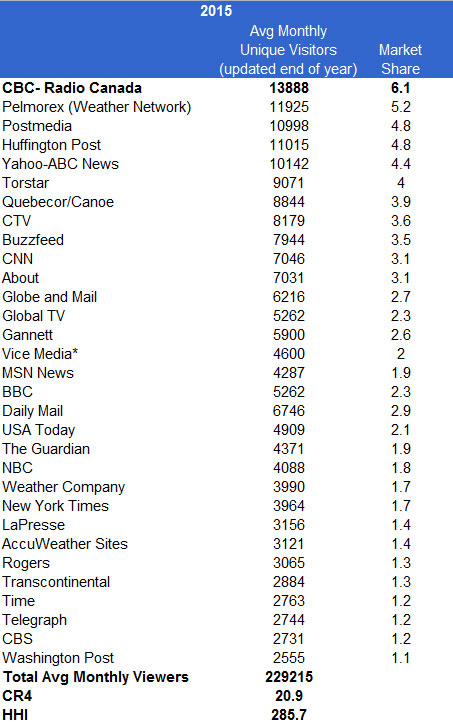
Source: ComScore Long Term Trend, September 2012 — September 2015, Total Canada, News and Information Category.
While the CBC is the number 1 internet news source in Canada, it is crucial to stress that it does not dominate the internet news environment. People get their news from many internet news sources — old (e.g. CBC, Postmedia, Toronto Star, CTV) and new (e.g. iPolitics, Huffington Post, Buzzfeed), domestic and foreign (e.g. BBC, Yahoo!-ABC, the Guardian, New York Times).
But before adopting a rose-tinted vision of things, however, there are several reasons for caution:
- Most news organizations are short on money, trust and full-time journalists. New internet news ventures like iPolitics are groping their way to survival. The “crisis of journalism” is real, as the Public Policy Forum’s recent report The Shattered Mirror: News, Trust and Democracy states – but not of the magnitude or for the reasons it suggests. Against the backdrop of a heightened state of flux, the CBC offers a steady, reliable and well-trusted source of news.
- New online journalistic ventures like iPolitics, Canadaland, The Tyee, Ricochet Media, etc. are important to their own niche audiences, but none of them crack the top 60 most popular internet news sources.
- While trust in traditional media is weak and declining it is lower yet for ‘internet-based’ media (sometimes undeservedly so). In contrast, a large majority of Canadians — 75-80% — trust the CBC. As such, it helps fill the ‘trust gap’ and since democracy rests on trust, we can say that the CBC’s makes a positive contribution to democracy.
- The economic base of the media no longer depends on advertising revenue but subscription fees: broadband internet, mobile phones, cable TV, Netflix, Spotify, etc. Subscription revenue now outstrips advertising revenue by a 5:1 ratio.
- Advertising spending has flat-lined since 2008 and fallen on a per capita basis in the last three years This is not because of the rise of the internet, Google and Facebook but the sluggish economy. What’s left is increasingly going to the internet. Google and Facebook, in turn, dominate internet advertising not because they are vampire squids sucking the lifeblood out of journalism and ‘old’ media but because they are better at doing what the mass media used to do best: delivering audiences to advertisers. Figure 5 shows how advertising revenue tumbled for most media after 2008, and even slowed for internet advertising.
Figure 5: The Impact of the Financial Crisis on Advertising Across Media, 2004-2015
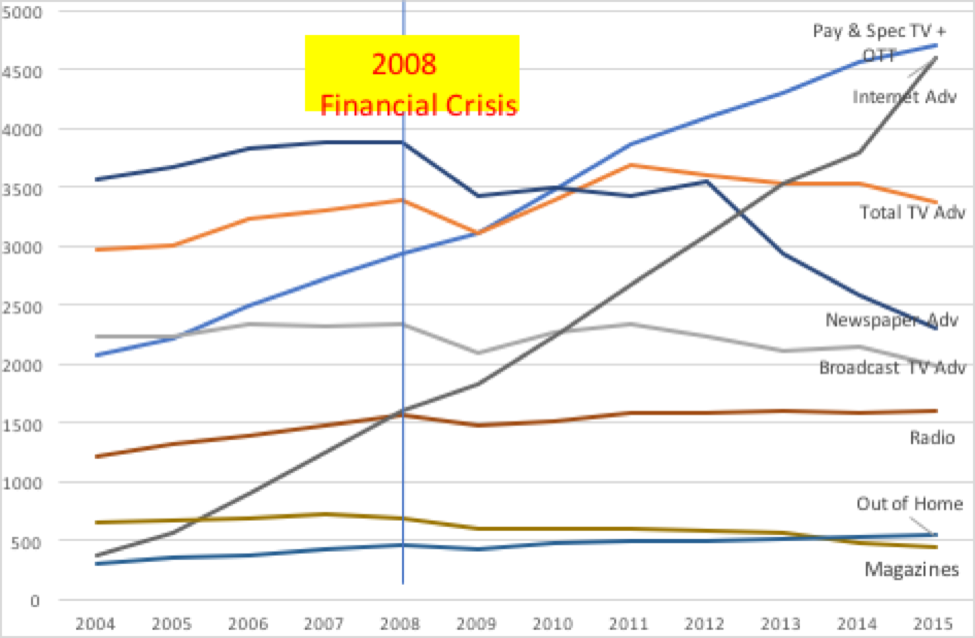
Source: Canadian Media Concentration Research Project.
- Advertising-funded mass media are in trouble not because of the CBC, but because (a) total advertising $ are stagnating or in decline; (b) pay-per media are expanding; and (c) the internet is better at delivering audiences to advertisers. The general public has never paid the full cost of general news services, and likely never will. Consequently, journalism and ‘general media services’ have always been subsidized by either advertising, wealthy patrons, propaganda in authoritarian regimes or the public purse in democratic countries.
- Given this baseline reality (i.e. unwillingness to pay), the market does not and cannot fully support the kinds of general journalism and media services that Canadians want and democracy needs. This is not to denigrate the market, but recognize its limits. Filling in the gap between what the market offers and what people want and democracy needs is the raison d’être of the CBC. As the bottom of the advertising subsidy falls out from under some media and journalism, what kind of subsidy will rush in to fill the void: (1) rich sponsors; (2) propaganda; or (3) the public purse? My vote is for the CBC.
What is to be done?
- Stop looking through the wrong end of the telescope; the CBC plays a smaller role in a larger and more internet- and mobile wireless centric media universe;
- The CBC needs to be put on a stronger footing by:
- Clarifying that its mandate includes offering services across all digital media;
- More than doubling its budget to bring it into line with the average of the OECD countries and eliminate advertising from its TV and online services;
- replace current annual funding cycles in favour of five- or ten-year cycles to help shield it from political influence and allow it to plan appropriately;
- make the appointment of its President and Board more independent from the government-of-the-day;
- dial-down the anti-CBC hyperbole in the press and some political quarters.
Valuing journalism and quality media is not a zero-sum game but a virtuous circle that benefits all: strong spending on PSM occurs alongside greater personal willingness to pay for news (Norway, Sweden, Denmark, Finland & the Netherlands), and is positively tied to very high rankings on free press indexes and strong democracies.
- Deal with the reality of high levels of media concentration and sky high levels of vertical integration in Canada because:
- telcos don’t care about content;
- telco-ISPs are pushing hard to become gatekeepers (publishers) in relation to the open internet rather than gateways (common carriers).
- lower the high prices for mobile wireless and broadband internet services and data and curb the use of data caps, as if somehow people use “too much internet”. Taking these steps will help increase the adoption and use of mobile wireless and broadband internet services;
- will help to decrease the problem of regulatory capture stop the spinning revolving door between industry and government – regardless of who or which party is in power.
Shattered Mirror, Stunted Vision and Squandered Opportunities
Two weeks ago, the Public Policy Forum published its report on the state of the news media in Canada: The Shattered Mirror: News, Democracy and Trust in the Digital Age. It’s an important report, and needs to be taken seriously.
The report’s portrait of the state of journalism in Canada is grim: advertising revenue has plunged in the past decade – due, it claims, to the internet, and to Facebook and Google especially; daily newspapers have been closed, merged or pared back during the same period; many local TV stations face a similar fate; well over 12,000 journalism jobs have vanished; fake news is pouring in to fill the void; and the social ties that bind us together are fraying. All of this adds up not just to a crisis of journalism but a potential catastrophe for democracy writ large, the report intones.
In the report’s view, throughout the 20th Century advertisers, audiences and news organizations shared a mutually beneficial three-way relationship: advertisers got cheap access to large audiences, journalists got paid, and we got our news for next to free because advertisers footed the bill. This literally was the “free press”, and by lucky happenstance, democracy was the better for it.
That’s all coming undone now, though, say the wise counsel of mostly senior journalists and journalism professors huddled around the Public Policy Forum’s new CEO, Edward Greenspon (and former Globe and Mail and Bloomberg News senior editor) who led the development of this report. They conclude with a dozen recommendations designed to turn back the tide. The cornerstones of their policy proposals aim to redirect advertising revenue that is currently flowing into the coffers of Silicon Valley-based internet giants like Google and Facebook back to Canada. Another group of policy recommendations aims to use a proposed new Future of Journalism and Democracy Fund to boost the capacity of professional journalism taking root in emerging digital news ventures and First Nations journalism organizations.
I think that the exercise is potentially useful, and that there’s no need to shy away from the idea that the federal government can adopt supportive policies to bolster journalism and help a democratic culture to thrive. However, this report is badly flawed. All along the way it cherry-picks evidence and gooses the numbers that it does use to make its case. There is also an acute sense of threat inflation that hangs about it. The extent to which Google, Facebook, Silicon Valley and “the Internet” are made the villains of the piece is both symptomatic of how the report tries to harness such threats to preordained policy ends and a framing that undermines the report’s credibility.
The Shattered Mirror also dodges four fundamental issues that hobble both its analysis and policy recommendations:
- Media concentration and the unique structure of the communication and media industries in Canada;
- The impact of the financial crisis of 2008 which, even though its epicentre lay elsewhere, has resulted in a lacklustre Canadian economy ever since. This resulted in a sharp drop in advertising that slammed ad-funded news media and from which they have never recovered, and likely won’t;
- Advertising is no longer the centre of the media economy, and receding ever further from that role by the day, so hinging a policy rescue on recovering so-called lost advertising is out of step with reality and likely to fail;
- The general public has never paid full freight for a general news service and likely never will. Thus, it has always been subsidized, and as the bottom on advertising revenue falls out that source of subsidy will have to be replaced by another if we really are concerned about getting the news we deserve – trying to wrestle money out of Google and Facebook (the report’s central policy proposal) won’t cut it. The proposal to apply the GST/HST to them, with some tweaks, so as to make it apply to all forms of advertising and to earmark these newfound tax revenues to original Canadian content, could help and is, thus, one I support.
Finally, I am skeptical about the “real news versus fake news” frame that girds the report. The language about “vampire economics” is overwrought. Such things give a tinge of moral panic to the report, and taints the analysis and policy proposals. Unless otherwise cited or linked to, the data sets underlying the discussion can be downloaded under Creative Commons principles from the Canadian Media Concentration Research Project’s Media Industries Database. A PDF version of this post is available here.
Chronicling the Crisis: the Public Policy Forum Makes its Case
As the Public Policy Forum documents, advertising revenue has plunged for daily newspapers, and is beginning to fall for television. Addressing “classified advertising” specifically the report states that “three-quarters of a billion dollars a year in reliable revenue vaporized in a decade” (i.e. 2005-2015). Daily newspaper display advertising revenue totaled $1.8 billion in 2006; a decade later it had been cut in half. Altogether, total daily newspaper advertising revenue has plunged by 40% — from $3.3 billion in 2006 to an estimated $2 billion this year. Community newspaper revenue has fallen by $407 million since 2012 (pp. 17-19). Will the last journalist please turn out the lights?
According to The Shattered Mirror, a similar fate is beginning to beset TV. Profits have plunged from 11% for “private stations” in 2011 to -8% last year, for instance (p. 24). Another study by Peter Miller and the Friends of Canadian Broadcasting that hangs about The Shattered Mirror report but which is not cited, worries that, economic trends, and what it sees as a series of wrong-headed decisions by the CRTC, could lead to another 30 local TV stations going dark by 2020.
Newspaper circulation has also been cut four-fold from just over 100 newspapers per 100 households to half that amount in the mid-1990s, to just eighteen last year. The paid daily newspaper as we have known it for the past century could be extinct in five years, the Public Policy Forum report warns (p. 15). And as those implications come to pass, fake news is pouring in to fill the void, desiccating the social bonds that tie us together as a nation, as a people, and as a democracy.
Figure 1 below illustrates the point with respect to declining circulation.
Figure 1: The Vanishing Newspaper: Newspapers sold per 100 households in Canada, 1950-2015, projected to 2025
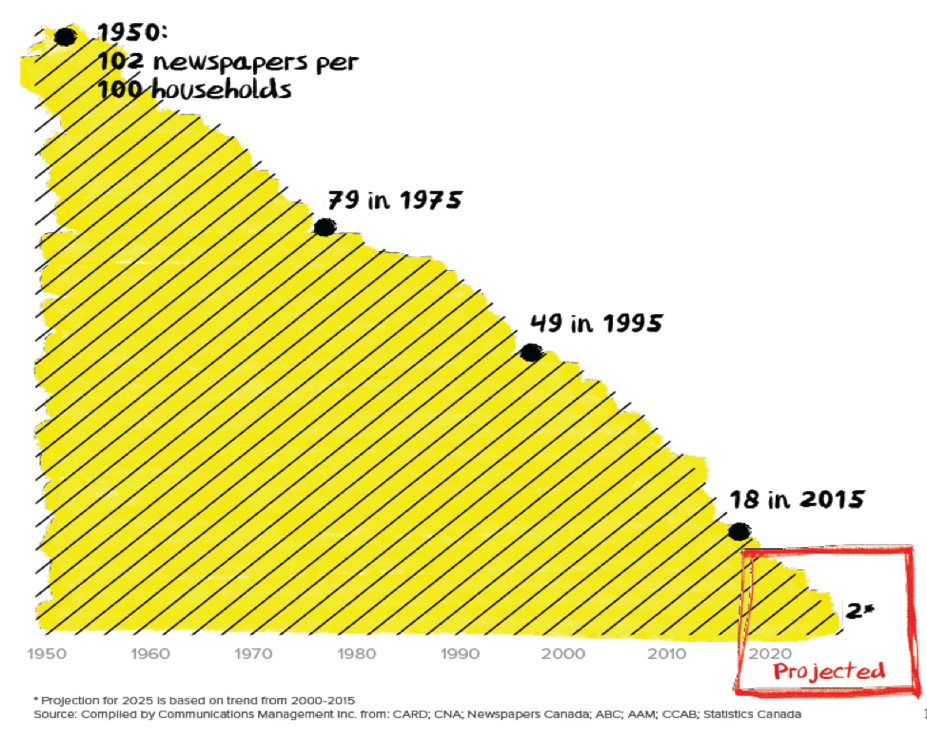
Source: Public Policy Forum (2017), The Shattered Mirror, p. 15.
In addition, twelve thousand journalists and editorial positions have been lost in recent decades, according to figures cited from the Canadian Media Guild. Unifor and the Communications Workers of America also report another 2000 or so positions lost as the massive shift in advertising revenue to the internet guts Canada’s news rooms.
The lost revenue at the root of this carnage, however, the report argues, has not vanished but migrated to the internet. In fact, internet advertising has sky-rocketed from half-a-billion dollars a decade ago to $5.6 billion last year, states the report. This ‘shift’ has benefitted a small number of internet giants based in Silicon Valley, while depriving Canadian news media of the money they need to survive.
The report is emphatic that the free-wheeling early days of the internet have been eclipsed by the rise of a few foreign digital media giants and a process of “vampire economics” whereby those giants, and Facebook and Google in particular, are sucking the lifeblood out of “real news”. As the report states, the internet giants are getting an incredibly “sweet deal”: “leverage the news others finance and grab the advertising that used to finance that news” (p. 31). But as Facebook and Google get rich, journalists, news organizations and, yes, us and democracy are being robbed blind. The report is explicit that only once this lost advertising revenue is brought home, will all be well: the so-called crisis of journalism will be solved and democracy saved.
Some of that money flowing south needs to be clawed back and the two behemoths need to learn to show more respect for the news content that they have used to build their empires, the report stresses. Not only do we need to do this, we can do it if policy-makers gather up the political will needed to change the Income Tax Act to make advertising on Canadian internet news sites tax deductible but not foreign websites (as has been done for newspapers and broadcasting since 1965 and 1971, respectively). GST/HST should also be applied to foreign internet companies that sell advertising and subscriptions in Canada, e.g. Google, Facebook and Netflix. These measures would cost little and raise $300-400 million that could be used to fund public policy initiatives to strengthen professional journalism (p. 84). In addition, Facebook and Google must be made to play an active role in stemming the tide of “fake news” flooding into our country while giving priority to Canadian news sources. In other words, they must be made to act more like responsible publishers (p. 97).
Tunnel Vision, Goosing the Numbers, and “Off Limits”
Advertising-supported journalism is not the ‘natural order of things’.
The case that the authors of The Shattered Mirror make about the severity of the crisis of journalism is impressive at first blush. Ultimately, however, it is neither convincing nor credible.
Its fixation on advertising revenue, for instance, assumes that it has always been an integral part of the natural journalistic order of things. It has not. Advertising revenue soared from being less than half of all revenue to account for between two-thirds and 90% of revenue at big city newspapers in the US and parts of Europe between 1880 and 1910, and in Canada two decades after that (Sotiron, 1997, pp. 4-7). While the advertising-supported model of journalism carried the day during the ‘industrial media age’ for much of the 20th Century thereafter, there is little reason to believe that it will or even should have an eternal lock on being the economic base of the media forever into the future – the Public Policy Forum report’s wishful thinking notwithstanding.
Moreover, while advertisers tied their fortunes to the commercial media model for close to a century, they had no special love for the media or the journalistic functions they perform, per se. Instead, they did so because it was the most cost-effective way to meet their needs. New and better means to deliver up audiences to advertisers at a much lower price have been developed since and, unsurprisingly, businesses have reached for the newest tool in their toolbox: the internet. This is an uncomfortable truth that the report refuses to acknowledge, and thus to engage with. Not even King Canute could turn back that tide, and nor should we want him to even if it was possible. We have to find a better way to pay for the news for just this reason and also because, for the most part, Nasreen Q Public never has been willing to pay for a general news service.
Advertising is being eclipsed by “Pay-per” media.
Advertising is also becoming a smaller and smaller part of a bigger and bigger media economy. It has long been eclipsed by the “pay-per model”, or subscriber fees, where people pay directly for the communications and media they use. Subscriber revenue outstripped advertising by a 5:1 margin for the ‘network media economy’ in 2015 (see here for a definition of the ‘network media economy”, p. 1). “Pay-per media” are now the economic engine of the media economy. The Shattered Mirror, however, does not seem to recognize this and thus examines the problems facing journalism through the wrong end of the telescope, e.g. advertising.
Take TV specifically. The report states that “TV revenue is start[ing] to drop”. The statement is true for advertising-supported broadcast TV, but not for TV as a whole. Subscription revenue for specialty and pay channels, OTT services like Crave TV and Netflix as well as and cable TV now account for three-quarters of all revenue, and for the most part continue to grow. Annual funding for the CBC makes up the rest, i.e. just over 5%. The Shattered Mirror draws general conclusions about the supposedly sorry state-of-affairs for TV writ large based on a small as well as diminishing part of a larger vista. The advertising-supported part of TV accounted for less than half of all revenue in 2015 (e.g. 42.6%). It is in trouble, but again this is a fraction of the whole picture.
In addition, blaming “the internet” ignores other potential explanations for the problems that do exist. Why, for example, is broadcast TV not in dire straits, and in some cases making a bit of a comeback in the US and some other countries (see FCC and Ofcom, for example)? The report does not bother to ask, let alone explore such realities, for reasons that will become clear in a moment (hint, it has to do with media concentration and the unique structure of the media and communication industries in Canada, issues that the report explicitly eschews).
Having left out the fastest growing and biggest segments of the media economy – the ‘pay-per’ segments – and painted a picture of rapacious foreign internet giants stealing away advertising revenue from Canadian news media organizations, the report ignores another fundamental fact that does not fit the story it wants to tell: advertising revenue across the entire economy has stagnated for close to a decade. Moreover, per capita advertising spending dropped from $371 per person in 2008 to $354 in 2015 – the last year for which a complete set of data is available. TV advertising specifically has stayed flat in absolute terms while falling from $102 per person in 2008 to $94 last year (see here). That said, however, and unlike the report’s claim to the contrary, total TV revenue continues to grow, and indeed revenues for specialty and pay TV as well as OTT services have soared over the years based on subscriber revenues, albeit with slow growth in some aspects of some of these services in the last year or two.
In addition, the report’s claims regarding the steep decline in “private station” profits from 7.3% to -8% between 2011 and 2015 is misleading (p. 16). The statement implies that it applies to TV in general but in fact refers only to the smallest and shrinking part of the TV landscape: commercial broadcast TV. Operating profits for pay and specialty TV — the biggest and still growing segment of the TV landscape — were 20.8% in 2015, however. For cable TV and radio, they were 19% (see CRTC here, here and here). Meanwhile, operating profits at Bell Canada Enterprises’ media arm were 25% in 2015 and an eye-popping 40% for the company as a whole – four times the average for Canadian industry (Statistics Canada). Figure 2 below illustrates the point.
Figure 2: Bell Media Operating Profits, 2015
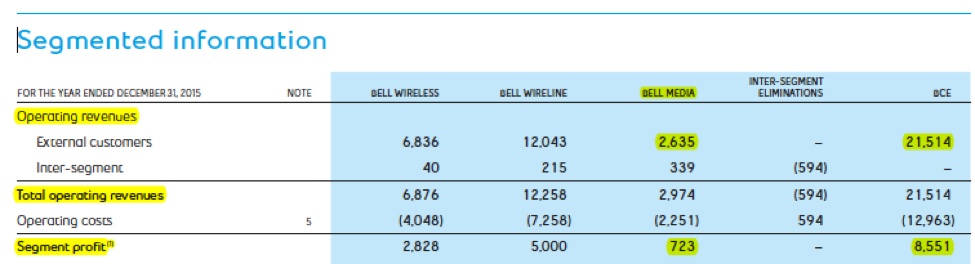 Source: BCE, 2015 Annual Report, p. 130.
Parenthetically, it is also important to note that Bell is the biggest, vertically-integrated TV operator in Canada by far, accounting for roughly 30% of all TV revenues and 28% of total revenue across the network media economy. Ignoring conditions at a company with this clout across the media economy is negligent, but also part of a tendency in this report to selectively invoke a small part of the picture to fill in a portrait of catastrophe of a larger kind. In terms of the rules of rational argument, this pattern is a type of spurious reasoning called an “indexical error”. The report is chock-a-block full of such examples, which lends to the impression that the report’s authors are goosing the numbers.
Let’s consider a few other claims made about collapsing circulation and the “vanishing newspaper” and the scale of journalistic job losses, before turning to its willful refusal to deal with fundamental considerations about how the unique structure of communication and media industries in Canada directly bear on its topic but which are wholly ignored.
The Vanishing Newspaper?
These examples are not innocent. They are part of a process of “threat inflation” with the aim of buttressing the case for the policy recommendations on offer. Much the same pattern can be seen in the report’s depiction of circulation trends for daily newspapers. Now, make no mistake about it, the picture cannot be spun as a good news story. That is not my point. Looking at the issues from different angles and a more measured and nuanced view reveals that that things are far from rosy, but they are not the catastrophe that The Shattered Mirror makes them out to be. The reasons why things are as bad as they are also demands a richer and more multidimensional explanation than the ‘single-bullet’ explanation the report offers: blame the internet (and Facebook and Google). To illustrate the point, let’s return to Figure 1 above, which is repeated below to make the job easier.
Figure 3: The Vanishing Newspaper: Newspapers sold per 100 households in Canada, 1950-2015, projected to 2025
The message of the Figure 3 is clear: newspapers have undergone a precipitous decline, and could vanish altogether soon. Indeed, already by 2015, the number of newspapers sold per 100 households was one-quarter of what it was in 1975. By this measure, the relentless decline and seemingly inevitable outcome look really, really bad – catastrophic even.
Now, let’s expand our measures to look at things from four additional angles: (1) total number of newspapers sold per week per person; (2) total number of newspapers sold per week per household; (3) total circulation; and (4) by revenue – shown for both total revenue and just advertising revenue. My numbers start in 1971 because that is the earliest date for which I could gather data fit for the task, but as far as I can tell that has no impact on the main point. And just to make my main point clear, it is that the Public Policy Forum’s Shattered Mirror report has selectively chosen a measure that paints the worst-case scenario rather than a nuanced, multidimensional picture of a situation that is bad enough that it doesn’t need to be exaggerated. In other words, I am depicting a strategy of policy argumentation that I call “threat inflation”.
Figure 4, presents two sets of data, one for the number of newspapers sold per week per person and another for the number of newspapers sold per week per household – both for the period from 1971 to 2015 (the latest year for which figures are available).
Figure 4: Per Household and Per Capita Decline of Daily Newspapers Circulation in Canada, 1971-2015
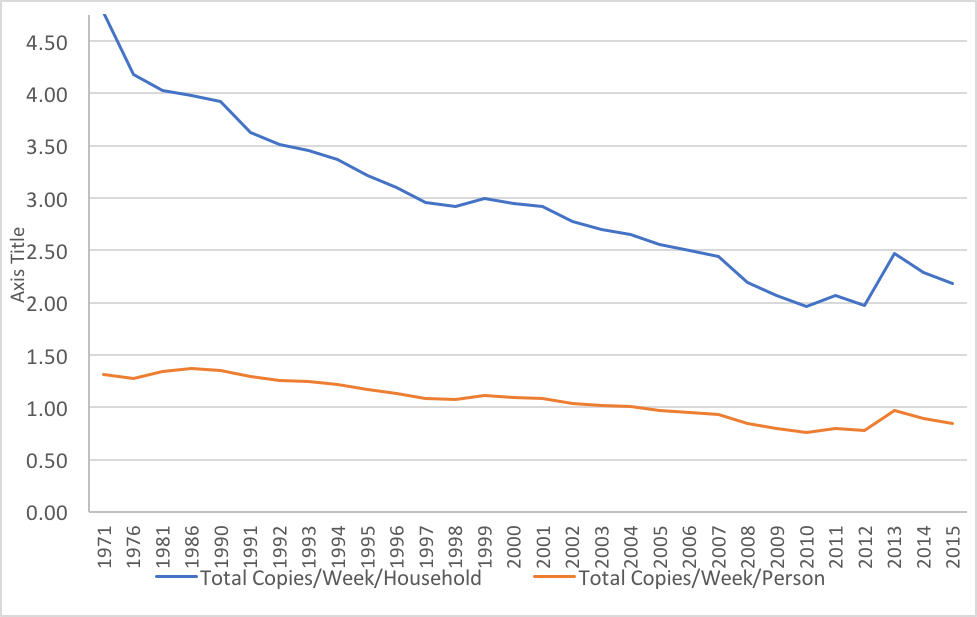
Sources: Newspaper Canada; Statistics Canada.
Figure 4 confirms that newspaper circulation has been in long-term decline and there appears to be nothing on the horizon to turn that around. If we care about newspapers because they are one of the main sources of original journalism – as I emphatically do – this is a ‘bad news’ story. Yet, while the decline shown in Figure 4 is obvious – indeed, circulation was cut in half over the period covered on the basis of total copies per week per household – that is half the rate depicted by The Shattered Mirror. The difference is likely due to the fact that the number of people per household has declined over time, so fewer people per household means fewer newspapers in each house even before we take declining circulation into account — versus the “vanishing newspaper” scenario.
Now, let’s look again from the vantage point of circulation per capita shown in Figure 4 above. It also shows that circulation levels have declined steadily since 1971, but by only about 35% versus the four-fold collapse The Shattered Mirror depicts. This is what I mean by threat inflation: choosing methods and numbers that inexorably lead to the worst-case conclusion.
Now let’s look at things from the vantage point of total newspaper circulation because if you’re in the journalism business, a key consideration has got to be not how many daily newspapers you can sell per person or per household but in total. Figure 5 depicts the trend over time.
Figure 5: The Rise and Fall of Newspapers Circulation in Canada, 1971-2015
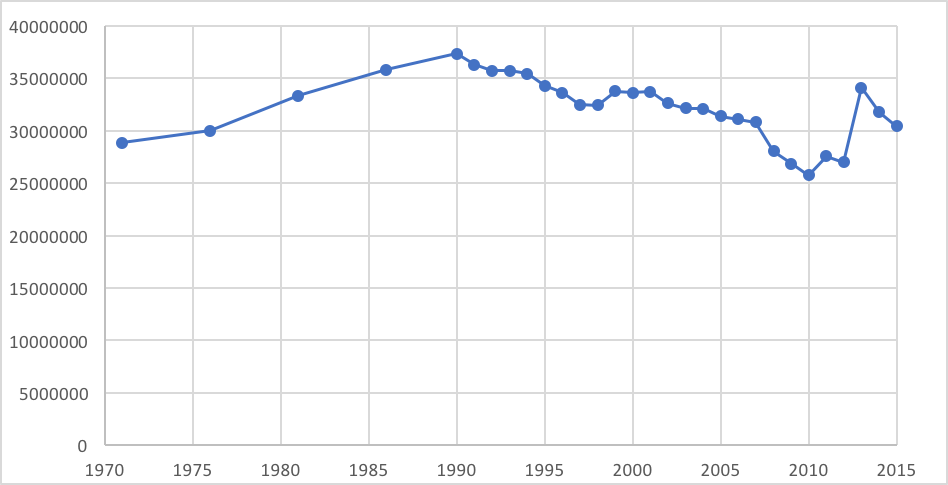
Sources: Newspaper Canada; Statistics Canada.
Figure 5 shows that, in terms of sheer volume, newspaper circulation continued to rise until 1990 (versus falling steadily from 1950). It has fallen since, albeit in fits and starts. And obviously, against a population that has swelled from 22 million to nearly 36 million over the timeframe covered, circulation is shrinking in relative terms, which is the point of the earlier figures. Yet, the point is once again that this is a ‘bad news’ story but not a catastrophic one, and the fact that circulation peaks in 1990 and then goes down in fits and starts thereafter also raises interesting questions about timing that are ignored by the Public Policy Forum report, again likely because they don’t fit the tale of doom and gloom that it is mobilizing, but which I will return to below.
Now let’s turn from circulation to revenue data to see what things look like from this vantage point. Figure 6 does that based on stand-alone advertising revenue and all sources of revenue (advertising, subscription and other, including digital/internet).
Figure 6: The Rise and Fall of Newspapers Revenue in Canada, 2000-2015
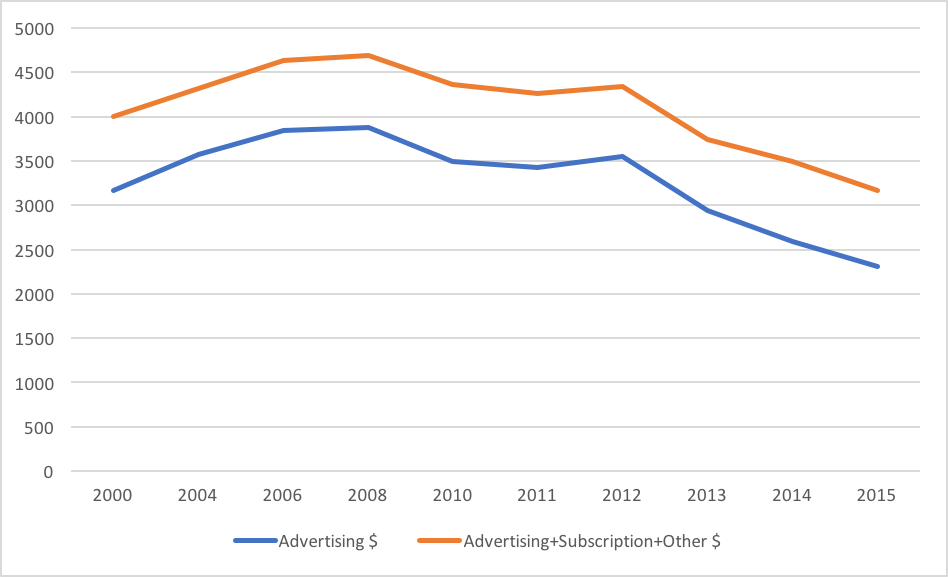
Sources: Newspaper Canada; Statistics Canada.
As Figure 6 shows, advertising as well as subscription and other sources of revenue continued to rise for newspapers into the 21st Century. Indeed, while circulation was in decline regardless of the measure used, revenue continued to climb. Revenue peaked in 2008 at $3.9 billion and $4.7 billion, respectively, for advertising and ‘total’ revenue measures — a crucial point in time for reasons that will emerge in a moment. Revenue has plunged since, with newspaper advertising revenue falling to $2.3 billion (a drop of 40%) and total revenue to $3.2 billion (a drop of 32%) in 2015. This is bad.
Thus far, none of the measures reviewed leads to a ‘good news story’, but each of them in their own way change the magnitude, timing and potential causes of the problem. Of utmost importance is that there is no downward spike in the fortunes of the press on any of these measures that coincides with when the internet takes off, either in its dial-up phase in the mid- to late-1990s or when broadband internet took centre stage in the early-2000s. Given this, the internet – and Facebook and Google – cannot be the villain of the piece that The Shattered Mirror (and so many lobbying the government from the “creator” and “cultural policy” groups) makes it out to be.
In fact, this is not news. While such claims are common, that they are wide of the mark is well known. One of the world’s top media economists, Robert Picard of the Reuters Institute of Journalism at Oxford University, for instance, has made this point for much of the last decade. I have too with respect to Canada and across the world. That neither circulation nor revenue dives downward with the arrival of the internet cuts to the heart of the central claim in The Shattered Mirror. Yet, like so much of the evidence that does not fit its “sky-is-falling-because-foreign-internet-giants-ate-Canadian-news-media’s-lunch” rhetoric, this evidence doesn’t make the cut. If all of this is correct, we must also change our diagnosis and policy proposals accordingly.
Alternative Explanations: Stagnating Advertising Revenue and Vanishing Jobs
Not only does newspaper revenue not spike downwards with the advent of the internet, the onset of economic woes for advertising supported media do not coincide with the time frames that the Public Policy Forum report identifies, typically 2005 or 2006 for newspapers and ‘recently’ for TV. The upshot of its misdiagnosis is to effectively carry on with the ill-fated case its authors want to make while avoiding another possible – and I believe far better — explanation for the woes they describe: the impact of the financial crisis in 2008 and economic instability that has followed ever since.
Figure 7 below illustrates the point by showing a sharp downward kink in revenue for nearly all the media sectors it covers since 2008. This reflects the impact of the global financial crisis on the media economy. At this point in time, advertising revenue falls for total TV advertising revenue, broadcast TV, newspapers, radio, out-of-home advertising and magazines. The impact even hits internet advertising and pay TV services, as their revenue growth flattens temporarily before rising again a year or two later.
Figure 7: The Impact of the Financial Crisis and Economic Stability on Media Revenue (millions$), 2004-2015
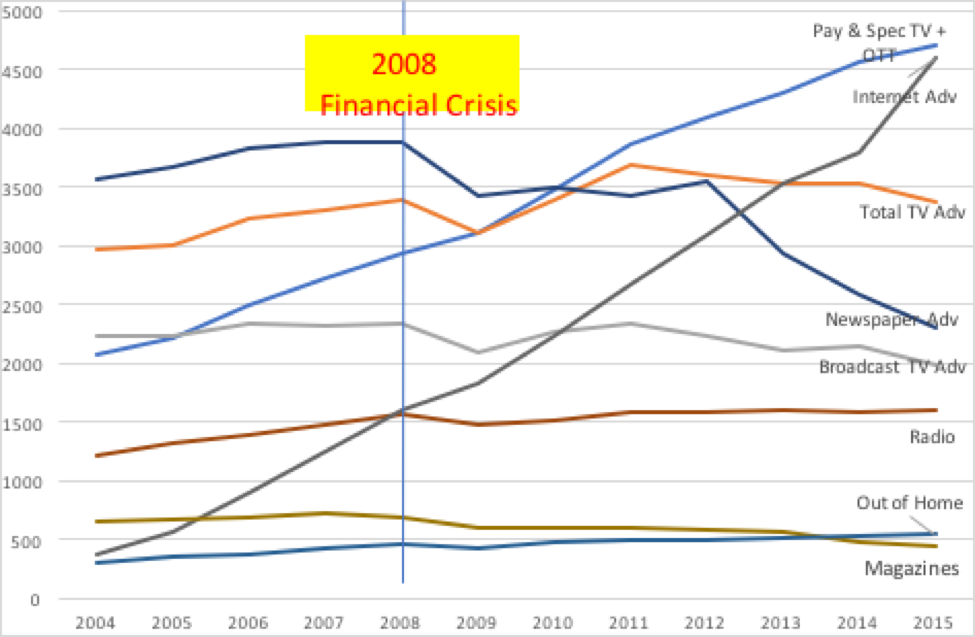
Sources: IAB.canada 2015 Actual + 2016 Estimated Internet Ad Revenue; TVB (2016). Net Advertising Volume, CRTC Communications Monitoring Report.
Total advertising revenue fell by 7% from $11.6 billion to $10.8 billion. It rose again the next year to recover the lost ground but unevenly. Tellingly, however, advertising revenue has fallen from $371 per person in 2008 to $354 on a per capita basis in 2015, and from $102 per Canadian to around $94 for TV– as indicated earlier.
The recovery that has occurred has taken place in fits and starts and has been very uneven across different media sectors. The long-term effects of that appear to be three-fold. First, it has gutted newspaper advertising revenue. Second, it has propelled the shift of the economic base of TV from advertising to subscriber fees. Third, amidst the upheaval, the internet has consolidated its place at the centre of advertising revenue. It now accounts for more than a third of all advertising revenue (36.2%) in a stagnating pool of advertising money.
Again, none of this is a mystery, except to those who work the policy apparatus here in Canada, and there is no mention of it in The Shattered Mirror or indeed in any of the policy reports being wheeled into action by the myriad of groups vying to shape the outcomes of Heritage Minister Melanie Joly’s Canadian Content in a Digital Age review. Beyond this cloistered community, however, the fact that the fate of advertising-based media turns tightly on the state of the economy – and indeed, is something of a canary in the coal shaft for it – is reasonably well known and discussed by media economists from across the political spectrum. This has been the case for many, many years (see, for example Picard, Garnham, Miege, Vogel but also any media economics text). That the subject is not even broached by the Public Policy Forum’s report is a measure of the extent to which it ignores evidence and ideas that don’t fit the story it wants to tell, and of a piece with its methodological tactics throughout the report.
In sum, it is a mistake to focus on a ‘silver bullet’ explanation of complex issues like the one before us. The fixation on the negative impact of the internet and the two villains of the piece, i.e. Google and Facebook, is misplaced. In short, advertising revenue has taken a nose dive because the economy has been shattered not because Tyrannosaurus Digital Media Rex Google and Facebook ate the news media’s lunch.
A Catastrophic Loss of Journalists?
Just as the data with respect to declining circulation and lost revenues in The Shattered Report is circumspect, so too are the figures that it cites for the number of journalist and editorial positions lost over the years partial and incomplete. The report says that between 12,000 and 14,000 such positions have been lost over an indefinite period that sometimes stretches back to the 1990s but with a stress on recent events. The figures cited are based on a tally of headlines announcing such cuts and more systematic record-keeping by the Canadian Media Guild, Unifor and the Communications Workers of America. I have no doubt that the human impact of the losses they document are real and severe.
However, there are two short-comings of the data presented. For one, it is based on headlines and record keeping that do a great job chronicling jobs lost but a poor one at keeping track of those gained. Second, Statistics Canada data depicts a wholly different picture. The report needs to at least explain why the Statistics Canada data offers a less satisfying account of the conditions than the sources it relies on. It does no such thing. In fact, and once again consistent with a pattern, the authors ignore this data completely.
According to Statistics Canada data the number of full-time journalists in Canada has not plummeted. In fact, it has crawled (stumbled?) upwards from 10,000 in 1987 to 11,631 in 2015. Figure 8 below illustrates the point.
Figure 8: Journalists vs the PR, Advertising and Marketing Professions,
1987-2015
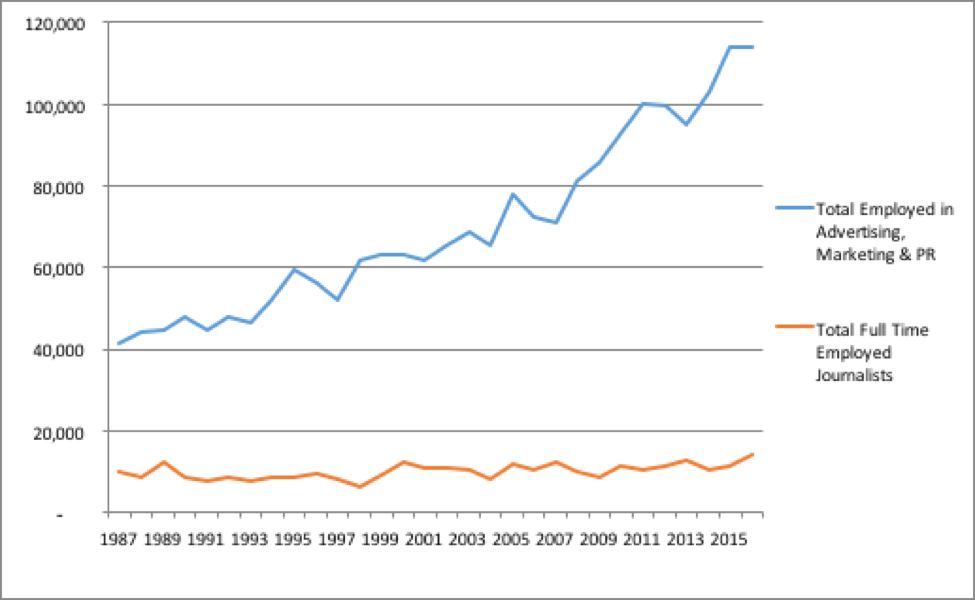
Sources: Statistics Canada (2016) Employment by occupation: 1123 Professional occupations in advertising, marketing and public relations and Statistics Canada (2016). Employment in Journalism occupation, by province. Custom LFS tabulation. File on record with author.
While this is a small increase, it is an increase all the same, and counter-intuitive as well. Things that are counterintuitive beg you to explore why they are so. Also consider that after years of a sluggish economy in the early-1990s, and extensive consolidation and cut backs in the latter part of the decade, the number of working journalists fell to a little over 6,000 (1998). If we take that as our base, the number of working journalists has nearly doubled since and, consequently, the period looks more like one of modest growth rather than a catastrophe.
Of course, this small increase should not be over-played. It has occurred against the backdrop of a media economy that has quadrupled in size. Even if the number of journalists has stayed relatively steady rather than collapsed, this still means that their numbers have shrunk relative to the size of the media economy. In other words, similar amounts of journalistic resources in a much bigger media pie constitutes a relative decline. This is cause enough for concern without the hyperbolic rhetoric that The Shattered Mirror leans on.
In addition, whatever modest growth has taken place has been vastly out-paced by the number of people working in the PR, advertising and marketing professions. Whereas there were four people of the latter type for every journalist in 1987, by last year, the imbalance had swelled to 10:1 — a triumph of the persuasion professions over journalism, which again is cause enough for commentary and concern. Yet again, the Public Policy Forum’s report is silent on the point.
My point, once again, is not to assert that the Statistics Canada data is definitive on the matter of journalistic and editorial job losses. Instead, it is to highlight how selective The Shattered Mirror report is. The pattern is one where evidence that fits its grim vision of the current state of journalism in Canada is highlighted while that which cuts across the grain is either downplayed or ignored completely.
Blindspot: the Media Concentration Problem
The Shattered Mirror also gives short shrift to the idea that media concentration and the structure of the communication and media industries might be a significant factor giving rise to the woes besetting the news media, except for the highly concentrated nature of internet advertising. As Greenspon told J-Source, media concentration is just not “the existential risk to media that it was for a number of years”. However, the report is more than willing to turn the screws on Facebook and Google’s dominance in the one market — online advertising – where they undoubtedly and overwhelmingly do dominate, while simultaneously turning a blind eye to high levels of concentration in several media markets and in terms of vertical- and diagonal-integration across the telecoms-internet and media landscape in Canada.
By The Shattered Mirror estimation Facebook and Google account for two-thirds of all internet advertising spending in Canada. It also shows that internet advertising has become more concentrated over time, not less: the top ten companies took 77% of all internet and mobile advertising revenue in 2009, but by 2015 that number was 86%. The top twenty companies accounted for 90% (pp. 31-32). There is evidence that these levels are growing. I agree with this part of the report’s analysis, not surprisingly since it draws heavily on data and estimates from the Canadian Media Concentration Research Project that I direct.
The same claims have been circulated by those who have advised or influenced the direction of The Shattered Mirror. Ian Morrison, the head of the Friends of Canadian Broadcasting, summarized the key claims being made as follows, for example:
Based on data from the Canadian Media Concentration Project [sic] at Carleton University we estimate $5 billion of Canadian advertising goes to foreign-owned internet companies such as Google and Facebook . . . . With the Interactive advertising Bureau projecting $5.55 billion in overall internet advertising revenue . . . for 2016, we estimate that almost 90 percent of what Canadian advertisers spend on digital ads will leave the country.
In an interview with the Globe and Mail’s Simon Houpt, Greenspon asserted that Google and Facebook alone “take in about 85% of digital ad dollars” – although that number conflicts with others elsewhere in the report. However, the numbers do seem to regularly get mixed up, so that it is not quite clear if we are talking about just Facebook and Google or some ‘other’ foreign internet giants as well.
My main concern is that claims that foreign-owned internet companies will take $5 billion in projected internet advertising revenue for 2016 – or 90%, and that Google and Facebook alone account for up to 85% of the total — out of Canada are stretching the available data beyond what can be reasonably supported. They build estimate upon estimate, jump through hoops, and draw questionable inferences to come up with these figures (see pp. 30-31).
The CMCR Project data estimates with reasonable confidence that, combined, Google and Facebook accounted for about $3.1 billion, or two-thirds, of a total of $4.6 billion in internet advertising revenue in 2015 – the last year for which final figures are available. There’s some room for adjustment either way. Based on what we do know the figures touted in The Shattered Report and elsewhere do not seem credible, even if repeating them in one venue after another seems to have given them an aura of holy writ.
This is especially troubling because the estimates offered not only extrapolate from the limited base of what we do know but serve as a springboard to The Shattered Mirror’s #1 Policy Recommendation:
Policy Recommendation 1: Change the Income Tax Act to make advertising on Canadian internet news sites tax deductible (as has been the case for newspapers and broadcasting since 1965 and 1971, respectively) while applying a ten percent withholding tax for advertising on foreign websites. The key aim is to open a new “revenue stream of $300 to $400 million that would be used to finance a special fund” much along the same lines as the existing levy on cable TV companies is used to fund Canadian content (pp. 83-84).
At a bare minimum, if their numbers are off, so too are these estimates.
Overall, the path to this policy recommendation and the proposal itself is flawed for a handful of reasons. For one, as just indicated, the available evidence is insufficient to support the report’s #1 policy proposal. Second, even if the numbers were right (or close), both the analysis and the policy proposal ignore the structural shift in the economic base of the media from advertising to the pay-per model described earlier, while assuming advertising has and should forever form an integral part of the natural order of the news media. Third, it appears to swap the bad idea of an ISP tax levied against wireline- and mobile wireless internet access providers (which, not coincidentally, are Canadian) for a “platform levy” applied against ‘foreign digital platforms’, e.g. Google and Facebook. If this is correct, the bait and switch on nationalistic grounds is objectionable on its own.
The bigger problem, however, is that the recommendation seeks to take an approach that has been applied to limited (single) purpose broadcasting distribution systems for the past half-century and apply it to general purpose internet platforms that host, store and facilitate a dizzying and ever expanding array of content, applications, services and uses. And it does so in the name of supporting a narrow range of content – “real news”, as the report calls it – that constitutes a tiny sliver of what people use and enjoy these platforms for. Whether applied to ISPs or digital platforms, the idea that the multitude of uses that people make of the internet should be harnessed to promoting journalism (or Canadian content generally) – no matter how important – is objectionable. In terms of a common test applied to free speech cases, while the goal being sought is legitimate, the means being promoted to achieve it is akin to a sledge hammer when what we need is a scalpel.
Finally, while the report does a good job of documenting the extent of the internet giants’ dominance of the online advertising market, both the analysis and proposal exaggerate the extent to which Google, Facebook and other ‘foreign internet giants’ influence reaches across the media landscape in Canada. By ignoring the latter, the effect is to minimize the extent to which media concentration and the uniquely high levels of vertical and diagonal integration between telecoms-internet service providers and other key areas of the media, especially television, have given rise to homegrown problems rather than the debilitating “vampire economics” imported from afar (the following paragraphs draws heavily from a series of CMCR Project reports: see here, here and here for more details and elaboration).
How to Look at Media Concentration
Using what I have learned as the “scaffolding method”, it is essential to look at the state of competition and/or concentration in one media sector at a time, group the different sectors together into reasonable clusters such as “content media” (e.g. newspapers, TV, radio, magazines, etc.), “connectivity media” (e.g. internet access, mobile wireless, etc.) and “internet media” (e.g. search, internet advertising, social media, browsers, etc), and then group everything together so as to get a view of the network media economy in its entirety. One must also look at trends over time, and in comparison to other parts of the world.
The Shattered Mirror report does nothing of the sort, and so it paints a picture sloppily with a broad brush, declaring that media concentration is not a problem when it feels fit to do so, but a worrying concern where that suits its purposes, i.e. in the areas that Google and Facebook dominate. Ultimately, there is no overarching sense of how everything fits together, and so the image drawn is arbitrary, and wholly dependent on the whims of the observer.
So, let’s try to get things straight in a minimal amount of space in what is already a long post. Google and Facebook do dominate internet advertising and the general trend with respect to concentration in this specific media market is up – as stated above. However, once we scaffold upwards from there to get a sense of how internet advertising fits into the whole media economy, we can see that it accounts for just 5.9% of a total $78 billion in revenue in 2015. Google and Facebook were the 6th and 14th biggest media operators in Canada in 2015, and had estimated Canadian revenues of $2.3 billion and $757.5 million, respectively. They accounted for 3% and 1% of all revenue across the media economy.
By comparison, the biggest player, Bell Canada, had $21 billion in revenue from its telecoms and TV operations in 2015. This was 28% of all revenue across the whole media economy, and nearly twice the size of its largest rivals: Rogers and Telus. It ten times that of Google and more than 25 times the revenue of Facebook. Thus, while certainly impressive, Google and Facebook don’t quite cut the imposing figure that The Shattered Mirror makes them out to be once placed in context.
When we look at specific media sectors and across the media economy as a whole, four observations about concentration levels in Canada stand out:
- They are generally high (with the exception of radio and magazines);
- They have gone up since the turn-of-the-21st Century (except modest dips from still high levels in the past five years for mobile wireless and cable/IPTV TV);
- They are not unusually high by comparative international standards but that’s mostly because, as one of the most authoritative sources on the subject states, media concentration around the world is “astonishingly high” (Noam, 2016, p. 25 and especially chapter 38, pp. 1307-1316);
- Canada is unique, however, in its high levels of vertical and diagonal integration.
In terms of vertical integration, Canada stands unique amongst countries insofar that telecoms operators own all the main television services, except the CBC. The scale of vertical integration more than doubled between 2008 and 2015, as the “big 4” – Bell, Rogers, Shaw (Corus) and QMI – expanded their stakes into mobile wireless, internet access, television distribution and more traditional areas of the media such as TV and radio. The “big 5” television groups – Bell, Shaw (Corus), Rogers, Quebecor and the CBC – collectively owned 217 television services in 2015. They accounted for 86.2% of total television revenue, up from three-quarters in 2008. Their TV operations include Canada’s major TV news outlets, from broadcast TV networks like CTV, Global, CityTV and TVA, as well as cable news outlets such as CTV, BNN, the Canadian franchise for the BBC, CablePulse 24, and so forth. The big four vertically-integrated telecoms giants are central to the news ecology in Canada. The Shattered Mirror gives no sense of this.
Beyond this, there are three other reasons why the unique structure of the media and communications industries in Canada are not peripheral, or anachronistic, but central to the study of news.
Lush Profits, Thin Journalistic Gruel
First, similar to the conditions at Bell that we saw earlier, Shaw, Rogers and Quebecor had operating profits of 42%, 38% and 37%, respectively in 2015 — roughly four times the average for Canadian industry. Shaw’s operating profits for its media division (including Corus, which is jointly-owned and controlled by the Shaw family) of 33% — even higher than those of Bell (25%). Operating profits at Rogers and Quebecor’s media divisions were a more modest 8.3% and 7.3%, respectively – a little lower than the average for Canadian industry. These observations are at odds with the story of doom and gloom that permeates The Shattered Mirror. The situation ranges from ho-hum at the media divisions of Rogers and Quebecor to fantastic at Bell and Shaw. While there is a difference between their focus on television news versus newspapers, which are increasingly ‘sticking to their knitting’, the fact that they are among the top news sources for Canadians furthers the point that they should be at the heart of the matters before us rather than pretty much excluded altogether.
Journalism and Data Caps: Reducing Dependence on the ‘Vampire Squids’ (i.e. Google and Facebook)
Second, these vertically-integrated companies also own all the main distribution networks (e.g. mobile wireless, wireline, ISPs and BDUs). Consequently, instead of wireline cable and telephone companies competing with wireless companies for control of customers’ access to the internet, TV and beyond, they have dominant stake on both sides: e.g. wireline and wireless. This is known as diagonal integration.
The last stand-alone mobile wireless company in Canada – Wind Mobile – was acquired by Shaw in 2016. By contrast, in many countries there are stand-alone, ‘maverick’ mobile network operators such as T-Mobile or Sprint in the US, or 3 in the UK.
Diagonal integration is important because it dampens competition between rival networks. Where it looms large, subscription prices for internet access and mobile phones tend to be a lot higher, data caps much lower, the application of zero-rating to some content and services but not others is more extensive, and ‘excess use’ charges very steep. Recent studies show that the cost of mobile wireless data plans is very high and data caps low in Canada relative to the EU28 and OECD countries (see Tefficient, 2016, p. 12; Rewheel, 2016, The state of 4G pricing – 1st half 2016 DFMonitor 5th Release).
These structures of ownership and the practices they engender can also transform carriers into editors, or gatekeepers. In doing so, it makes them more like broadcasters and publishers rather than common carriers (an idea that is similar to but not the same as what is now commonly referred to as Net Neutrality). The heavy reliance on relatively low data caps and expensive overage fees by all the telecoms-internet and media giants – Bell, Rogers, Shaw and Quebecor — in Canada constrains what and how people consume the news, watch TV, listen to music, communicate with one another over the internet and mobile devices, buy stuff, consult online health and education resources, and work.
As an integral part of human experience, and the critical infrastructure of the economy, society and journalism, this is an enormous issue. Many of those pushing for a renewed sense of cultural policy have called on the government to leverage these conditions by zero-rating Canadian content (i.e. exempting it from data caps) while applying data caps to everything else. Doing so is an explicit call to gerrymander control over the pipes to tilt the field against ‘foreign content’ in favour of Canadian content. Imagine, however, if data caps were far more generous and prices more affordable. Then, Canadians could freely access content of their choice, including news which, as The Shattered Mirror shows they value greatly (even if unwilling to pay for it), without worrying about going over their restrictive monthly data caps and paying a punishing price because of that.
This would have great value for news organizations as well. They would benefit in two ways. First, news organizations would enjoy a less obstructed pathway to where their audiences increasingly get their news from: their smartphones. Second, they would avoid the non-negligible costs of designing their online news offerings for platforms such as Google’s AMP and Facebook Pages.
Google AMP and the news sites that use it are explicitly designed for mobile wireless access, for example, where the cost of data is high and the use of data caps by mobile wireless operators prevalent and a lot lower than the desktop Internet. Based on this, Google’s AMP strips down webpages and services so that results load nearly ten times as fast, thereby saving on data charges.
The costs of designing for Google AMP, however, are considerable and a whole new sub-industry of designers with specialized technical and journalistic skills is being called into existence to service the need, and charging accordingly. The roster of the ‘big brand’ news organizations that have signed up to these efforts speaks volumes about who can afford the additional burdens, financial, technical, human or otherwise: eg. the CBC, Postmedia, New York Times, Wall Street Journal, the Guardian, Financial Times, Vox, Atlantic.com, to name the most prominent.
At the end of the day, the central question remains: does any of this work? Nobody knows.
Nonetheless, these platforms are fast becoming an integral part of the news ecology, and they are also part of the problem of news providers having to give up control of their content and operations to internet companies. By dealing with the high-levels of vertical and diagonal integration in Canada that are at the root of restrictively low data caps that magnify the cost of uniting audiences with journalism to begin with, the happy upshot could be to lessen journalism’s excessive dependence on the ‘vampire squid’ internet giants like Facebook and Google that the Public Policy report rails against.
Blowing up the Bottom Line: The High (Social) Cost of Media Concentration
Perhaps one of the most important reasons that it is folly to willingly turn a blind eye to high levels of media concentration and the peculiar structure of the media industries in Canada is because the costs of bulking up have had devastating impacts. The cost of bulking up that have led to where we are have not been negligible and were built atop dreamy-eyed visions of convergence from the late-1990s until the turn of the century. At the time, the valuations of media assets soared but such visions of the future failed while saddling media enterprises with unsustainable debt levels that were payable at interest rates that sometimes ran as high as 18% in the case of Canwest, for example. This took place precisely when all-hands-on-deck were needed to deal with the rise of the internet and changing audiences’ behaviour. Many of these ventures failed and wiped out billions in capital. A few highlights will help to illustrate the point.
Sun Media, for example, was acquired by Paul Godfrey at a total value of just under $400 million in 1996, with a few small papers added in exchange for the Financial Post the next year, and then flipped to Quebecor in 1998 for $983 million – double the original value in two years. Quebecor then acquired regional newspaper publisher Osprey for $517 million in 2007. All-in-all, the combined value of Sun and Osprey was nearly $1.5 billion. They were sold back to Godfrey and Postmedia in 2015 for $316 million — $1.2 billion in the value of the capital behind the newspapers wiped out, while onerous debt payments continue to hang like an albatross around the biggest chain of newspapers in the country until the present day.
So, too, with the Southam newspaper chain. Conrad Black consolidated ownership over the chain in 1996 for around $1.2 billion, then sold them to Canwest four years later for $3.2 billion. However, Canwest went bankrupt and the papers were sold to Postmedia in 2010 in a highly leveraged deal for $1.1 billion — the same as when Black gained control decade-and-a-half earlier. Last year, Postmedia was worth $56 million — a loss of a billion dollars in market capitalization in five years (also see Bruce Livesey’s National Observer article and Marc Edge’s new book on the meltdown of journalism within the Postmedia empire, and more broadly).
At the height of the turn-of-the-21st Century convergence craze, Bell acquired CTV and the Globe and Mail. Together with the Thomson family it created Bell Globemedia, with Bell holding a 70% ownership stake in the entity and the Thomson family the rest. The capitalization of the new company was $4 billion. Bell Globemedia floundered from the beginning, however, and Bell exited the business in 2006. The venture was renamed CTV Globemedia and recapitalized at a value of $1.2 billion – a loss of nearly $3 billion (BCE AR 2006, p. 84). Of course, Bell reacquiring CTV in 2011 for $1.3 billion.
Collectively, roughly $6 billion in market capitalization was destroyed and precisely when the country’s biggest media companies should have been focusing attention, investment and whatever other resources they could muster on dealing with the rise of the internet and, somewhat later, the smartphone, and changes in how people were using the media. This is to say nothing of the extraordinary wave of lay-offs and job cuts at these outlets, and the labour strife that accompanied such processes. The Public Policy Forum’s report gives us a whiff of the costs in terms of journalistic and editorial jobs lost, but nowhere does it connect the dots. Of course, having ruled these issues “off-limits”, what should we expect?
Inner Circles, Cloistered Views and Missed Opportunities
That The Shattered Mirror, as it’s lead author’s post release comments indicate, willingly walked away from these issues is stunning, and naïve. In doing so, it walks away from an impressive body of research from around the world that says that these issues are important, extraordinarily complex, and foundational to understanding the emerging digital media environment.
While I am happy that the authors plucked from some of our flagship reports (see here and here), I am disappointed that they only picked the juicy parts that fit into their vilification of Facebook and Google and the “vampire economics” that they say rules the highly concentrated internet advertising market in Canada while turning a blind-eye to all the other data and discussion in our report. Interested readers will also find much value in the work Eli Noam, a Professor of Finance and Economics at Columbia University and editor, most recently, of Who Owns the World’s Media, a thirty-country survey done by as many research teams covering three decades that looks at the issues in front of us with an open mind, and some stunningly important conclusions – many of which are counter-intuitive and at times seems to run at cross-purposes to one another. Robert Picard of the Reuters Institute of Journalism at Oxford University is another excellent media economist who looks at these issues with an open mind, as is Gillian Doyle, among many others.
That the report refuses to engage with media concentration and the peculiar structure of the media is not surprising given that many of those surrounding its lead author, Edward Greenspon, in the development of this report have not just sat back and taken arm chair academic views on these matters but have been leading cheerleaders for the processes of consolidation in Canada that have got us to where we are. So why look in the mirror? The industrious reader can consult the list of acknowledgements to sort out who is who and draw their own conclusions.
Given all this, that media concentration wasn’t on the agenda is not surprising. It’s still a pity, though, because the issues are serious. By taking the course that it has, the report has also squandered an opportunity to build on the momentum that has been building in regulatory circles at the CRTC, Industry Canada and even the Competition Bureau. For the past several years, each of them have been using many of the policy levers at their disposal to address media concentration and counter some of the abuses of dominant market power present in several media markets – abuses that are no longer mere allegations but established legal facts. That the Public Policy Forum has taken the stance it has is a missed opportunity, not just in terms of building on the momentum that already exists amongst regulators and policy makers, but also the incredible amount of research and writing that many scholars, public interest and consumer groups, citizens and others have poured into these activities.
Final Thoughts and a Few Policy Proposals
The effort fails in terms of the analysis conducted for all the reasons set out above, and because the prescriptions counselled draw from the past and will be a drag on the future. Its analysis fixates on a dwindling part of the media, namely media that are subsidized by advertising, as if they are a part of the natural order of things and should be so forever. As both an empirical and a normative matter, this is simply not the case.
In the real world, however and as we have seen, the media economy is increasingly internet- and mobile wireless centric. For better or worse, subscriber fees and the “pay-per model” have become the driving force. The report fails to deal squarely with the idea that the underlying subsidy that has been provided by advertising for a good part of the 20th Century is stagnating, and by some measures in decline (per capita), and that the part of the advertising revenue that does remain is going to Facebook and Google not because they are venal but because they are more efficient at doing what the ‘legacy media’ used to do best: deliver audiences to advertisers.
That was always a bit of a Faustian bargain, and still is. There is no reason why we should pull out all the stops to try to bring it back. It won’t happen, and advertising subsidized media raise their own prickly problems, not least of which is it is never really the audience – us – that are the main parties calling the shots. Given the extent to which it is wedded to advertising, it is also not surprising that the report acknowledges but shies away from another undeniable fact that is inseparable from the points raised here and which is key to understanding journalism: the general public has never paid for a general news service. This has not changed (see here and here, for example).
Forgetting also that there has never been any true love between business and the advertising-supported media model — just a marriage of convenience — the report keeps alive the innocent fable of how the mutually beneficial relationship between advertisers, journalism and audience brought us “the free press” and how we must wrestle this back from the “vampire economics” of Silicon Valley. No, that won’t work, no matter how much the report gooses the numbers and argues in favour of its proposal to impose a withholding tax on the advertising and subscriber fees of ‘foreign digital platforms’. Nor should it. The invidious distinctions between Canadian media versus those from the world beyond our borders that it draws is based on warmed over cultural nationalism from the 1960s and 1970s, and this, too, should also raise an eyebrow.
The idea that we should harness society’s whole communication infrastructure – increasingly the internet – to foster a small sliver of activities that people use it for is also backwards. As said earlier, in the past, this may have been an acceptable idea because a limited purpose broadcasting distribution network was leveraged to support a single activity: broadcasting. Means were directly related to ends, and this made sense, even against the tough standards of free speech. Yet, today, we are in a different place where Canadians are being asked – incessantly – to harness a multi-purpose and general communication infrastructure (the internet) that already supports a vast array of activities that continue to expand in terms of diversity to a narrow, albeit incredibly important, range of activities.
The Shattered Mirror is not a forward looking report in these regards. It largely ignores questions about how the availability and control of distribution infrastructure (rather than just “digital platforms”) fundamentally effects the shape of the news media overall. To the extent that it does, the recommendations trot out the familiar calls for an ‘ISP tax’ to fund journalism that is so beloved by resurgent cultural nationalist groups (rather than the capacious language of “general intelligence” and “the people’s correspondence” that informed the universal postal system during the founding days of American democracy). They seem to see Minister Joly’s review of Canadian Content in the Digital Age as a once in a lifetime chance to entrench policy tools designed a half-a-century ago for ‘the industrial media age’ forever by applying them holus bolus to the emergent internet and mobile wireless-centric communications and media universe of the 21st Century. Nothing could be less helpful.
As I have tried to make clear above and every time I write on these matters, I am an enthusiastic supporter of the idea that a viable democracy needs good journalism, and that the culture of a democratic society needs arts, knowledge, media, public libraries, schools, science, archives, and a whole bunch of other things. We need a big view of culture, and we need to pay for it accordingly. So here are a few of my big ideas:
- Bite the bullet and accept that the general public has never paid full freight for a general news service and that, consequently, it has always been subsidized by advertising, “the state” or rich patrons. The question is how to do that today in a way that is fair, independent, effective, and accountable? The report goes part way in this direction with its Policy Recommendation #3 to change tax laws to encourage charities and philanthropists to step into the breach and invest in original news. I agree, but also think we need to dig deeper along the lines suggested below.
- Apply the HST/GST to all advertising expenses and subscription fees without discrimination based on medium or nationality, and earmark the funds generated for a “Future of Journalism and Democracy Fund” of the type the Public Policy Forum envisions (Policy Recommendation #5), but make the fund even broader to support other kinds of original Canadian content creation, from films, TV drama, video games, music, archives, etc. Consolidate the CanCon funds I say, and take a very big view of what CanCon is.
- Bolster the CBC across its mandate to inform, enlighten and entertain versus The Shattered Mirror’s emphasis on the first function (its Policy Recommendation #10). Do this because a ‘platform agnostic’ public media service not only informs people but plays a key role in cultivating new talent across the arts, and exposing artists to the audiences they need to go on to become bigger commercial successes. In line with these ideas, unshackle the CBC from any suggestion that its sails have been forever tied to the listing mast of the broadcasting ship. It should also be funded accordingly and in line with median levels of government support for public media in OECD countries (versus at the lower ends of the scale) (a modified version of the Public Policy Forum’s Recommendations 11 and 12, but without the restrictive focus on the CBC’s “informing” function).
- We can no longer think about journalism and the media without thinking about broadband internet and mobile wireless. In an ever more internet- and mobile wireless-centric media universe, this is essential. The “founding fathers” in the US stressed the essential role of a free press to democracy (as The Shattered Mirror notes), but they also went much further by subsidizing a universal postal system to bring “general intelligence to every man’s [sic] doorstep” to the tune of tens of billions of (current) dollars a year in the 19th Century to achieve that aim. So, too, must we integrate our thinking about broadband and mobile wireless policy with content, journalism and news together today (on postal history and news, see John).
- This means emphasizing the importance of common carriage and universal broadband internet. It is essential to not impose the publishing or broadcasting models on society’s communication infrastructure. Mobile wireless and internet access providers should be gateways not gatekeepers. This will help ensure that news organizations and all forms of media, cultural and personal expression can have unfettered access to those with whom they’d like to share an experience, an idea, a story. It will also help to reduce journalists and news organizations from their growing dependence on Google, Facebook, Apple, etc. for the reasons outlined above. Universal broadband internet service should also be funded accordingly by raising the subsidy from its current level of roughly $2 per person per year to a figure, by way of suggestion, between the $5 per person per year that Sweden invests to promote universal broadband internet uptake and the $33 per person per year that we currently invest in the CBC. The report is silent on these issues but by implication, it is hostile to them.
- Crush the idea that appears from time-to-time in the report that Facebook and Google should be treated like publishers. They are not. Similar to how the development of modern capitalism depended on the creation of the limited liability corporation so too do broadband internet and digital platforms that host, store and distribute huge amounts of other people’s content require the concept of the limited liability ‘digital intermediary’ to operate at scale. Google, Facebook, and the others that facilitate commercial and cultural intercourse over the internet are already treated this way by the law, and they should continue to be treated as such, without being ‘above the law’, or worse enrolled by governments using beyond the rule-of-law tactics to tackle a myriad of evils, whether stamping out child pornography, mass piracy, terrorist propaganda, counterfeit goods, etc. Where the interest is great, the law needs to swing in behind the power that these intermediaries have by dint of the fact that they stand mid-stream amidst the torrent of internet traffic.
The fact that intermediaries are increasingly being enrolled by governments to undertake these tasks without proper legal underpinnings, however, has already created problems enough (here, here and here). Calling, as this report does, to enroll ‘digital intermediaries’ like Facebook and Google to suppress “Fake News” is similarly fraught with problems. That this is so is readily evident in Facebook’s ham-fisted approach to enforcing its “community standards” that have led it to censor, for example, the Pulitzer Prize winning “napalm girl” photo of Kim Phuc running naked away from a village just after it was bombed by the US during the Vietnam War and when it has taken down or otherwise blocked access to images of, for instance, the famed Statue of Neptune in Bologna, the Little Mermaid Statue in Copenhagen, Evelyne Axell’s Ice Cream and Gustave Courbet’s Origin of the World. Illma Gore’s sketch of Donald Trump in the nude has also been banned from the site (see here).
While the desire to stamp out ‘fake news’ may seem especially appealing at the moment, there is good evidence that despite the fact that “fake news stories” were plentiful in the 2016 US election, the effects are probably not as strong as many seem to think. As the new “Social Media and Fake News in the 2016 Election” study by Hunt Allcott and Matthew Gentzkow from New York University and Stanford University, respectively, finds, this is because even though Americans use social media a lot, only a small portion of them – 14% — relied on social media as their “most important source of news” during the election. Instead, TV was the main source of political news by far. Even those who did get their news from social media, and were therefore exposed to fake news that favoured Trump over Clinton by a wide margin, very few could remember “the specifics of the stories and fewer still believed them”, observes a Poynter Institute summary and commentary on the study being recited here.
Ultimately, we need to see this report for what it is: the latest in an unending firehose of reports from well-heeled think tanks across the country, including the Friends of Canadian Broadcasting (here, here, here), the Fraser Institute, the MacDonald Laurier Institute and the C.D. Howe Institute that cover much the same ground. All of them respond to and in one way or another try to influence Heritage Minister Melanie Joly’s call for a top-to-bottom review of cultural policy, dubbed Canadian Content in a Digital World. That she has stimulated such interest is to her credit. However, the extent to which these reports are flooding the ‘marketplace of ideas’ with tired old ideas is a problem that I hope she and the good folks at the Department of Canadian Heritage – the cultural policy sausage factory, if you will – recognize them for what they are, and deal with them accordingly.
The Shattered Mirror also complements the Canadian Heritage Parliamentary Committee’s unfinished survey of similar terrain, and a series of recent decisions by the CRTC that are intended to shape the future of TV, broadband internet and mobile wireless services in this country: (1) its trilogy of Talk TV decisions; (2) its universal broadband internet service, and (3) several others that go to the core of the increasingly fibre and mobile wireless internet infrastructure that underpin the entire communications and media landscape upon which more and more of our economy, society and our day-to-day lives depend.
This report has nothing to say on the full sweep or specific details of these matters but lines up with those complaining bitterly about the CRTC’s new found willingness to take on media concentration and the perils of vertical and diagonal integration. The extent to which they do so and pine to keep industrial-era media policies — tweaked to bring them up to ‘digital speed’ — forever is a measure of how backwards such stances are and really just how much they see things through a rearview mirror. We deserve better, and let’s hope we get it.
Why Bell’s Bid to Buy MTS is Bad News
Last week, BCE announced its $3.9 billion bid to acquire MTS, the incumbent wireless, internet and IPTV provider in Manitoba. BCE’s share of revenue (28%) across the telecoms-internet and media landscape is already close to double that of Rogers (16.3% market share) and Telus (15.9%). Approving this deal would only further gird Bell’s place at the apex of the Canadian communication system.
Blessing the deal would also be at cross-purposes with findings by the CRTC and Competition Bureau on several occasions last year that telecoms and TV markets in Canada are highly concentrated, while turning a blind eye to the anti-competitive behaviour that led to those findings. The number of mobile wireless competitors in Manitoba would also drop from four to three as a result, effectively putting a stake through the last government’s policy of promoting four wireless carriers across the country.
Of course, there is no need for the new Liberal Government to keep a policy created by its predecessor, but it would be well-advised to consider the real benefits of keeping this policy (see the OECD’s review for why this is so). Finally, and this is key to the analysis that follows, what if, contrary to the claims of the deal’s backers, MTS has maintained low prices while achieving profit levels and making substantial capital investment in 4G mobile wireless, fibre-to-the-doorstep and competitive TV services?
Do Low Prices Amount to a Short-Sighted Race to the Bottom and Low Quality Network Infrastructures?
So far several commentators have raised the alarm that a takeover of MTS will drive up prices as Bell, Rogers and Telus assert their dominance in Manitoba in a manner all to familiar to other regions across the country (Geist and Blackwell). Such a prospect turns on the fact that already Bell, Rogers and Telus price their plans $30 to $70 less than their equivalent offerings in Ontario, Alberta and BC to meet the rates charged by MTS and SaskTel in Manitoba and Saskatchewan, respectively. Figure 1 below illustrates the point.
Figure 1 Retail Wireless Plan Prices by Province (September 2014).
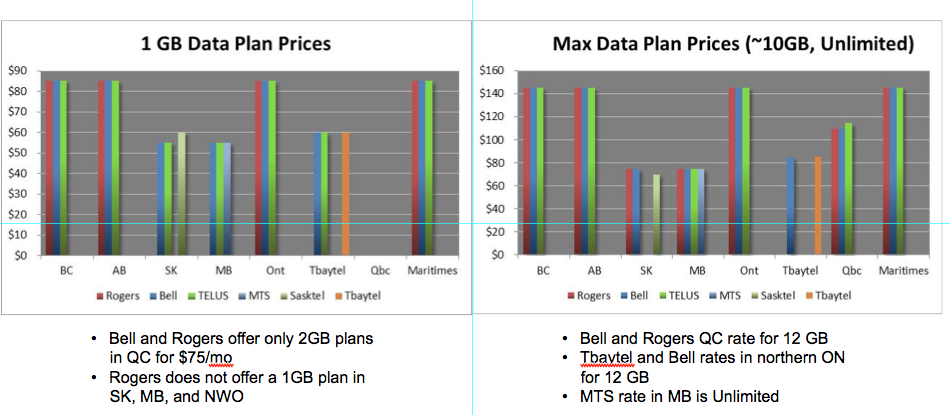
Source: MTS, SaskTel & tbaytel (2015). Telecom Notice of Consultation CRTC 2014-76 Review of Wholesale Mobile Wireless Services (para 25).
According to Bell and MTS, however, the deal is not about maintaining cheap but lower quality services at all. Instead, it is about bringing MTS out of the dark ages and into the future with an ambitious billion dollar investment program spread over five years to bring state-of-the-art fibre optic networks in Manitoba, increase the reach of Bell’s “world class” Fibe TV service, and to expand wireless 4G LTE network coverage in the province (BCE, Analyst Presentation, 2016, p. 6).
BCE’s CEO George Cope has been keen to emphasize that the market might become even more competitive after the deal. As he sees it, there will be three large firms competing even more aggressively after the deal than the current situation where MTS rules the wireless market with over half of all subscribers followed by Rogers with a third of the market share, trailed far behind by Telus (9%) and Bell (7%) (based on 2014 figures) (CRTC, 2014, unpublished data; also MTS, 2014 Ann Rpt, p. 7).
The intensification of “sustainable competition” would be especially likely, it is claimed, after Bell divests one-third of MTS’s wireless subscribers to Telus, as the deal envisions, according to Cope. The upshot is that instead of two strong competitors, MTS and Rogers, followed in the distance by Telus and Bell, there will be three “strong players”. Table 1 below shows the pre- and post-merger results.
Table 1: Mobile Wireless Carriers’ Market Shares in Manitoba Pre- and Post-Merger
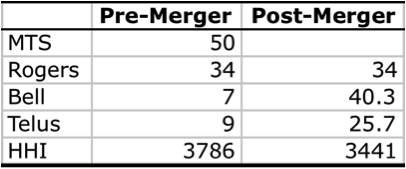
Source: MTS (2015). Annual Report 2014, p. 7.
According to this view, this is how dynamic competition works. Big players with deep pockets, staying power and know-how compete vigorously with one another on the frontiers of technological and service innovation rather than on the basis of “unsustainable price rivalry”. Regulatory economist Gerry Wall also chimed in to support this line of argument, telling the National Post that while MTS wireless pricing “forced the Big Three to match [its] low prices”, such a strategy is “unsustainable”. As Wall further added:
The aggressive pricing strategy has been successful in terms of keeping customers but I think it has taxed them financially – and the investment required for 4G and next gen networks is very challenging (quoted in Corcoron, 2016, “Good Riddance to Fourth Carriers”).
In simple terms, to focus on cheap prices now might sell Manitobans down the river in the long-run if MTS is not making enough money to build the infrastructure needed to support the province in the 21st Century. These are serious issues indeed, but are they right?
I don’t think so. In fact, as we will see below, while prices are low in Manitoba compared to much of the rest of the country, profits and capital investment at MTS are actually higher than Bell’s.
Why Even Imperfect Competition is Better than a Tight Oligopoly
BCE’s bid for MTS must obtain the blessing of three regulators: Innovation, Science and Economic Development (ISED, the recently renamed Industry Canada), the Competition Bureau and the CRTC. One of BCE’s main claims in favour of the deal is that it holds forth the prospect for sustainable competition if given the green light by regulators. Seeming to recognize that this is not a slam dunk, BCE and MTS expect the review process to take up to a year.
On the basis of the standard tools typically used to examine these things – i.e. Concentration Ratios (CR) and the Herfindhahl–Hirschman Index (HHI) – the case is doubtful. In terms of the CR measure, we will go from a situation where the top four firms control 100% of the market to one where three firms will do so.
While the distribution of market shares of Bell (40%), Rogers (34%) and Telus (26%) (see Table 1 above) that will result should the deal be approved does tally with Bell’s view of things, the HHI – which is specifically designed to assess competitive intensity – tells a different story. The HHI score will decline from 3786 to 3441, but the more urgent point is that this still indicates skyhigh concentration levels. Indeed, any result over 2,500 indicates extremely high levels of market concentration. This deal will do nothing to change that.
Even these points underplay the extent to which consolidation dynamics will likely be ramified by BCE’s takeover of MTS. For instance, while Bell presents its plan to divest a third of MTS subscribers to Telus as a magnanimous gesture intended to mollify regulators, this ignores the fact that the two have had a network sharing deal that covers the province since 2001 (see Klass, 2015).
Furthermore, Bell’s takeover of MTS could leave Rogers out in the cold given that it and MTS have paralleled Bell and Telus to build jointly-shared networks of their own. MTS and Rogers first joined forces in 2009, for instance, to build a shared HSPA+ mobile wireless network in Manitoba. Similar arrangements were struck again in 2013 to build a shared LTE network; in fact, before the takeover was announced, MTS already had plans in place to cover more than 90 per-cent of Manitoba’s population with 4G LTE wireless service by 2018 (MTS, 2013 AR, p. 12).
Where Rogers will stand once that agreement comes to an end, however, has so far gone unspoken. If Rogers is left out in the cold, then the circumstances will be worse than ever, with not even a full duopoly left, given Bell and Telus’ shared interests in the province. However, even if Rogers is taken care of, so to speak, the cozy oligopoly that now straddles much of the land will only be reinforced.
That already very high levels of concentration exist and could get worse is not a mystery. As Eli Noam (2013) observes, concentration levels around the world for these markets tend to be “astonishingly high” (p. 8).
What has made the difference is regulators willing to face up to such realities and deal with them accordingly. And a key element in such responses has been the adoption of fourth wireless carrier policies. Of course, there is no magic number in terms of how many players a market can sustain but experience shows that a fourth competitor helps to break dominant players’ tendency to fly as a flock in markets defined by a tight oligopoly.
The advent of four or more rivals, in turn, results in more competitive retail pricing as well as more robust wholesale access regimes and a virtuous circle of more competitors, greater pricing diversity and the advent of mobile virtual network operators, for instance – all of which helps to breakdown barriers to adoption. This is especially important in Canada with respect to mobile wireless services, where it ranks 32nd out of 40 OECD and EU countries (see Broadband Wireless Penetration sheet)
Moreover, the pursuit of the “fourth competitor” policy is far from being just a populist ploy, as some critics grouse. Indeed, with communication costs a key part of doing business within Canada and around the world, businesses are pushing for lower wireless and broadband internet prices. This is why such issues are pressing more urgently not just on Canadian policy-makers and regulators but also their international counterparts at the OECD and WTO as well (OECD, 2013, p. 21).
Profits @ MTS are High, Not Low
Claims that competition and low prices have been artificially sustained in Manitoba collide with the reality that profits at MTS are very high, not low, and much higher than BCE’s actually. Bell itself noted the point in its presentation to analysts, suggesting that MTS EBITDA rates were comparable to its own, i.e. in the 40% range (BCE, Analyst Presentation, 2016, p. 5).
However, even that low-balls the state of affairs. As a matter of fact, EBITDA at MTS has been considerably higher than those at BCE for the past six years for which data was examined. Table 2 below illustrates the point.
Table 2: Revenue and EBITDA @ MTS vs BCE, 2010-2015
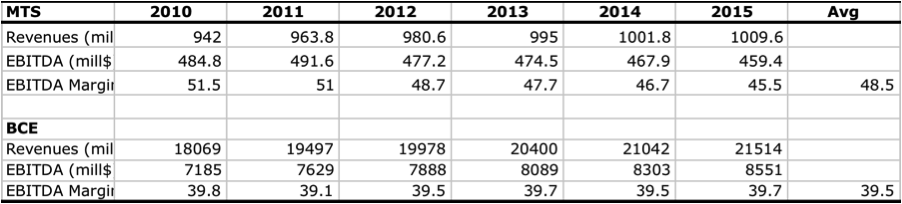
Sources: Company Annual Reports.
In short, MTS has maintained low prices while achieving profit levels that are even higher than those of BCE. The same story holds for capital investment.
Capital Investment @ MTS is Not Low but Higher than BCE’s
To hear BCE boss George Cope and MTS’s CEO Jay Forbes tell it last week, MTS is starving for investment capital because cheap prices have led to low profits. Consequently, MTS is at risk of falling behind when it comes to upgrading the information infrastructures that Manitobans will need to survive and thrive in the 21st Century.
The very high levels of profit – by the standards of BCE, the communications sector, and across Canadian industry as a whole – however, paints a very different picture. The evidence with respect to capital investment also belies the claims being touted in support of the deal. As a matter of fact, capital investment at MTS has also been higher than BCE in relative terms. Table 3 illustrates the point.
Table 3: Capital Investment @ MTS vs BCE, 2010-2015
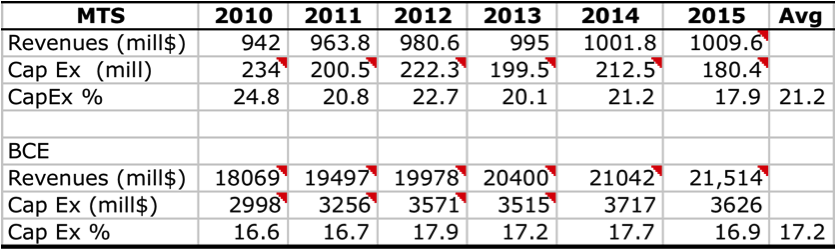
Sources: Company Annual Reports.
MTS has been investing in the range of $200 million for the past half-decade or more. At best, BCE’s commitment to spend $1 billion over the next five years will hold the line on what MTS has been investing. In other words, the deal offers nothing better than what is currently on offer and we can only hold our breathe that BCE follows through on its pledges, but on this score, its track record does not instil confidence.
Capital Investment in 4G Mobile Wireless Services
Without taking an overly rosy view of things, MTS has made substantial capital investments in fibre-to-the-node (FTTN) and fibre-to-the-home (FTTH) networks, and to expand its 4G HSPA+ and LTE networks in cities and communities across the province. Its 4G HSPA+ and ‘true 4G’ LTE wireless networks now cover 98% and 78% of Manitoba’s population, respectively (MTS, 2015, para 20).
The latter is less than the 86% coverage that Bell has achieved in its service areas in Ontario, Quebec and the Atlantic region (BCE, 2015, p. 10), but this reflects two things: first the more rural and dispersed nature of Manitoba’s population and, second, the fact that the deployment of new networks takes place in “step changes”, with early leads typically being transitory. In any case, the gap that currently exists will likely narrow during the next 18-24 months as MTS reaches its goal of 90% population coverage by 2018 (MTS, 2013 AR, p. 12). To the extent that this falls short of BCE’s aim for 98% coverage, BCE has not included any targets beyond those MTS has already made in its takeover bid.
If there’s any question about the quality of MTS’s LTE network, such concerns can also be allayed by its first place ranking by PCMag.com in 2013. Moreover, its network sharing deal with Rogers also allows it to obtain access to wireless devices that might otherwise be hard to get for smaller scale carriers like itself (MTS, 2014 AR, p. 6).
Leaders and Laggards and a World Turned Upside Down to Sell a Dubious Deal
Wireless investment is one thing, but MTS’s investment in highspeed broadband networks has been greater than Bell’s for years. Indeed, the irony of the deal now being pitched is that the laggard (Bell) seeks to take over the leader (MTS) when seen from the vantage point of broadband internet development in general, and fibre-optic based networks in particular.
In terms of residential broadband internet availability, for example, 95% of Manitobans have access to basic broadband from MTS at 5 mbps – the current broadband target set by the CRTC in 2011 — a figure that compares favourably with Bell in Quebec and Ontario (94% and 97%, respectively) but which is higher than in the Atlantic provinces, where access to 5 Mbps broadband ranges from 77% in PEI to 90% in NB (CRTC, 2014 CMR, Figure 2.0.5).
Turn our attention to more advanced fibre-based networks to the neighbourhood and the premise, and services that run overtop of these networks, notably IPTV, however, and the advantage tilts significantly in MTS’s advantage.
MTS began to roll out such services in 2003 and within a year the number of IPTV subscribers began to take off. Now, 70% of households in Manitoba have access to its IPTV service – Ultimate TV — and with internet speeds up to 50 Mbps, while FTTH is available in sixteen communities (MTS, 2014 AR, p. 12).
In contrast, Bell only began to deploy such services first in the Atlantic Provinces in 2009, followed a year later in Ontario and Quebec. Bell boasts that 7.5 million businesses and homes currently have access to its FTTN or FTTH network (Bell, 2015 BSO Submission, para 39), and that its Fibe TV is available to 6.2 million households (BCE, 2015 AR, p. 32).
These numbers may appear impressive at first blush but reconcile them with Statistics Canada data on the number of businesses and residential households in Bell’s service areas and a different picture takes shape: i.e. only about 60% of all households have access to Fibe TV, while less than two thirds of residential households and businesses have access to the company’s FTTN and FTTH network. In short, Bell was slower off the mark than MTS and continues to lag behind in terms of the uptake of these services. Table 4 below illustrates the pint. .
Table 4: IPTV Subscribers, 2004-2014
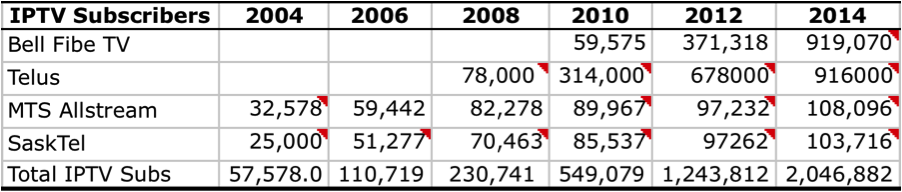
Sources: Company Annual Reports.
The uptake of the MTS’s Ultimate TV IPTV services has also been swifter than the take-up of Bell’s Fibe TV in its territory. Indeed, as Table 5 below illustrates, the take-up of MTS’s Ultimate TV is nearly twice that of Bell.
Table 5: IPTV Subscribers/Total Network Access Connections, MTS vs Bell, 2012-2014
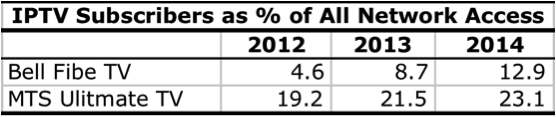
Sources: Company Annual Reports.
Small Cable Packages, Pick & Pay TV and Consumer Choice: MTS Subscribers are Already There
The fact that IPTV take up in Manitoba is high compared to the standards that prevail in Bell’s operating areas reflects the broader fight that has been taking shape over “cable TV” during the past decade. Indeed, the conservative versus more progressive views of Bell and MTS, respectively, also comes into focus when we look closer at their respective approaches to TV.
In this regard, Bell, the largest vertically-integrated telecoms-internet and media conglomerate in the country, and the biggest force in TV by far (61 TV channels and one-third of all TV revenue), has fought the CRTC tooth and nail over the regulator’s push to give people more choice over their cable TV subscriptions by mandating the offering of “skinny basic”, pared down channel bundles and, by the end of 2016, true ala carte channel offerings. Indeed, having banked on the vertically-integrated model through its take-over of CTV and Astral in 2011 and 2013, respectively, Bell has been loath to yield control over its TV operations.
MTS, in contrast, is not vertically-integrated, and having taken the plunge into the TV delivery business with the launch of its IPTV services since 2003-2004, it has been eager to pick up subscribers as swiftly as it can. To this end it has been successful, with twice the number of subscribers on a per capita basis as Bell (see Table 5 above). And as part of this effort, MTS has been offering smaller TV packages for several years and even some of the most popular sports channels on a pick-and-pay basis.
Thus, as the company states in its most recent Annual Report about the CRTC’s Talk TV rulings last year:
. . . Because we offer a number of services on a standalone basis today, the changes to our systems to introduce pick-and-pay by December 2016 should also be relatively simple to implement (p. 25).
Yet, while MTS has been ahead of the curve, it also notes year-after-year that access to programming, especially high-end entertainment and sports programs, has been extremely difficult. Why? Because:
Much of this content is created and/or owned by our competitors (Bell, Rogers and Shaw), who could have conflicting interests when we negotiate for their content. To date, the CRTC has offered broadcasting distributors such as MTS limited protection against attempts by our competitors who own this content (for use in both traditional television and mobile applications) to charge us unfair rates or deny us access to this content altogether (emphasis added, MTS, 2015 AR, p. 25).
In other words, the CRTC’s attempts to introduce more competition and flexibility have been met by fierce opposition from Bell, which has turned to Cabinet and the courts in a series of bids to overturn these moves. Smaller, non vertically-integrated entities such as MTS, however, have seen the regulator as offering too little, too late.
Data Caps: Hesitant Use at MTS versus Major New Revenue Stream and Broadcast TV Protection Tool @ BCE
Another significant area where MTS has distinguished itself from Bell is in the use of data caps. As MTS comments,
. . . We are the only provider in Manitoba to provide unlimited data plans. With MTS, our customers can surf, download and stream all they want on our Internet and wireless services without worrying about paying overage charges within Manitoba. Our wireless networks, coverage and experience are all built to make it easy to stay powered and connected (MTS, 2014 AR, p. 7).
At Bell, in contrast, data caps are prevalent and so-called overage charges steep. Whereas MTS has been hesitant to use data caps to limit how people use the mobile wireless and internet access they pay for, Bell uses restrictive data caps routinely as a lucrative new stream of revenue and to protect its highly leveraged investments in broadcasting from the onslaught of over-the-top streaming service such as Netflix, Spotify and so forth.
This point strikes at the heart of Bell’s bid to acquire MTS because, as the telecoms consultancy Rewheel (2015) has shown, in markets that go from 4 to 3 wireless carriers, not only do prices tend to rise steeply but data caps become smaller and the cost of data on a per GB basis far higher. BCE’s take-over of MTS threatens to take a situation that is already exceptional by international standards (i.e. the prevalence of data caps is comparable in only three other OECD countries: Australia, Iceland and New Zealand) from bad to worse.
In sum, with data caps much less common and the cost per GB much lower in Manitoba than in most of Bell’s operating territory, the potential for similar results to take hold in Manitoba are great, especially with the CEOs and financial officers of both firms openly talking about the desire to drive up ARPU at MTS.
Some Concluding Observations and Options for What Might be Done
To be sure, one has to be careful not to idealize conditions in sunny Manitoba versus those in Bell’s operating territories. Indeed, not all is just fine in Manitoba.
The CRTC’s review of basic telecommunications service, for example, heard from one intervener after another that broadband access in both companies’ operating territories leave much to be desired. Yet, neither company appears eager to rectify the situation unless a strict business case can be made to do so. Moreover, while BCE and MTS executives have waxed on at length about how to raise average revenue per user (ARPU) at MTS, they have had little to say about how rural service might be improved (BCE, Analyst Presentation, 2016, p. 6).
The contention that conditions in the province lag those in Central and Eastern Canada, however, and that Bell will ride to the rescue of a beleaguered provincial carrier down on its knees due to populist pandering through cheap services that have undercut the potential for dynamic competition and innovation over the long run, is woefully misleading. There is no evidence that competition will become more intense on account of a marriage of the two companies, especially if Bell hands off a third of MTS’s mobile wireless subscribers and retail stores to Telus. This will be doubly certain without any game plan to ensure Rogers maintains network access comparable to what it currently has in Manitoba, but even then that would do little more than keep the tight oligopoly alive, and there is little to commend such a policy.
Furthermore, there is little to no evidence of a profit crunch at MTS disabling its ability to invest substantially in the information infrastructure needed to support the Digital Economy in the 21st Century. In fact, profit and investment levels are higher at MTS than at BCE, while prices remain substantially less in Manitoba compared to BC, Alberta and Ontario where the dominance of the big three remains solid. Despite the significantly lower prices in the province, ARPU levels at MTS are consistent with those elsewhere in Canada, implying that cheaper rates are leading to more use – exactly what the aim of good communication policy should be. Any takeover of MTS by Bell would likely see such realities quickly overtaken by Bell’s preferred model where expensive prices, restrictive data caps and high ‘overage charges’ are the norm.
So, what’s to be done? From easiest to hardest, at least in terms of political will, four options seem possible. They are:
Option #1: Do Nothing
Accept the deal as proposed by Bell with the divestitures to Telus and maybe some minor tinkering around the edges.
Option #2: The OFCOM Solution
In this scenario, Canadian regulators could join forces to arrive at a solution similar to what Ofcom did in 2011 when faced by a reduction of five mobile wireless competitors to four in the UK market. In that case, when Orange (France Telecom) and T-Mobile (Deutsch Telecom), the 3rd and 4th biggest players in the market, respectively, proposed to merge in 2011, the UK telecoms and media regulator blessed their merger on the condition that the new entity – Everything Everywhere (EE) — hand over a quarter of its prized LTE/4G spectrum to the number four player, Hutchison 3. The two other largest players – Vodafone and O2 – complained bitterly, but to no avail, and with access to spectrum, towers and other resources needed to be viable, 3 stepped into the breach to become a significant 4th player in the UK market ever since.
In the present situation, Bell’s plan to divest subscribers to Telus might look good on paper but ignores their long-standing network-sharing agreement. In the eventuality that Bell does acquire MTS, steps might be taken that simultaneously prevent Rogers from being frozen out the market once its network sharing agreement with MTS comes to an end while going further to support Telus as a larger force in the province at the same time as a new 4th player is encouraged.
Yet the chance of a new 4th player emerging in Manitoba are slim given that the most likely candidates, e.g. Shaw and Wind, already showed little interest in entering the province before the latter was taken over by the former. Indications since are that their reluctance to launch in Manitoba has, if anything, hardened. Shaw, for instance, transferred the 1700 MHz AWS spectrum it acquired at discount rates in 2008 as part of the government’s bid to cultivate new entrants to Rogers in 2014, while Wind sold 15 MHz paired AWS-1 spectrum to MTS last year (MTS, AR 2015, 6).
Thus, while potentially the most interesting and earnest option on offer, the hope of keeping four players alive — the “Ofcom Solution” — is probably the most complicated and least likely to work.
Option #3: Double-down on the open access and regulated wholesale access rules while promoting Mobile Virtual Network Operators (MVNOs)
Given that the second option is unlikely to succeed, and the reasonable prospect that a combined Bell-Telus arrangement and a marginalized Rogers might lead to an even tighter oligopoly than that which already exists in much of the rest of the country – i.e. with effectively 2.5 players – regulators might double down on the CRTC’s wholesale mobile wireless ruling from last year, while expanding it to include stricter access to towers, backhaul and for MVNOs.
Strict limits on the use of data caps might also be imposed. They might even be banished for a period of time, as the FCC recently did as a condition for blessing Charter Communications’ acquisition of Time Warner Cable and Bright House Networks (see here).
Option #4: Kill the deal
If evidence and rational argument were our guiding light, then the most palatable option – but also perhaps the most politically difficult, especially given Bell’s intensive lobbying of the new government some thirty-two times in the seventeen weeks since the Liberals have been in power – would be to simply kill the deal.
With concentration levels already sky high, it would be unseemly to bless more consolidation. This is especially so with the CRTC and Competition Bureau having found on several occasions in the past year that Bell, Rogers and Telus have significant market power in the mobile wireless and wireline markets and that they have used such power to do everything they can to give new rivals a still birth. Both regulators also arrived at similar findings on the TV side as well, to which the CRTC’s series of TalkTV decisions are a response.
Without these remedies having yet had time to produce the desired results, and Bell – more than most – fighting them tooth and nail every step of the way, giving it the green light to buy MTS would be akin to blessing bad behaviour. Moreover, Bell’s attempt to tee up a take-over of MTS within this context is a sure sign of hubris, and reason enough to turn it back.
A Radical Broadband Internet & Cultural Policy for Canada
This post responds to last weekend’s announcement by Canadian Heritage Minister Melanie Joly of a top-to-bottom review of Canadian broadcast, arts and culture policy. It’s also informed by the CRTC’s #TalkBroadband review where it is wrestling with the vital question of whether universal, affordable basic telecoms services should be expanded to include broadband internet access and, if so, at what standards of speed, quality and affordability, and who should pay for it all?
Both events offer enormous opportunities for good things to happen, but also for much mischief, especially if those who have been lobbying the new government day and night since it arrived in office last November get their way. Indeed, Bell has lobbied various arms of the new Trudeau government thirty-two times – nearly twice a week! — between the time it took power in November and the end of March (Office of the Commissioner of Lobbying of Canada). In light of this, while careful and considered thought is essential, there is no time to waste.
In this post, I want to do three things:
- outline the scale of the media economy and the state of concentration and vertical integration across the telecoms, internet and media landscape in Canada – the bedrock upon which all else unfolds;
- discuss what regulators and policy-makers have done in response to these conditions so far and broader policy issues related to broadband internet, mobile wireless and broadcast policy; and
- conclude with five modest proposals, one large one and one radical suggestion about what might be done to close the gap between how things are and what we might want them to be.
A Lay of the Land: Bigger Players and A Bigger Pie
While the Canadian media economy is small by US standards, it is amongst the biggest dozen or so in the world. The telecoms, internet and media markets in Canada have nearly quadrupled in size in the past thirty years. Total revenues were $75.4 billion in 2014.
Is media ownership concentration in Canada high?
Yes, based on historical, international and conventional economic measures (see the CMCR Project’s Media and Internet Concentration in Canada, 1984-2014 report).
Is the level of vertical integration in Canada high? Yes. The top 4 Canadian vertically-integrated (VI) companies’ – Bell, Rogers, Shaw, QMI, in that order — share of all telecom, internet and media revenues is 57%.
Figure 1: The “Big 4” VI Companies’ Share of the Media Economy, 2014
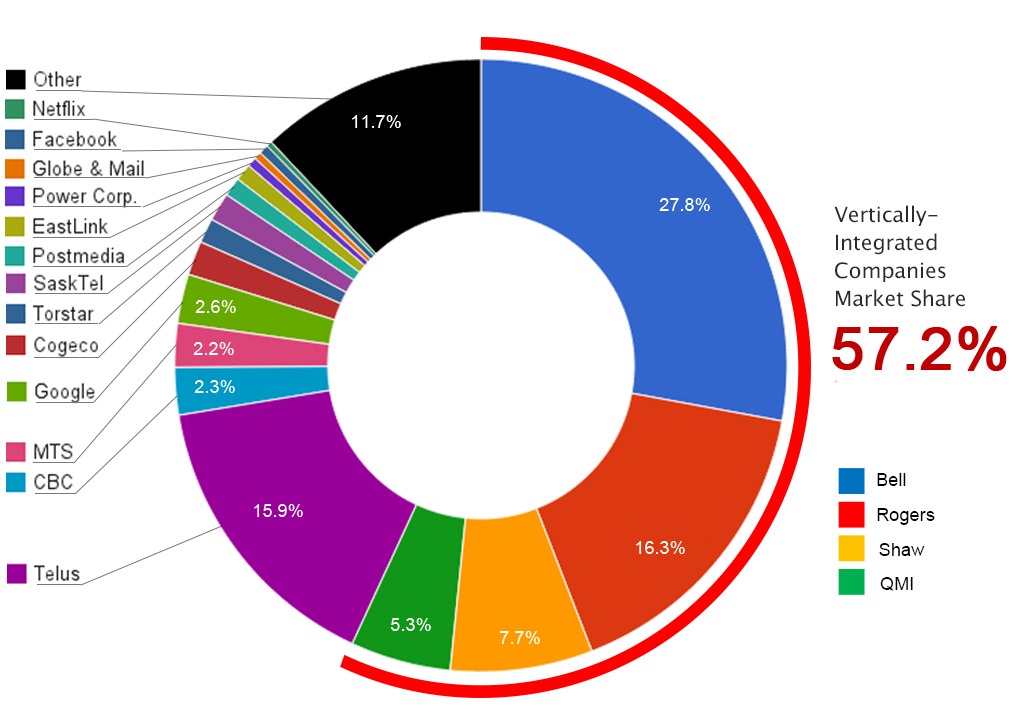
Sources: CMCR Project Media Industry Data.
This is significantly higher than the top four VI companies in the US (40%): AT&T (DirecTV), Comcast, Charter (including Time Warner & Bright House) and Cox. Figure 2 below shows the state of affairs before yesterdays amalgamation of Charter, Time Warner and Brighthouse was approved.
Figure 2
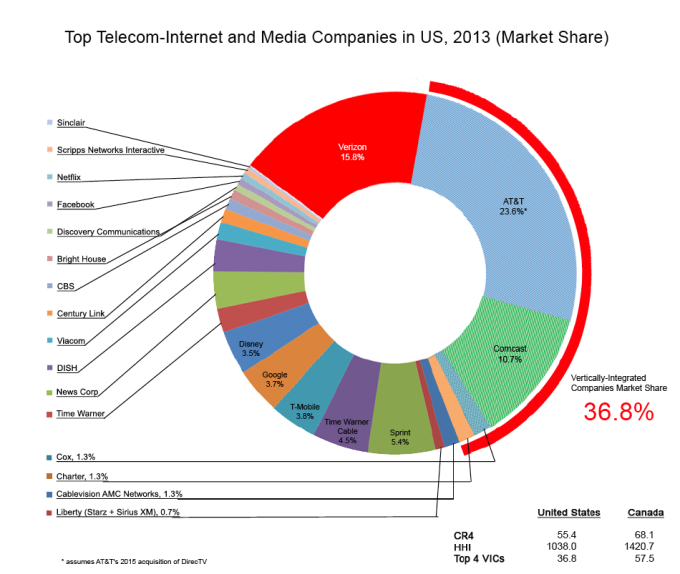
Sources: Company Annual Reports.
Canada ranks at the very top of the list of 30 countries studied by the IMCRP in terms of vertical integration (see here and here).
The big Canadian telcos – except Telus – all own substantial television operations, sports teams and arenas, and so forth. Other than AT&T’s recent acquisition of DirecTV, most US telcos do not own their own television and film operations: Verizon, Frontier, Centurylink, T-Mobile. Besides AT&T, there are no telcos on the list of four biggest vertically-integrated companies in the US.
But what about Google, Facebook and Netflix? Their combined share of all media revenues in Canada is less than 4 percent – as of 2014 (see CMCR Project Workbook “Top 20 w telecoms” sheet).
Are Canada’s vertically-integrated media companies too big to regulate? No.
Are they being regulated effectively? Not as effectively as they might be.
Do regulators have justifiable reasons to intervene? Yes.
Concentration and vertical integration levels are high and the companies’ abuse of their market power is now a conclusion of fact, not conjecture.
Wireless markets are under-developed; prices per GB on wireless and wireline networks are high; speeds relative to comparable international peers are high for wireless, modest for wireline. Adoption is moderate for the latter, but extremely low for the former (mobile phones) (a series of international price, speed, access, adoption and subsidy comparisons can be found here)
People in Canada are voracious users of the internet and all kinds of media, and have long been so (see Cisco’s Visual Network Index Forecast, 2015-2020, for example). Still, however, they must also measure what they watch and do with these vital tools of modern life because of the high cost of a GB in Canada and the prevalence of relatively low data caps on wireless and wireline networks.
Restrictive data caps reflect the high levels of vertical integration in Canada and serve to protect the VI giant’s broadcast operations from streaming services like Netflix, etc. Just two days ago, in contrast, the FCC in the US approved the take-over of the Time Warner and Brighthouse cable companies by Charter but only on condition that it commit to not using data caps for the next seven years. This was done specifically to remove an barriers to the further development of over-the-top video services like Netflix, Amazon Prime, and unbundled services from CBS, Viacom, HBO, the NLB, and so on (see here, here and the WSJ).
In Canada, the CRTC gave provisional blessing to data caps back in 2009. However, they have gone from being used sparingly to manage internet congestion to become a steady and lucrative new stream of revenue for Bell, Rogers, Telus and Videotron ever since (Shaw advertises data caps but does not apply them). Canadians loathe data caps and the expensive “overage charges” they entail. Data caps send a dumb message as well: that somehow we are using “too much internet”.
While Shaw distinguished itself on this point when appearing before the CRTC on Tuesday, it has been discouraging to listen to Bell, Telus, MTS, SaskTel, Bragg and the small indy telcos talk about the need to scrimp on how much internet people use and the speeds that should be available. Their visions of what Canadians deserve as part of a universal basic broadband service is myopic and wholly uninspiring.
The extensive reliance on relatively low data caps in Canada constrains what and how people watch TV, listen to music, communicate with one another over the internet and mobile devices, and work. As part of human experience, and critical infrastructure for society and economy writ large, this is a problem.
Information and cultural goods are public goods and paying for them out of the public purse is reasonable and ought to be pursued but commercial media stand steadfastly and vocally opposed to any such expansion of public communication. I propose that we amalgamate Canada Post with the CBC to create the Canadian Communications Corporation, the combined result of which could operate as the 4th National Wireless Company, Broadband Provider in remote, rural and under-served urban communities, and Public Broadcaster rolled into one.
Netflix and Google should be able ply the land free as they like within the usual bounds of the rule of law with respect to market power, privacy, copyright, free speech, etc.
It is not unreasonable, however, to talk about levying a “public data resource” royalty on Google in return for giving it a free hand in gathering all the data from our ‘human’ and natural resources that it uses to run Google Search, Android, Google Maps, Google Earth, Google Books, etc. Such a levy could be used to restore some of Statistics Canada’s funding and technical expertise, and the long-form census. At the very least, foreign internet firms operating in Canada should pay taxes like the rest of us. Indeed, rumour has it that Canada is the only country where Netflix doesn’t pay any taxes. Western University Professor Sam Trosow is right: we must think about information policy in a holistic way.
Whereas the Competition Bureau folded in its antitrust investigation of Google last week the day before the European Commission opened up a second prong in its antitrust case against the digital behemoth – the first with respect to its dominance of EU search markets, where it often has a market share over 90%, the latest a new front targeting Google’s leveraging of its Android operating system to gain prime real estate on people’s mobile devices for the its Play Store, Chrome Browser and Search to the exclusion of other competitors and a different range of preloaded functions, capabilities and apps – there is still time to take another look in light of the fuller view being brought into focus by Joly’s DigiCanCon review and the CRTC’s ongoing #TalkBroadband proceeding. We need a “whole of government” approach, and so far, that is missing in action.
What are regulators doing?
They are:
Unbundling the Network: Partially. Hesitantly. . . . Slowly turning from a systems and broadcast-centric view of the world to a lego-land, telecoms-internet-mobile wireless centric view of the world – skinny basic, untied streaming tv services like Shomi and Crave, and pick-and-pay TV are just the start (for an early vision along these lines, see Huber’s The Geodesic Network II).
The CRTC and the previous government have made the high levels of concentration in mobile wireless, broadcast distribution undertakings (DBUs) and television a centre-piece of their proceedings and policies.
They are rediscovering market power
The CRTC called a spade a spade in its Wholesale Mobile Wireless decision last year, for instance:
Bell Mobility, RCP [Rogers], and TCC [Telus] collectively possess market power in the national market for GSM-based wholesale MVNO access (CRTC 2015-177, para 88).
The Competition Bureau’s findings were crucial to this outcome, although its appearance before the CRTC hearing on the matter was abysmal.
They have rediscovered and applied section 27 of the Telecommunications Act in three cases: Wholesale Roaming investigation 2014-398; Wholesale Mobile Wireless Decision 2015-177; Mobile TV 2015-26.
The Wholesale Roaming investigation 2014-398 found that wholesale mobile wireless roaming rates were “clear instances of unjust discrimination and undue preference”; banished exclusivity provisions in wholesale roaming agreements; and opened a wider examination into wholesale mobile wireless services that led to the second-shoe falling, the Wholesale Mobile Wireless Decision 2015-177.
In Wholesale Mobile Wireless Decision 2015-177 the CRTC re-asserted its authority to regulate wholesale mobile wireless facilities and rates, set temporary caps on wholesale roaming rates and called a Phase II costing proceeding upon which it will set out new guidelines for wholesale wireless roaming rates.
The Mobile TV 2015-26 Decision did four things.
- it found that Bell and Videotron were giving themselves “an undue and unreasonable preference” by “providing the data connectivity and transport required for consumers to access the mobile TV services at substantially lower costs . . . relative to other audiovisual content services”.
- the CRTC concluded that this was bad for competition, the development and growth of new OTT services, and for consumer-citizens.
- it drew a sharp line between transmission (common carriage) and broadcasting (content). In so doing, it forced Bell, Shaw and Rogers to bring their Mobile TV offerings into compliance with some of the common carrier principles flowing from section 27 of the Telecommunications Act.
- it acted on the well-founded and meticulously researched and formulated complaint by a citizen and now Ph.D. student in the School of Journalism and Communication at Carleton University, Ben Klass.
Return of the State and Zombie Free Markets
That the previous government’s actions and ongoing regulatory intervention in the market is substantial in Canada is beyond doubt. At the same time, however, this is not unique. We have seen the “return of the state” in many countries. In the real world, the effective operation of “real markets” depends on the rule of law and the firm hand of independent regulators, back-stopped by, yet independent from, politicians, policy makers and the Ministers whose bailiwick it is to see that good things happen (in this case, this is Minister Navdeep Bains at Innovation, Science and Economic Development and Minister Melanie Joly at Canadian Heritage).
In terms of what has been done in recent years, we have had spectrum auctions aplenty, explicit spectrum set asides for new cellcos, regulated wholesale mobile wireless roaming rates, adoption of the Vertical Integration Code, the stripped down ‘skinny basic’ TV with a price cap, the push to keep over-the-air TV alive in so that the digital switch over of a few years back might bear fruit and become a thorn in the side of cable, satellite and IPTV companies whose rates continue to climb much faster than inflation, and the forced unbundling of tv channels.
All of these steps run counter to some of the companies’ – especially Bell and Shaw, but less so Rogers and QMI — ‘walled garden/information control’ models of operation. Having banked on such a model (and with the banks, especially RBC, holding significant ownership stakes in most of the key players), the push back against these efforts to limit the companies’ ambitions are coming from some of the most powerful forces in the land. Such push back can be seen, for example, in:
- Bell’s recurring editorial interventions in the country’s biggest TV and radio news media outlets;
- litigation (e.g. against the Mobile TV, Wireless Code, Superbowl Simsub rulings from the CRTC);
- a Petition to Cabinet to overturn the CRTC’s forward looking wholesale access to fibre-to-the-X ruling;
- threats of capital investment strikes and a bevy of other efforts to turn back the tide.
So what are the limits to this newly interventionist Regulatory State?
First, while the CRTC has rediscovered section 27 of the Telecommunications Act – the no undue preference clause – we must remember that it is followed immediately by section 28, which those in the know see as saying that carriers cannot give undue preference EXCEPT when doing so advances the objectives of the Broadcasting Act. This puts the best bits of the telecoms act at war with itself and risks subordinating telecommunications – broadband internet, basically – to broadcasting.
Such waffling runs counter to the principles of telecommunications upon which the open internet and mobile phones are built — tried and trued principles that come down to us in section 36 of the Telecommunications Act from Roman Roads, Venetian Canals, and the Taxis family courier service in medieval Europe.
Moreover, while one might argue that section 36 should be the crown jewel of the Telecommunications Act, there has been an extreme reluctance to use it. Why?
Regulatory hesitancy seems greatest on this point. This is evident in its almost complete lack of use during a time when those who own the media have become so inextricably intertwined with the ownership and control of messages. It is also evident in the exception carved out for over-riding this principle if it meets some ill-defined objectives of the Broadcasting Act. It is time to wheel section 36 out of storage and put it back in place as the crown jewel around which the entire set-up of the evermore internet- and mobile wireless-centric universe revolves.
This hesitance was also visible in the Mobile TV, a case in which content — and the carriers’ control of it — is very much front and centre. While drawing a sharp line between carriage and content, however, the CRTC refused to reach for the bedrock of common carriage: section 36. This seems to mark the outer limits of where it seems willing to go and in continuation with the fact that this section has been largely dormant over the years.
While the decision to kick some new life into section 27 is to be applauded, and the increased willingness to constrain the power of vertically integrated companies by loosening their grip over the basic building blocks of the network media ecology – spectrum, wholesale mobile wireless facilities and roaming rates, data transport and content – and sharpening the lines between carriage and content is great, much more is needed.
Like what?
5 Modest Suggestions + 1 Big One + 1 Radical One.
- Eliminate section 28 of the Telecommunications Act;
- Eliminate section 4 in the Broadcasting and Telecommunications acts so that both pieces of legislation can talk to one another (we don’t need new legislation and any attempt at such will only ensnare us in interminable delay and special (corporate) interest pleading;
- Breathe new and vigorous life into section 36 by firmly separating control over the infrastructure from influence over the messages / content flowing through the pipes / ether. Sharpen and harden the line between carriage and content. Any proposals to use a levy on ISPs and mobile phones to fund CanCon should be given a stillbirth. While the entrenched clients of the existing broadcasting system never miss a beat to promote “the ISP tax”, these ideas are out of synch with the times and the tastes of the people. They are anti-internet and prolong “a systems” view of the world that conceals a murky labyrinth of cultural policy funds flowing from one pocket to another, often within the vertically-integrated companies.
- Impose vertical separation along functional lines between carriage and content, and between wholesale access to passive network infrastructure and network operators and retail telecoms service providers.
- Transfer authority over spectrum from Industry Canada to CRTC.
1 Big Proposal
- Eliminate the whole category of broadcast distribution undertakings (BDUs) upon which the cable, satellite and IPTV industry is based. It’s all telecom-internet access and carriage now. Take the funds funneled into the Canadian Media Fund from BDUs directly out of the general treasury.
More generally, we need to think about bringing subsidies for broadband connectivity into line with funding for the CBC and Cancon. Currently, the CBC receives $33 per person per year, with nearly three-quarters of that amount again for the arts and culture at large. Broadband internet subsidies, by contrast, are a comparative pittance at roughly $2 per person per year.
I do not think that Canadian citizens would chafe at upping that amount to somewhere between what Sweden spends on broadband internet access subsidies (an average of $5 per person per year) and the CBC ($33 per person per year) (see sheets 3 & 4 here). Any bid to pare back the CBC and other arts and culture funding should be dismissed out of hand. We are not big spenders when it comes to arts, culture and Cancon, and generally at the lower end of the scale. In short, there’s little room for cutting, although how subsidies are organized, allocated and used are other matters altogether and surely up for grabs under the sweeping review that Minister Joly is spearheading.
1 Radical Proposal: The Canadian Communication Corporation (C3)
Merge Canada Post with the CBC to create the Canadian Communication Corporation (CCC) with a mandate to become the fourth national mobile wireless provider; blanket cities with open access and light up the vast stock of under- and unused municipal dark fibre; extend public wifi; extend broadband internet access to under- and unserved people in rural, remote and poor urban areas; create, disseminate and make public art and culture as accessible and enjoyable as possible, and fund it from the treasury not by an opaque labyrinth of intra- and inter-industry funds overseen by a fragmented cultural policy bureaucracy.
The original goal of the U.S. Post Office was to bring “general intelligence to every man’s [sic] doorstep”, while also serving as a heavily subsidized vehicle for delivering newspapers (John, 2010; Starr, 2004). The CCC could be to the broadband internet and mobile-wireless centric world of the 21st century what the Post Office was to the print world of times past.
The CCC could repurpose some of the CBC’s existing spectrum holdings and broadcast towers for mobile wireless service coast-to-coast-to-coast, real estate could be combined and used to site towers, local post offices used to sign up cellphone subscribers and sell devices, and Canada Post vehicles given more windshield time making sure that the country’s system of correspondence, communication and parcel delivery run as they should.
Postal workers are giving some thought to renewing the post office for a broader sense of purpose, but have not ventured into this territory — yet; at the same time, informal discussions with some Canada Post senior execs suggest that this isn’t the first time they have heard of such ideas. Equally important, I don’t detect any inherent hostility against them.
Maybe it is time to discuss a #RadicalMediaPolicy4Canada? With two official proceedings underway, maybe we can broaden the terrain with a third?
* This post reworks ideas first presented at the Forum for Research and Policy in Communication’s Rebooting Canada’s Communication Law at the University of Ottawa, May 22, 2015. Thank you to Monica Auer for inviting to present there.
Telus Trifles with Telephone History to Service its Constrained View of Universal, Affordable Broadband Internet Access Today
Setting the Stage
Today, the CRTC enters week two of its major review of affordable basic telecoms service in Canada. The key issue? Whether universal, affordable basic telecoms services should be expanded to include broadband internet access and, if so, at what standards of speed, quality and affordability, and who should pay for it all.
Some of us argue that the goal of affordable, universal broadband service needs to be defined broadly. Others, such as Telus, argue that it should be drawn very narrowly to include only services based on needs not wants. In Telus’ restrictive view of the world, basic broadband internet access should support email, web browsing and maybe a couple of e-commerce activities but not over-the-top video services or H-D two-way interactive gaming. If the CRTC is to adopt a broadband speed target at all, Telus says, it should be no more the 5 Mbps down, 1 Mbps up (see its second intervention, paras 90-91).
To support its view, Telus hired two experts to critique the work submitted by those who argue for the more expansive view, including that of your’s truly. The gist of my submission is that affordable universal service is a concept that is not static but changes with developments in technology and society. I also argue that the politics of universal service involved in working this out are coterminous with the history of general purpose communications networks from the post office to the telephone and now the internet.
In the US, for example, this began with the post office starting with the Postal Act of 1792, and whose mandate was “to bring general intelligence to every man’s [sic] doorstep”, while also serving as a heavily subsidized vehicle for delivering newspapers across the country with the aim of helping the nation’s journalism flourish (John, 2010, p. 20; Starr, 2004). In short, universal postal policy was also about press, information, social and economic policy, all rolled into one.
I then argue that people agitated for such goals in relation to POTs (plain old telephone service), libraries and broadcasting. That they are doing so now in relation to broadband internet access is no surprise.
Indeed, in Canada and the US people pushed hard to transform the telephone from the late-19th and early 20th centuries from a luxury good and tool of business and government into a social necessity (Pike & Mosco, 1986), and a popular means of interpersonal communication. In an all-IP world, people are building upon this history by not only bringing intelligence to every citizens’ doorstep but by helping to make that doorstep the perch from which we can see and speak to the world.
Hired Guns, Weird Timeframes and Looking for Keys Under Lampposts
In line with Telus constrained view of basic service, its hired expert, McGill Political Scientist Richard Schultz writes that we need to clear away the many misconceptions and myths that exist about how “universal service became part of Canadian regulatory and policy debates” (para 2). Taking aim at my intervention specifically, Schultz asserts that
. . . perhaps no single statement in the various submissions epitomizes the problems . . . than the following from the Canadian Media Concentration Research Project first intervention: “Policy makers have struggled for over 100 years how best to achieve universal telecommunications service” (para 4).
Purporting to set the historical record right, Schultz argues that we need to do two things: first, to look at the period “from 1906, or more precisely 1912” up to around 1976, followed by another thereafter” and, second, search for explicit statutory statements where universal basic service is set out as a formal legal requirement for basic service, with the assumption being that the absence of such statements means that there’s never been such an idea in Canada and that claims to the contrary are just hollow rhetoric.
After doing what is akin to a text search of the relevant laws and coming up empty handed, Schultz concludes that there never were such politics over, or legal basis for, universal service in the late-19th or early-20th centuries and, in fact, that such issues were largely ignored. To the extent that such issues were given attention at all, he argues, the impetus came from enlightened corporate leaders at Bell and other telephone companies rather than politicians, policy makers or the public at large – in other words to the extent that universal service existed at all, it was an act of noblesse oblige (paras 5-9). Moreover, according to Schultz’s telling, to the extent the regulators and policy makers have played a role in bringing it about, universal service is of recent vintage.
Shultz’s arguments are curious for two reasons. First, the date that he begins with ignores vitally important points that predate 1906, while ignoring or giving short shrift to events within his selective timeframe. Second, the idea that a text search for “universal service” in the relevant legislation that comes up empty handed supports the conclusion that the idea was non-existent is like the proverbial drunk looking for their keys under the lamp post.
History Cut Short: Looking Just Outside the Weird Timeframe . . .
Let’s deal with the start date that Schultz selects first, i.e. 1906. This date is plausible because this is when telephone companies were brought under the remit of the Railway Act of 1903 and the purview of the first regulatory board in Canada, the Board of Railway Commissioners. Yet, starting in 1906 is fundamentally wrong for many reasons. For one, if we start just a few years earlier, we see that the adoption of the Railway Act was predicated on the idea that there are certain industries so fundamental to the economic and social life of the nation that they are imbued with a public interest and an “obligation to serve”. Railways came first, telegraphs and telephones next.
Statements aplenty to this effect underpin the legislative history of the Railway Act, and when telegraph and telephone companies were brought under its purview three years after its adoption the same principles automatically applied. Thus, when the Railway Act was expanded to include telephones in 1906, there was no need to be explicit about the “obligation to service” because that was baked into the statutory basis upon which railway, telegraph and telephone regulation was based. In short, there was no need to state the obvious.
The classic text on such matters, Alfred Kahn’s The Economics of Regulation: Principles and Institutions, provides an excellent introduction to businesses cloaked with a public interest, their obligation to serve, and the role regulators play in using the best available knowledge and experience to decide how such matters will be dealt within in any particular instance (see pp. 3-5, for example). These are the guiding rules and principles of regulation, not legislation, although regulators’ authority to do what they do is and must be grounded in laws that give them the authority, mandate and legitimacy to take the steps they do.
Schultz’s start date of 1906 is especially odd given the monumental inquiry into the telephone industry convened just one year earlier – 1905 — by the Liberal Government of Prime Minister Wilfrid Laurier, otherwise known as the Mulock Committee, after its chairperson and Postmaster General at the time William Mulock. The Mulock Committee helps to put the CRTC’s review of the basic service obligation in perspective given that while the Commission will hear from 90+ intervenors over three weeks, the Mulock Committee heard from many more during its forty-three days of hearings and thousands of pages of testimony.
As part of the public record, it received interventions from members of the public, co-operatively run telephone companies, municipal governments, foreign telephone systems and experts, and Bell management, among many others. It was an enormous undertaking, and one that underscored the fact that achieving some measure of public control – i.e. regulation in the public interest — over the telephone network was of the utmost importance.
Contra Schultz and Telus’ claim that issues of universal service were missing in action during this early period of telecommunications history, voices aplenty called for accessible and affordable telephone service at this time, not just for the business classes who were its main users but for all classes of the public. One among many, the Manitoba Government’s submission, for example, highlighted these points as follows:
. . . the telephone is . . . one of the natural monopolies, and yet is one of the most . . . necessary facilities for the despatch of business and for the convenience of the people . . . .[T]he price . . . should be so low that labouring men and artisans can have convenience and advantage of the telephone, as well as the merchant, the professional man and the gentleman of wealth and leisure” (Manitoba Government to Mulock Committee in 1905, quoted in Winseck, 1998, p. 137).
If this is not a call for affordable service, I am not sure what is. The only reason they are missing for Schultz and Telus is because such activities fall outside of their self-selected – and odd — time frame that begins a year after the biggest inquiry into the telephone and public service in the 20th Century occurred (except maybe the proceedings dealing with the introduction of competition in the last twenty-five years of that century).
We can also go well beyond 1906 and the Railway Act, or 1905 and the Mulock Telephone Inquiry, to the first days of the Bell Telephone Company of Canada’s operations to add further insight into the history of universal telecoms service. Thus, in 1882, Bell’s founding charter was revised to include the touchstone phrase that its operations were to be conducted and overseen by the federal government for “the general advantage of Canada”.
A few years later, and a decade before the United States pursued the same course of action, the federal Patent Commissioner voided Bell patents because Bell was not making enough use of its equipment in Canada and blocking access to those who might (see MacDougall, 2013, p. 43). Municipalities also chafed — and told the Mulock Committee as much – at how their weak powers under the federal government’s authority and the “general advantage of Canada” idea in Bell’s charter constrained their capacity to grant competing franchises, regulate rates and adopt other methods that might help extend the telephone beyond a small number of business users to make it more accessible and affordable.
And when competition did break out, as in Montreal in 1888, for instance, Bell launched a ruthless price war with its rival, the Federal Telephone Company, until the latter capitulated and sold out to Bell three years later. In Winnipeg it created a “dummy company”, the People’s Telephone Company, to give the illusion of competition; while in Peterborough and Dundas, to kill new independent telephone companies, Bell gave away service for free. Yet, all this, too, is ruled out by the self-selected time frame that Schultz imposes on the subject.
When Kingston joined the Ontario Municipal Association in 1903 to adopt a resolution calling for municipal authority to regulate telephone rates, Bell threatened not to renew its franchise and to withhold further capital investment. In the same year, the Mayors of the Montreal suburb of Westmount and Toronto, William Lighthall and Oliver Howland, respectively, spearheaded a drive to gain greater regulatory authority over telephone rates for municipalities while calling on the federal government to take control of the long distance network. By 1905, 195 municipalities had joined the call, with support from the Montreal and Toronto business associations and the farmers’ association, Dominion Grange (also see MacDougall, 2013, pp. 44-46, 125-127; Winseck, 1998).
In an immediate sense, the cities’ calls largely fell on deaf ears at the federal government. As a result of this drift of events, in 1902, 1-in-50 Ottawa citizens had regular telephone service. The upshot, as Bell Canada President Charles Fleetford Side never missed a chance to stress, was that the telephone was treated as a luxury not necessity.
It was against this backdrop, however, that Prime Minister Wilfrid Laurier’s Liberal Government convened the Select Committee on Telephones in 1905. However, none of this even merits a mention in the hired expert report that Professor Schultz has prepared for Telus and submitted to the public record of the CRTC’s current review of basic telecoms service. In short, those parts of the historical record that don’t fit Telus’ restrictive view of universal telecoms service are simply omitted from Schultz’s account.
Inside the Timeframe Things Disappear
Missing, also, is the fact that all three prairie governments effectively nationalized their telephone systems between 1906 and 1909 largely because, as Manitoba had told the Mulock Committee, Bell refused to extend its network in the province or to make the service more affordable for more people. During this time, Bell vacated the field as prairie governments took over telephone service between 1906-1909 in Manitoba and Alberta, although with Saskatchewan following the ‘Scandinavian’ model whereby the government initially owned the long distance networks while cities and cooperatives built up the local networks (MacDougall, 2014, p. 190).
In addition, far from the folding of telegraph and telephone companies into the purview of the Railway Act being an inconsequential gesture, as Telus and Schultz suggest, Canada’s first regulator – the Board of Railway Commissioners — cut its teeth on a wide variety of issues that all had to do with carving out what it means to set public policy and regulate businesses affected with a public interest, to use Alfred Kahn’s terminology. Thus, and for instance, even though some people suspected that the Government had simply shelved the recommendations of the Mulock Committee, the report helped to set the zeitgeist and in the next few years the BRC found its footing on ground made solid by the extensive proceedings that had just transpired.
Thus, between 1908 and 1915, the BRC displayed the will and room for independent action needed to increase the availability of affordable telephone service to business and all classes of people alike. For instance, the BRC nullified the then widespread exclusive contracts that Bell had hitherto sewn up with railway stations – the main centers of commerce and the flow of people – across the country. The provisions in the Railway Act requiring telephone rates that were “just and reasonable” were also given new life; as were those that required that rates and services be offered in a manner that was “not unjustly discriminatory or unduly preferential” (Railway Act, c. R-2).
Standard technical interfaces allowing interconnection between Bell and independent telephone companies were adopted, and telephone companies were required to file their tariffs with the BRC. In 1910, the BRC made a landmark ruling that brought common carriage into the purview of telecommunications in Canada as well, and which remains a defining pillar of the Telecommunications Act (sec 36) to this date.
The BRC also began systematically collecting data on Bell and other telephone companies with respect to rates, miles of telephone line and the number of exchanges in operation, people served, workers employed, and so on and so forth. The first monitoring reports, Telephone Statistics, were published. The number of independent telephone companies soared from 530 in 1912 to 1700 by 1917, accounting for half of all subscribers at the time. To be sure, the exact phrase “universal service” may not appear in these efforts, and the aims of such an objective were not achieved, but its spirit – in bits and pieces and the totality of the record – is undeniable.
To be sure, while Bell struck a tone then that was as parsimonious as the one Telus is striking now, it was not completely tone deaf to the drift of events taking place. Thus, while the Bell Telephone Company of Canada’s long-standing chair, Charles Fleetford Sise was renowned for his penny-pinching ways and emphasis on serving only high-end business users who appreciated the high quality of the company’s networks and didn’t mind paying the price to do so, by 1912 even he seemed to be changing his tune.
Thus, in Bell Canada’s Annual Report of that year, Sise is quoted as follows:
. . . In 1906 the operation of the Company was placed under the supervision of the Railway Commission, which has considered several matters brought before it for adjudication, and has, in its conclusions, acted in an impartial and judicial manner.
Our relations with the Public continue to be very satisfactory, and the general feeling now seems to be that the telephone service to be perfect must be universal, intercommunicating, interdependent, under one control…and that rates must be so adjusted as to make it possible for everyone to be connected who will add to the value of the system to others (emphasis added, Fetherstonhaugh, 1944, pp. 224-225).
This is hugely important because, in Schultz’ words, to the extent that we had universal service at all, it was because the companies gave it to us out of the goodness of their hearts. Yet, here is Sise saying something very different, and in his account, the regulator looms large.
Schultz also draws on Milton Mueller’s (1998) history of universal service in the US to argue that the concept of universal service didn’t really mean what we think it means, but rather was more of a technical concept that referred to a single system (i.e. a monopoly) available everywhere rather than to everyone at affordable rates (see paras 30-31 in Schultz). Again, Sise’s words suggest something different.
The Politics of Telecoms Policy and Universal Service Restored
While Sise was likely singing from the same hymn sheet as the American Bell, the reading that Schultz tries to impose is at odd with a broader reading of Bell and its management’s stance within the context of the politics of the progressive era in the US (circa 1890-1920) when people like AT&T boss Theodore N. Vail worked harder than ever to reconcile a nascent kind of big business capitalism that his company represented, large technical systems of which the telephone system was an example par excellence, and the public interest (see Sklar, 1988, for example). All of these ideas were at play and expressed from a wide variety of positions, from the narrow and technocratic (Walter Lippmann, for example), to the broad and expansive (John Dewey). Even on the face of it, Sise’s invocation of a telephone service that is universally available at rates that “make it possible for everyone to be connected” chime with such views while also resonating strongly with our modern conceptions of universal service.
Suffice it to say that Schultz’s fundamentally flawed account of the history of universal service carries on throughout the period he covers. To be sure, there are times, for example in the post WWII era in which the politics of telecommunications and universal service did fade into the woodwork, but that, I would argue, is due to the “corporatist politics” and social settlements of the era. This meant that such matters were attended by those directly involved: the telephone companies, the regulators, and to an extent the telephone company labour unions. Indeed, when telephone regulation rested with the Board of Transport Commissioners (1938-1967) and then the Canadian Transport Commission (1967-1976), respectively, they did take a particularly technocratic and narrow view of things whereby, rather than hearing from people directly, they believed that the company engineers and economists appearing before them were best placed to deliver insights and results that were in the public interest.
The Public Returns and the Public Interest is Revived
That kind of thinking was also prevalent in the US at the time, as well. Crucially, however, it was also rejected in the landmark United Church of Christ case in 1966 when the Courts scolded the FCC into a new way of thinking by arguing that the only way to know what the public interest is, was to have the public in front of the FCC to tell them what it is. The doors to the FCC swung open and the preceding phase of corporatist politics was jettisoned in favour of public participation as a result.
The CRTC followed course a decade later, in 1976, but on its own accord after its remit was expanded to take over telecommunications from the Canada Transport Commission. Immediately upon taking over telecoms, the CRTC candidly announced the following:
… In a country where essential telecommunications services are provided largely by private enterprise with some degree of protection from competition, the public interest requires that those services should be responsive to public demand over as wide a range of possible, and equally responsive to social and technological change.
The principle of “just and reasonable” rates is neither narrow nor a static concept. As our society has evolved, the idea of what is just and reasonable has also changed . . . . Indeed, the Commission views this principle in the widest possible terms, and considers itself obliged to continually review the level and structure of carrier rates to ensure that telecommunications services are fully responsive to the public interest.[1]
Indeed, these ideas and values stand as a consistent thread between then and now: the Commission sets what constitutes basic service in light of constantly evolving technological, economic, social and political realities. That such ideas were in the air at the CRTC in the mid-1970s was also not anomalous but part and parcel of the times as well. Schultz offers a glimpse of this when he mentions the Department of Communication in passing (see para 46). However, the DOC is more important than he leads on. It articulated a broad vision of the “wired society” that it saw as being on the immediate horizon as broadband networks converged with computing and a cornucopia of information and media services to become the infrastructure of society in the near future. We’re here now, even if Telus hopes that the DOC’s broad vision is not.
Such ideas play little role in Schultz’s account and thus in helping us understand universal service and its evolution over time. They are part of what he thinks is a moment when the politics of universal service does emerge for the first time, but they are not given the gravitas that they probably deserve nor are they stitched into the flow of time – backwards or forwards – in ways that they need to be. As a result, the argument that was the closing decades of the 20th Century there were a watershed moment when the values, ideas and politics of universal telecoms services emerge for the first time is incorrect, for all of the reasons indicated above.
Look Where Things Are Not Where the Light Shines Brightest
Finally, and as I told the Commission last week and in my response to Telus’ questions to me earlier, most countries do not legislate specific affordable broadband service targets. Instead, the normal practice is to pursue broadband targets as a matter of public policy, developed and back-stopped by regulators and policy-makers that have the legal and political mandate to do what they need to do to achieve outcomes that are in the public interest. And this is as it is in Canada as well.
Ultimately, Schultz’s history is fundamentally flawed. Its main function appears to be to marshal scholarly credibility and legitimacy in the service of those who seek a specific, strategic outcome. It is a poor piece of research and hopefully will be given very little attention by the Commission, or anyone else for that matter.
Universal service for an all-IP world is something that we have to arrive at. It will not be easy. But an already difficult task won’t be made easier by those who use and abuse history for their own strategic ends.
[1] emphasis added, CRTC (1976). Telecommunications Regulation – Procedures and Practices (prepared statement). Ottawa: Minister of Supply and Services.
Guilty Pleasures and Proper Needs: Who Gets What Kind of Internet, and Who Decides?
On Tuesday night I joined several other speakers at the Internet4All public forum held by ACORN, an advocacy organization that works on behalf of low- and moderate-income families in cities and neighbourhoods across Canada. The event was part of the run up to today when ACORN and its other partners in the Affordable Access Coalition[1] plan to tell the CRTC basic telecoms service review that broadband internet access is expensive and out-of-reach not just for people in rural and remote areas – the focus of many of the presenters in the first three days of the Commission’s review – but for people with low incomes in cities across the country as well.
ACORN’s Internet4All Public Forum


The link between income, affordability and internet adoption is clear, even if the exact causal links between them are not. Thus, while 80% of households in Canada subscribe to the internet from home, 2-out-of-5 of in the lowest income bracket do not, and one-out-of-every-three Canadians do not have a mobile phone. At the top of the income scale, in contrast, adoption levels are close to universal at over 95% for both. The figure below illustrates the points.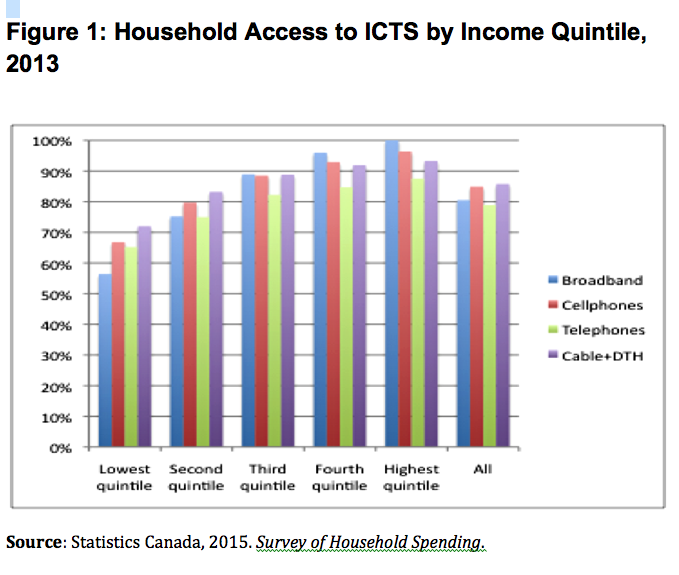 While some wonder if this is because some people might not want to use the internet, the strong relationship between income and adoption suggests that this is not a choice but a function of affordability. Moreover, study after study tell us one thing: that the price of broadband internet and mobile phone services in Canada are high by the measure of all respectable studies of the issue (see, for example, the Wall, OECD and FCC reports). The high prices these studies document might account for a modest portion of the budget for the “average Canadian”, but for low- and modern-income families they compete with putting food on the table and a roof over their heads.[2]
Such realities also help to describe why, at best, ‘wired broadband internet’ adoption rates in Canada fare only reasonably well compared to other developed countries, but terribly for mobile wireless services. That affordability is clearly an issue is also illustrated by the fact that in Toronto, for example, just 20% of households in public housing communities have broadband internet service. These are the realities that are motivating ACORN members, and why the advocacy group is going to the CRTC today.
While the industry has done little to counter these realities, at least one has taken voluntary steps to help ameliorate the problem for some: Rogers. In 2013, it launched its ‘connected for success’ initiative with the aim of bringing affordable broadband internet access to 58,000 low income families in Toronto public community housing. Last week, Rogers came to the Centretown Citizens Ottawa Corporation to announce that the program is being extended to 150,000 families in 533 public housing communities in Ontario, New Brunswick and Newfoundland & Labrador for the next two years.
In its expanded “connected for success” initiative, Rogers offers broadband internet with speeds of up to 10 Mbps download and up to 1 Mbps upload, with data caps of 30 GB, for $9.99 per month. As a voluntary effort, this is certainly a step in the right direction.
At the same time, however, announced on the eve of the CRTC’s review of the basic telecoms service it is hard not to see the venture as a fine example of “regulation by raised eyebrow”, wherein just the threat of regulatory action brings about some gestures toward the desired results.
The people attending ACORN’s internet4all forum also suggested that while Rogers’ focus on non-profit community housing is good, the vast majority of low-income families do not live in social housing but market housing. Who will serve them?
In Ontario alone, 168,000 families were on the waiting list for community housing last year. This is more than Rogers is targeting across all of Central and Eastern Canada! For them, the cheapest option Rogers offers is its newly launched “Internet 5” service, but it offers only half the speed of the public housing option and is three times the price, once the cost of renting the modem is factored in.
Perhaps the biggest drawback is that these services are designed for individuals rather than households with several family members who might be running multiple devices at the same time, as Rogers’ own marketing materials on its website indicate. It is not just that the speeds are slow but that the data caps for both services — 30 GB for the public housing version, 25 for the latter – are exceedingly low. Cisco, in contrast, estimates the average Canadian household used 56 GB in 2014, and is expected to reach around 180 GB by 2019.
Figure 2: Rogers Internet Service Plans Compared
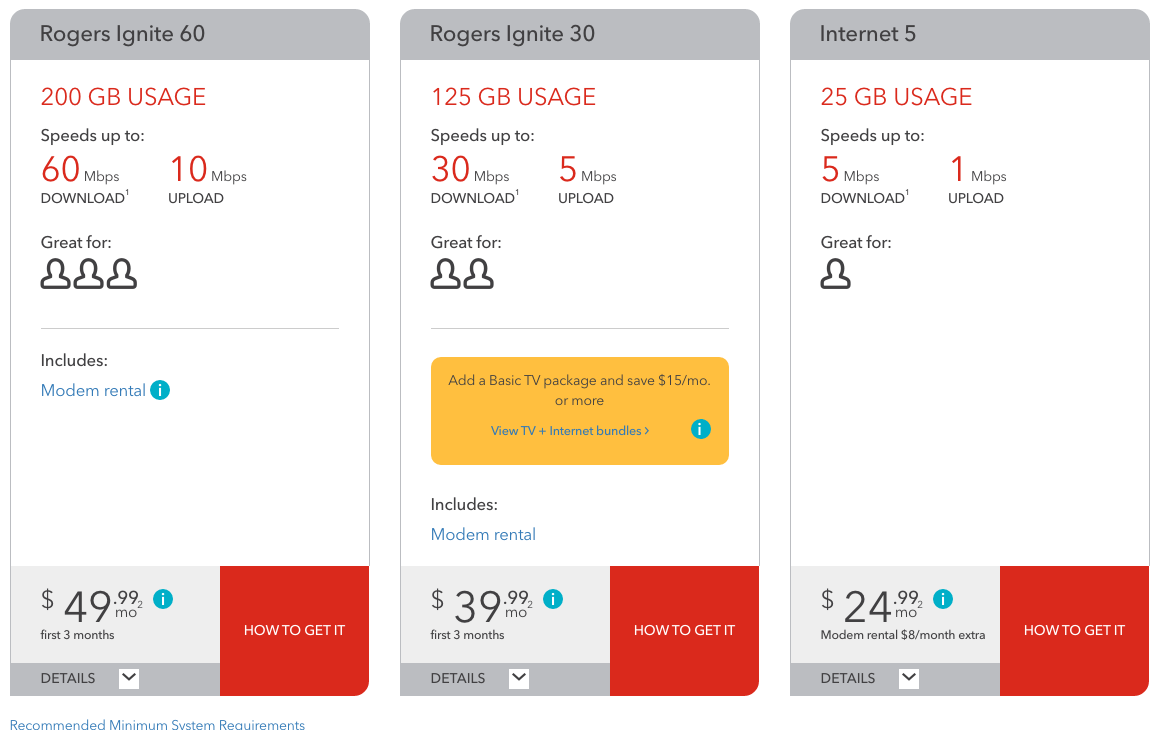
And what about the punishing overage charges that come along with those low data caps? On this, many of those attending the internet4all event the other night had a lot to say. Lastly, what happens to those who sign up for “connected for success” when the program meets its expiry date in two years?
Some argue that some access is better than none. More specifically, there are those who assert that when it comes to defining basic internet service, the aim is to give people basic broadband internet based on need rather than wants and desires.
We have certainly heard a lot of this kind of thinking already. Telus, in particular, argues that the only change the CRTC should consider is making the current “aspirational target” of 5 Mbps up and 1 Mbps down for all Canadians a formal obligation (see here, for example). In response to all those who claim that the standards of 25 and 30 Mbps up and 3 down adopted in the US and 28 EU countries, respectively, and that apply to all citizens and which must be met, as the FCC in the US puts it, a “reasonable and timely fashion”, Telus says humbug.
Over-and-against the view that anything less than these standards are not up to how individuals and families actually use the internet, especially in terms of viewing video and using multiple devices at the same time, Telus takes a flinty eyed view to argue that things like
. . . email access, web browsing and e-commerce . . . are the services that are necessary for meaningful participation in the digital economy. It is not reasonable to include over-the-top video and H-D two-way interactive gaming as essential applications that must be supported by Internet access faster than TELUS’ recommended 5/1 Mbps BTS (Telus, paras 90-91).
The Commission also appeared to strike a similar note when Chairman J. P. Blais kicked off proceeding Monday morning with the remark that the basic service objective must be firmly grounded in evidence, and that “it is crucial not to confuse ‘wants’ with ‘needs’”. Some chimed in immediately that Blais’ words reflected a “disciplined start”, while the CBC, in contrast, interpreted the remarks to imply that the Commission had already trimmed its sails and people ought not to expect much. Already by the end of first day, however, the Commission seemed to soften its tone.
Drawing the lines between basic needs and productive uses along such lines and whatever else people might do with their internet connections smacks of a long and hoary history where people have been told that what they use the media at their disposal for should take a backseat to more “important” uses, and consequently frowned upon and discouraged as a result. When I expanded on this idea at ACORN’s Internet4All forum, people got up one after another to give rhyme and verse on why such distinctions are not only wrong-headed but objectionable.
Why should people and families with low incomes — precisely the ones most likely to “cut the cable cord” to save money — be told that watching TV is beyond the pale. Isn’t it enough that they be able to do so without affordable basic internet access being hedged about by so many narrow and utilitarian values as to rule out such pleasures?
On this point, I heard much about Netflix and cartoons, and how telling stories, art and culture are essential to who we are as human beings, to our imaginations, and how we express ourselves. The gentlemen who relayed the bulk of this line of thinking will be there to tell the CRTC the same today.
And what about using the internet to get the news, a point that Chairman Blais also appears to fully grasp, given his remarks that with the French language newspaper LaPresse being available online only now, people have to have an internet connection to read it? This chimes with the results of a recent Statistics Canada study on how people “get the news”. As the video component of online news grows, it is going to become a lot harder to carve out this bandwidth intensive aspect of online news from the low capacity text based part.
Another person observed that as government departments put more information online they are also putting it online in video form. She pointed to Health Canada videos on palliative care and diabetes to illustrate the point, and to the essential role that these videos play in educating people and raising awareness about both conditions. How to distinguish between such “worthy” forms of high bandwidth intensity video and the frivolous kind we don’t hold aloft?
Another woman spoke about how her hearing impaired partner communicates regularly with her family back home in Australia by video and how doing so is not only crucial to their relationship but to her partner’s mental well-being more generally. Then there was another woman who spoke of coupon cutting online because, well, all the coupons are now online, and so too, by the way, are most of the rental housing advertisements.
A young man came up afterward and spoke to me about working a grueling 70+ hour work week throughout high school because both of his parents were on the Ontario Disability Support Program (ODSP), and the income they received was not enough to make ends meet. Despite being in the “gifted class” at Lisgar Collegiate here in Ottawa, with an average over 90%, his role of main family breadwinner meant that he had to drop out, unable to meet the competing demands of doing both. Yet, a few years later he completed an internet-based high school course, much of it based on instructional videos and video conferencing. He’s now at Algonquin College with hopes to complete his studies at Carleton when finances allow.
Another helped a friend faced with a $190 repair bill for a broken washing machine that she could ill afford. Instead of calling the Maytag repair guy, he turned to Youtube, found a $3 solution, and his friend kept her much needed money for other pressing uses. As a recent MTM study observes, nearly two-thirds of all Canadians used Youtube to learn how to fix or do something in the last year.
Of course we can pile up anecdotes like leaves in autumn but the point is, that even those of us who study these matters full-time don’t have a clue about many of the things that people do with the internet, for both pleasure and productive purposes. I see little way to effectively distinguish between the two and don’t think that much good will come from trying.
That we don’t know the half of what people do in their uses of media comes as no surprise to communication scholars because if the field teaches anything, it teaches that people use communication technologies in unintended ways and that this in turn pushes those technologies along unanticipated paths of development. Any effort to distinguish between “basic” uses that people should have access to as part of an affordable broadband internet obligation and those they shouldn’t risks running roughshod over these lessons. Worse, it risks substituting the regulator and carriers’ judgments for what people themselves are in the best position to decide.
As I pointed out in my testimony to the Commission the other day, providing people with affordable, universal broadband internet in the 21st century is a necessity, and it is in line with what we have done historically in Canada in relation to plain old telephone service. And it is in line with what other countries comparable to ours are doing around the world.
To be sure, this is going to cost money, and that means that somebody’s going to have to pay and who ultimately pays will be us — citizens and taxpayers. I do not see a problem with that.
Total federal subsidies for broadband internet development and affordable prices in Canada are at the very low end of the scale at around $2 per year. This is similar to what people in Bulgaria, Romania and Austria invest, whereas I think we could easily move into the middle of the pack to spend, say, $4.50 to $12 a person per year as they do — that is 40 cents to a buck a month extra on our internet bills — in Sweden, Estonia, the UK, Germany and Finland to subsidize internet development (compared to NZ and Australia at $25 and $163, per person, per year, respectively, for their own national broadband initiatives).
Consider this as well: In Canada, compare the $2 per person per year in total federal subsidies for broadband connectivity to the $33 given to the CBC, by contrast. The point is not to bring the latter down to the former by any stretch of the imagination, but rather to bring broadband subsidies closer to those that we give to the CBC (to say nothing of the myriad of other ‘content subsidies’). In the internet age, while content may be king, it is connectivity that is probably emperor. Our public funding arrangements should better reflect such priorities.
Ultimately, any steps to draw lines between frivolous wants that we can cast aside and productive uses that can be folded into basic internet service will likely look, at least in hindsight, like so many similar such efforts in the past: as paternalistic and elitist efforts, and foolish ones at that. The Commission should give little credence to such ideas, and indeed should reject them out of hand. Get the structure of the internet policy framework right, and the rest will likely fall into place as it should.
For these reasons, we need less flinty-eyed, utilitarian outlooks drawn from Victorian England and a more imaginative view of the future, albeit one that is still grounded in what people are already doing with the internet and plenty of room to grow so that all Canadian citizens can use the internet as they see fit, both today and tomorrow.
[1] Which also includes the Public Interest Advocacy Centre, Consumers Association of Canada, Council of Senior Citizens Organization of BC and the National Pensioners Federation.
[2] On this measure, Canada ranks in the middle of comparable EU and OECD countries according to the ITU, see pp. 102 and 109, for example.
The clash over the Internet infrastructure of the 21st century
Cities, corporate interests and the new Trudeau government are at the centre of a debate with massive ramifications on how Canadians access the web.

Just days before the Trudeau Government was about to be sworn in at the end of 2015, Bell landed a rarely used Cabinet Petition of a vitally important CRTC decision on the new government’s desk. The CRTC decision (2015-326) in question allows wholesale access by rival internet companies such as TekSavvy, Primus, Distributel, etc. to the fibre-based internet access networks now being built by the incumbent telcos and cablecos in cities across the country (Bell’s appeal can be found here and all of the responses for and against it can be found here).
The decision updated the wholesale access regime that has long been in place for the telephone and cable companies’ existing ‘copper’ and ‘coax’ networks and applied it to the fibre optic-based internet access networks that are now being built and which will likely be the information infrastructure for Canada throughout the 21st century. It’s basic thrust was that as the internet infrastructure evolves so too must the wholesale access rules, lest even the modest competition that independent ISPs like TekSavvy, Distributel, Primus and nearly 500 others across the country have been able to generate be left to wither on the vine.
As part of its appeal, Bell sought and obtained support from several mayors, notably the Mayors of Toronto and Ottawa, both of whom submitted letters to Cabinet supporting Bell’s position. Written on city letterhead, the letters implied that Mayors Tory and Watson of Toronto and Ottawa, respectively, were acting on behalf of their cities (see here and here), but the past few weeks has shown that they acted on their own without consulting council.
Thus, last week, in a 28-5 vote, Toronto City Council passed a motion that stands as a major rebuke to Tory while lending its support to the CRTC’s smart, well-reasoned and forward looking decision (see here). The Toronto Star and Globe and Mail both covered the issue.
In Ottawa, Councilors Jeff Leiper and Diane Deans, among others, have raised similar concerns and yesterday (February 10), Leiper introduced a motion in City Council similar to that adopted by Toronto. The motion is significant not just because it too, if passed, will stand as a rebuke to Watson and support the CRTC, but also because Leiper has several years of high level experience at the CRTC and much experience before that at a major consultancy specializing in the telecoms and internet industry. The plan is to put the motion to a vote at the next meeting of City Council on February 24. The Ottawa Citizen covered the story here.
These moves by the Ottawa and Toronto city councils also line up with an intervention by Calgary Mayor Naheed Nenshi, who far more than just offering up a modified boilerplate letter along the lines offered by Tory and Watson, had city staff prepare a smart and very detailed 30 page report in support of the CRTC, and with strong arguments as to why more competition is both needed and possible. You can find this intervention here.
While the mayors of Toronto and Ottawa and a few others signed off on letters in support of Bell, most cities across the country sat this one out: e.g. Montreal, Windsor, Vancouver, Quebec City, Edmonton, Winnipeg, Saskatoon, Halifax, St. John’s, Saint John’s, etc. We can be quite certain that Bell approached these cities and, not feeling that they could support the company, they likely chose to stay silent. Add these cities to Calgary’s opposition, and the overwhelming majority of Canadian’s live in cities that have not lined up in Bell’s corner.
There’s two other points to be made about Tory and Watson’s support. First, both of their letters repeat one of Bell’s key talking points on the issue: namely, that the CRTC is unfairly giving rivals discounted access to its infrastructure and this will likely deter future investment. As Watson told the Ottawa Citizen yesterday,
“They [i.e. Bell and the other companies] invest tens of millions of dollars in their network, just to have competitors come and use their network at a severely reduced cost” (emphasis added).
A week earlier John Tory hit the same notes in an interview with the Toronto Star:
“If you put politics aside, . . . when people make these investments, they have to be able to garner proper return on them, otherwise they just won’t make them. And I think that would be very damaging for the city”.
The CRTC dealt with such claims head on in its ruling and rejected them.
The problem with the mayors’ view is that the CRTC’s decision does not grant discounted access to the incumbent telephone and cable companies fibre-based networks. Instead, it gives rivals regulated access on terms that are still being hammered out between industry players and the regulator. However, if history is our guide, and it no doubt is, in the case of the old ‘copper’ networks, the Commission set the wholesale rates at a 40% mark-up on costs, or in other words, at a level that guarantees Bell a 40% return on its investment (see here and here).
In other words, far from being short-changed, Bell is likely to be compensated handsomely for the use of its networks.
Lastly, the intersection of federal telecoms-internet policy with municipal politics in our own time harkens back to the formative era in telecoms in Canada over a century ago. A few examples will help to illustrate the point.
- When the federal Patent Commissioner voided Bell patents in 1885 because Bell was not making enough of its equipment in Canada, Bell feared, and others widely believed, that competition would emerge, as happened in the US a few years later. However, this did not transpire. Why? Because while nullifying the patents gave would be competitors access to the technology, Bell’s exclusive municipal franchises blocked cities from granting competing franchises. With only weak powers under a strong federal government that had granted Bell a charter to develop the telephone system for the “general advantage of Canada”, municipalities tried to eek out a tiny amount of influence via their ability to grant franchises, but those often came back to haunt them.
- When Kingston pushed to have the telephone company’s poles, wires & rights-of-way taxed as capital assets in 1899, Bell mounted a legal case to have them taxed on their value as scrap–and won.
- When competition did break out, as in Montreal in 1888, for instance, Bell launched a ruthless price war with its rival, the Federal Telephone Company, until the latter capitulated and sold out to Bell three years later. In Winnipeg it created a “dummy company”, the People’s Telephone Company, to give the illusion of competition; while in Peterborough and Dundas, to kill new independent telephone Bell gave away service for free;
- When Kingston joined the Ontario Municipal Association in 1903 in the adoption of a resolution calling for municipal authority to regulate telephone rates, Bell threatened not to renew its franchise and withhold further capital investment;
- In the same year, the Mayors of the Montreal suburb of Westmount and Toronto, William Lighthall and Oliver Howland, respectively, spearheaded a drive to gain greater regulatory authority over telephone rates for municipalities while calling on the federal government to take control of the long distance network. By 1905, 195 municipalities had joined the call, with support from the Montreal and Toronto business associations and the farmers’ association, Dominion Grange. While evidence at the time and recent historical research has shown (Wallsten) that the model had been successful in some Scandinavian countries at the time (e.g. Sweden and Denmark), the cities’ calls fell on deaf ears at the level of the federal government.
- As a result of this drift of events, in 1902, 1-in-50 Ottawa citizens had regular telephone service. The upshot, as Bell Canada President Charles Fleetford Side never missed a chance to stress, was that the telephone was treated as a luxury not necessity.[1]
This history reminds us that, unlike Toronto and Ottawa today, and similar to the position now being struck by Calgary and its more progressive mayor Naheed Nenshi, cities have long chafed under their weak position subordinate not just to the giants of the telecoms industry but to a federal government seemingly all-too-willing to turn a blind eye to their demands. Instead, at least historically, the latter has seemed more willing to acquiesce to incumbents’ demands to build things on their own terms and time line rather than, as Bell’s charter once required, for the general advantage of Canada.
The CRTC’s wholesale fibre internet access decision offers a chance to turn this around. While it is easy to get lost in the weeds on this one, the key point is that fibre internet access will be a key part of cities and Canada’s infrastructure for the 21st century. Without it, the stubbornly high levels of concentration and strong tendency for incumbent telephone and cable companies to fly as a flock rather than compete vigorously will likely persist, at the expense of Canadians from coast-to-coast.
The new Trudeau Government should act swiftly and decisively in the present case. It would be wise to avoid granting Bell’s wish lest it erode confidence in the regulator while lending succor to the view that the “Natural Governing Party” – as the Liberal Party is known in far too many quarters — is too close to the industry, and thus unable to act in the best interest of all Canadians.
[1] The points on the history of the telephone in Canada are taken mostly from Robgert MacDougall’s (2014) The People’s Network: The Political Economy of the Telephone in the Gilded Age (pp. 44-46, 125-127). Philadelphia: Penn State University; Dwayne Winseck (1998). Reconvergence: A Political Economy of Telecommunications in Canada. Cresskill, NJ: Hampton; Robert. E. Babe. (1990). Telecommunications in Canada. Toronto: University of Toronto.
Photo

 Mediamorphis
